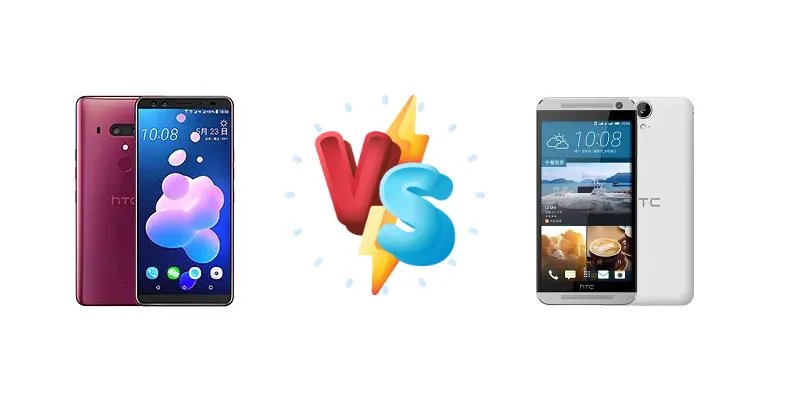
The HTC U12+ represented a return to flagship form for the company, boasting a cutting-edge Snapdragon 845 processor and a sophisticated camera system. The HTC One E9, released earlier, aimed for a more accessible price point with the MediaTek Helio X10. This comparison dissects the core differences between these two devices, helping you determine if the U12+'s premium features justify its higher cost.
🏆 Quick Verdict
For most users, the HTC U12+ is the clear winner. Its Snapdragon 845 chipset delivers significantly superior performance and efficiency, translating to a smoother user experience and better gaming capabilities. While the One E9 offers a budget-friendly entry point, the U12+'s advancements in display quality, camera technology, and overall responsiveness make it the more compelling choice.
| Network |
|---|
| 2G bands | GSM 850 / 900 / 1800 / 1900 - SIM 1 & SIM 2 (dual-SIM model only) | GSM 850 / 900 / 1800 / 1900 - SIM 1 & SIM 2 |
| 3G bands | HSDPA 850 / 900 / 1700(AWS) / 1900 / 2100 | HSDPA |
| 4G bands | 1, 2, 3, 4, 5, 7, 8, 12, 13, 17, 20, 28, 32, 38, 39, 49, 41, 66 | LTE |
| EDGE | - | Yes |
| GPRS | - | Yes |
| Speed | HSPA 42.2/5.76 Mbps, LTE-A (5CA) Cat18 1200/150 Mbps | HSPA 42.2/5.76 Mbps, LTE Cat4 150/50 Mbps |
| Technology | GSM / HSPA / LTE | GSM / HSPA / LTE |
| Launch |
|---|
| Announced | 2018, May 23 | 2015, May. Released 2015, May |
| Status | Available. Released 2018, June 29 | Discontinued |
| Body |
|---|
| Build | Glass front (Gorilla Glass 3), glass back, aluminum frame | - |
| Dimensions | 156.6 x 73.9 x 8.7 mm (6.17 x 2.91 x 0.34 in) | 156.5 x 76.5 x 7.5 mm (6.16 x 3.01 x 0.30 in) |
| SIM | Single SIM (Nano-SIM) or Hybrid Dual SIM (Nano-SIM, dual stand-by) | Nano-SIM + Nano-SIM |
| Weight | 188 g (6.63 oz) | 147 g (5.19 oz) |
| | IP68 dust/water resistant (up to 1.5m for 30 mins)
Pressure-sensitive buttons | - |
| Display |
|---|
| Protection | Corning Gorilla Glass 3 | To be disclosed |
| Resolution | 1440 x 2880 pixels, 18:9 ratio (~537 ppi density) | 1080 x 1920 pixels, 16:9 ratio (~401 ppi density) |
| Size | 6.0 inches, 92.9 cm2 (~80.3% screen-to-body ratio) | 5.5 inches, 83.4 cm2 (~69.7% screen-to-body ratio) |
| Type | Super LCD6, HDR10 | IPS LCD |
| Platform |
|---|
| CPU | Octa-core (4x2.8 GHz Kryo 385 Gold & 4x1.7 GHz Kryo 385 Silver) | Octa-core 2.0 GHz Cortex-A53 |
| Chipset | Qualcomm SDM845 Snapdragon 845 (10 nm) | Mediatek MT6795M Helio X10 (28 nm) |
| GPU | Adreno 630 | PowerVR G6200 |
| OS | Android 8.0 (Oreo), upgradable to Android 9.0 (Pie), Sense UI | Android 5 (Lollipop), upgradable to 6 (Marshmallow), Sense UI 7 |
| Memory |
|---|
| Card slot | microSDXC (uses shared SIM slot) | microSDXC (dedicated slot) |
| Internal | 64GB 6GB RAM, 128GB 6GB RAM | 16GB 2GB RAM |
| | - | eMMC 5.0 |
| Main Camera |
|---|
| Dual | 12 MP, f/1.8, 1/2.55", 1.4µm, dual pixel PDAF, Laser AF, OIS
16 MP (12 MP effective), f/2.6, 1/3.1", 1.0µm, 2x optical zoom, AF | - |
| Features | Dual-LED dual-tone flash, HDR | LED flash, panorama, HDR |
| Single | - | 13 MP, f/2.2, 28mm (wide), AF |
| Video | 4K@60fps, 1080p@60/240fps, 1080p@30fps (gyro-EIS), HDR, 24-bit/96kHz stereo sound rec. | Yes |
| Selfie camera |
|---|
| Dual | 8 MP, f/2.0, 1/4", 1.12µm
8 MP, f/2.0, 1/4", 1.12µm | - |
| Features | HDR, panorama | HDR |
| Single | - | 4 MP, f/2.0, 27mm (wide), 1/3", 2µm |
| Video | 1080p@30fps | 1080p@30fps |
| Sound |
|---|
| 3.5mm jack | No | Yes |
| 35mm jack | - | Yes |
| Loudspeaker | Yes, with stereo speakers | Yes, with stereo speakers |
| | 32-bit/384kHz audio
| - |
| Comms |
|---|
| Bluetooth | 5.0, A2DP, aptX HD, LE | 4.1, A2DP, aptX |
| NFC | Yes | Yes |
| Positioning | GPS, GLONASS, GALILEO, BDS | GPS, GLONASS, BDS |
| Radio | No | FM radio |
| USB | USB Type-C 3.1 | microUSB 2.0 |
| WLAN | Wi-Fi 802.11 a/b/g/n/ac, dual-band, Wi-Fi Direct, DLNA | Wi-Fi 802.11 a/b/g/n/ac, dual-band, DLNA, hotspot |
| Features |
|---|
| Sensors | Fingerprint (rear-mounted), accelerometer, gyro, proximity, compass | Accelerometer, gyro, proximity, compass |
| Battery |
|---|
| Charging | 18W wired, QC3, 50% in 35 min (advertised) | - |
| Talk time | Up to 24 h (3G) | - |
| Type | Li-Ion 3500 mAh, non-removable | Li-Po 2800 mAh, non-removable |
| Misc |
|---|
| Colors | Translucent Blue, Ceramic Black, Flame Red | Black, White |
| Models | U12, 2Q55100 | One E9 dual sim |
| Price | About 450 EUR | About 320 EUR |
| Tests |
|---|
| Audio quality |
Noise -93.7dB / Crosstalk -52.7dB | - |
| Battery life |
Endurance rating 64h
| - |
| Camera |
Photo / Video | - |
| Display |
Contrast ratio: 1818:1 (nominal), 3.085 (sunlight) | - |
| Loudspeaker |
Voice 77dB / Noise 73dB / Ring 99dB
| - |
| Performance |
AnTuTu: 263696 (v7)
GeekBench: 9001 (v4.4)
GFXBench: 20fps (ES 3.1 onscreen) | - |
HTC U12+
- Significantly faster processor (Snapdragon 845)
- Superior display quality with high contrast ratio
- Faster charging and potentially better battery life
- Higher price point
- May be harder to find due to age
HTC One E9
- More affordable price
- Simple and straightforward user experience
- Potentially easier to repair due to simpler components
- Substantially slower performance
- Lower display quality
- Less capable camera system
Display Comparison
The HTC U12+ boasts a superior display experience. While specific nit values aren't provided, the contrast ratio of 1818:1 (nominal) and 3.085 (sunlight) indicates excellent visibility even in bright conditions. The One E9, lacking these detailed specs, likely features a standard LCD panel with lower contrast and brightness. This difference is crucial for outdoor usability and overall image quality, making the U12+ more enjoyable for media consumption.
Camera Comparison
The camera systems represent a significant divergence in capabilities. While both phones offer photo and video recording, the U12+'s camera benefits from the processing power of the Snapdragon 845 and likely incorporates more advanced image processing algorithms. The One E9's camera, constrained by the Helio X10's limitations, will likely produce less detailed images, particularly in low-light conditions. Without specific sensor details, it's safe to assume the U12+ features a larger, more capable sensor, resulting in superior image quality and dynamic range.
Performance
The performance gap between these devices is substantial. The HTC U12+'s Qualcomm SDM845 Snapdragon 845, built on a 10nm process, offers a significant leap in CPU and GPU performance compared to the HTC One E9's MediaTek MT6795M Helio X10 (28nm). The Snapdragon 845's octa-core configuration (4x2.8 GHz Kryo 385 Gold & 4x1.7 GHz Kryo 385 Silver) provides a more balanced and efficient processing experience. The Helio X10's octa-core 2.0 GHz Cortex-A53, while capable, struggles with demanding tasks and is less efficient, leading to potential thermal throttling. The 10nm node of the Snapdragon 845 also contributes to better battery life.
Battery Life
The HTC U12+ achieves an endurance rating of 64 hours, suggesting excellent battery life. Its 18W wired charging with QC3 support allows for a 50% charge in approximately 35 minutes. The One E9's battery capacity and charging speed are not specified, but given its less efficient chipset, it likely requires more frequent charging. The U12+'s combination of a more efficient processor and faster charging provides a more convenient and reliable battery experience.
Buying Guide
Buy the HTC U12+ if you prioritize performance, camera quality, and a modern user experience. It's ideal for power users, mobile gamers, and those who demand the best from their smartphone. Buy the HTC One E9 if you're on a tight budget and primarily need a basic smartphone for calls, texts, and light web browsing. It's a viable option for users who don't require demanding applications or high-end features.
Frequently Asked Questions
❓ Is the HTC U12+ still a good buy in [current year] considering its age?
Despite being an older model, the U12+ remains a viable option for users who prioritize performance and camera quality over the latest features. The Snapdragon 845 is still capable of handling most modern applications and games, and the camera system delivers excellent results. However, software updates may be limited.
❓ Can the HTC One E9 handle modern mobile games like PUBG or Call of Duty?
The HTC One E9's Helio X10 chipset will struggle with demanding games like PUBG or Call of Duty. You may experience significant frame rate drops, lag, and overheating. It's best suited for less graphically intensive games.
❓ What are the potential downsides of choosing the HTC One E9 over the U12+?
Choosing the One E9 means sacrificing significant performance, camera quality, and display brightness. You'll also likely experience slower app loading times and a less responsive user interface. Software updates are also less likely to be available.