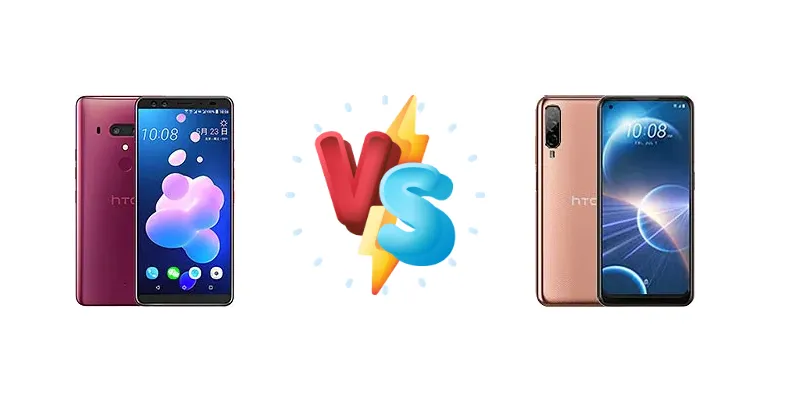
The HTC U12+ represented a high-water mark for HTC's flagship ambitions, boasting a Snapdragon 845 in 2018. The Desire 22 Pro, released much later, aims for a different segment – offering 5G connectivity and modern features at a more accessible price point with the Snapdragon 695. This comparison dissects the core differences between these two devices, helping you determine which best suits your needs in 2024.
🏆 Quick Verdict
For users prioritizing raw performance and a superior display, the HTC U12+ remains the stronger choice despite its age. However, the Desire 22 Pro provides a compelling value proposition with 5G connectivity, wireless charging, and reverse wired charging, making it ideal for budget-conscious users who don't demand top-tier processing power.
| Network |
|---|
| 2G bands | GSM 850 / 900 / 1800 / 1900 - SIM 1 & SIM 2 (dual-SIM model only) | GSM 850 / 900 / 1800 / 1900 |
| 3G bands | HSDPA 850 / 900 / 1700(AWS) / 1900 / 2100 | HSDPA 850 / 900 / 1700(AWS) / 1900 / 2100 |
| 4G bands | 1, 2, 3, 4, 5, 7, 8, 12, 13, 17, 20, 28, 32, 38, 39, 49, 41, 66 | 1, 3, 5, 7, 8, 20, 28, 38, 39, 40, 41 |
| 5G bands | - | 1, 3, 7, 20, 28, 41, 78 SA/NSA |
| Speed | HSPA 42.2/5.76 Mbps, LTE-A (5CA) Cat18 1200/150 Mbps | HSPA, LTE, 5G |
| Technology | GSM / HSPA / LTE | GSM / HSPA / LTE / 5G |
| Launch |
|---|
| Announced | 2018, May 23 | 2022, June 28 |
| Status | Available. Released 2018, June 29 | Available. Released 2022, July 10 |
| Body |
|---|
| Build | Glass front (Gorilla Glass 3), glass back, aluminum frame | - |
| Dimensions | 156.6 x 73.9 x 8.7 mm (6.17 x 2.91 x 0.34 in) | 166.3 x 76.9 x 9.4 mm (6.55 x 3.03 x 0.37 in) |
| SIM | Single SIM (Nano-SIM) or Hybrid Dual SIM (Nano-SIM, dual stand-by) | Nano-SIM + Nano-SIM |
| Weight | 188 g (6.63 oz) | 205.5 g (7.27 oz) |
| | IP68 dust/water resistant (up to 1.5m for 30 mins)
Pressure-sensitive buttons | IP67 dust/water resistant (up to 1m for 30 min) |
| Display |
|---|
| Protection | Corning Gorilla Glass 3 | Corning Gorilla Glass |
| Resolution | 1440 x 2880 pixels, 18:9 ratio (~537 ppi density) | 1080 x 2412 pixels, 20:9 ratio (~400 ppi density) |
| Size | 6.0 inches, 92.9 cm2 (~80.3% screen-to-body ratio) | 6.6 inches, 104.8 cm2 (~82.0% screen-to-body ratio) |
| Type | Super LCD6, HDR10 | IPS LCD, 120Hz |
| Platform |
|---|
| CPU | Octa-core (4x2.8 GHz Kryo 385 Gold & 4x1.7 GHz Kryo 385 Silver) | Octa-core (2x2.2 GHz Kryo 660 Gold & 6x1.7 GHz Kryo 660 Silver) |
| Chipset | Qualcomm SDM845 Snapdragon 845 (10 nm) | Qualcomm SM6375 Snapdragon 695 5G (6 nm) |
| GPU | Adreno 630 | Adreno 619 |
| OS | Android 8.0 (Oreo), upgradable to Android 9.0 (Pie), Sense UI | Android 12 |
| Memory |
|---|
| Card slot | microSDXC (uses shared SIM slot) | microSDXC (uses shared SIM slot) |
| Internal | 64GB 6GB RAM, 128GB 6GB RAM | 128GB 8GB RAM |
| Main Camera |
|---|
| Dual | 12 MP, f/1.8, 1/2.55", 1.4µm, dual pixel PDAF, Laser AF, OIS
16 MP (12 MP effective), f/2.6, 1/3.1", 1.0µm, 2x optical zoom, AF | - |
| Features | Dual-LED dual-tone flash, HDR | Dual-LED flash, HDR, panorama |
| Triple | - | 64 MP, f/1.8, (wide), PDAF
13 MP, f/2.4, 118˚ (ultrawide)
Auxiliary lens |
| Video | 4K@60fps, 1080p@60/240fps, 1080p@30fps (gyro-EIS), HDR, 24-bit/96kHz stereo sound rec. | 1080p@30fps |
| Selfie camera |
|---|
| Dual | 8 MP, f/2.0, 1/4", 1.12µm
8 MP, f/2.0, 1/4", 1.12µm | - |
| Features | HDR, panorama | HDR |
| Single | - | 32 MP, f/2.0, (wide) |
| Video | 1080p@30fps | 1080p@30fps |
| Sound |
|---|
| 3.5mm jack | No | Yes |
| 35mm jack | - | Yes |
| Loudspeaker | Yes, with stereo speakers | Yes |
| | 32-bit/384kHz audio
| - |
| Comms |
|---|
| Bluetooth | 5.0, A2DP, aptX HD, LE | 5.1, A2DP, LE |
| NFC | Yes | Yes |
| Positioning | GPS, GLONASS, GALILEO, BDS | GPS, GLONASS, GALILEO, BDS |
| Radio | No | Unspecified |
| USB | USB Type-C 3.1 | USB Type-C 2.0, OTG |
| WLAN | Wi-Fi 802.11 a/b/g/n/ac, dual-band, Wi-Fi Direct, DLNA | Wi-Fi 802.11 a/b/g/n/ac, dual-band, Wi-Fi Direct |
| Features |
|---|
| Sensors | Fingerprint (rear-mounted), accelerometer, gyro, proximity, compass | Fingerprint (side-mounted), accelerometer, gyro, proximity, compass |
| Battery |
|---|
| Charging | 18W wired, QC3, 50% in 35 min (advertised) | 18W wired
Wireless
Reverse wired |
| Talk time | Up to 24 h (3G) | - |
| Type | Li-Ion 3500 mAh, non-removable | Li-Po 4520 mAh |
| Misc |
|---|
| Colors | Translucent Blue, Ceramic Black, Flame Red | Wave Gold, Starry Night Black |
| Models | U12, 2Q55100 | - |
| Price | About 450 EUR | About 460 EUR |
| Tests |
|---|
| Audio quality |
Noise -93.7dB / Crosstalk -52.7dB | - |
| Battery life |
Endurance rating 64h
| - |
| Camera |
Photo / Video | - |
| Display |
Contrast ratio: 1818:1 (nominal), 3.085 (sunlight) | - |
| Loudspeaker |
Voice 77dB / Noise 73dB / Ring 99dB
| - |
| Performance |
AnTuTu: 263696 (v7)
GeekBench: 9001 (v4.4)
GFXBench: 20fps (ES 3.1 onscreen) | - |
HTC U12+
- Significantly faster processor (Snapdragon 845)
- Superior display contrast ratio for better viewing
- Proven endurance rating of 64 hours
- Older device, potentially limited software support
- Lacks modern features like 5G and wireless charging
HTC Desire 22 Pro
- 5G connectivity for faster data speeds
- Wireless and reverse wired charging for added convenience
- More affordable price point
- Less powerful processor (Snapdragon 695)
- Display quality likely inferior to U12+
- Limited camera information available
Display Comparison
The HTC U12+ boasts a display with a contrast ratio of 1818:1 (nominal) and a significantly higher 3.085:1 ratio in sunlight, suggesting superior outdoor visibility. While the Desire 22 Pro’s display specifications are not provided, its later release doesn’t guarantee a comparable level of contrast. The U12+'s higher contrast ratio translates to richer colors and deeper blacks, enhancing the viewing experience, particularly for HDR content. The absence of detailed display specs for the Desire 22 Pro suggests a focus on cost optimization rather than display quality.
Camera Comparison
Both devices feature camera systems, but detailed sensor information is limited. The U12+’s camera capabilities were competitive in its time, but without specific details, a direct comparison is difficult. The Desire 22 Pro’s camera specs are also lacking, making it hard to assess its image quality. Given the Desire 22 Pro’s positioning as a more affordable device, it’s likely to feature a less sophisticated camera system than the U12+, potentially with smaller sensors and less advanced image processing. The absence of information on OIS or aperture sizes for either device hinders a thorough analysis.
Performance
The core difference lies in the chipsets: the U12+ utilizes the Snapdragon 845 (10nm), a flagship processor from 2018, featuring an octa-core configuration with Kryo 385 cores clocked up to 2.8 GHz. The Desire 22 Pro employs the Snapdragon 695 5G (6nm), a mid-range chip with a slightly different core arrangement (2x2.2 GHz Kryo 660 Gold & 6x1.7 GHz Kryo 660 Silver). The 6nm process of the 695 offers improved efficiency, but the 845’s higher clock speeds and more powerful core architecture deliver significantly greater processing power. This translates to faster app loading times, smoother multitasking, and superior gaming performance on the U12+. The 845’s Adreno 630 GPU also outperforms the 695’s Adreno 619.
Battery Life
The HTC U12+ has an endurance rating of 64 hours, indicating solid battery life. It supports 18W wired charging with Quick Charge 3.0, promising a 50% charge in 35 minutes. The Desire 22 Pro also supports 18W wired charging, but adds the convenience of wireless charging and reverse wired charging. While the Desire 22 Pro’s battery capacity isn’t specified, the addition of wireless charging suggests a focus on modern convenience features, potentially at the expense of overall battery endurance compared to the U12+.
Buying Guide
Buy the HTC U12+ if you need a phone capable of handling demanding tasks like gaming and video editing, and value a high-contrast display for media consumption. Buy the HTC Desire 22 Pro if you prefer a modern feature set including 5G, wireless charging, and reverse wireless charging, and prioritize affordability over peak performance.
Frequently Asked Questions
❓ Will the Snapdragon 695 in the Desire 22 Pro struggle with graphically intensive games?
The Snapdragon 695 is a mid-range chip and will likely require reduced graphics settings for demanding games. While it can handle most titles, users shouldn't expect the same level of performance as the Snapdragon 845 in the U12+, which was a flagship processor in its time. Expect some frame drops in the most demanding games.
❓ Does the HTC U12+ still receive software updates in 2024?
Given its age, the HTC U12+ is unlikely to receive major Android version updates. Security patches may be infrequent or non-existent. This is a significant consideration for users concerned about security vulnerabilities and the latest features.
❓ Is the reverse wired charging on the Desire 22 Pro useful for topping up accessories?
Yes, the reverse wired charging feature allows you to use the Desire 22 Pro as a power bank for smaller devices like wireless earbuds or smartwatches. While the charging speed won't be as fast as a dedicated charger, it's a convenient feature for on-the-go charging.