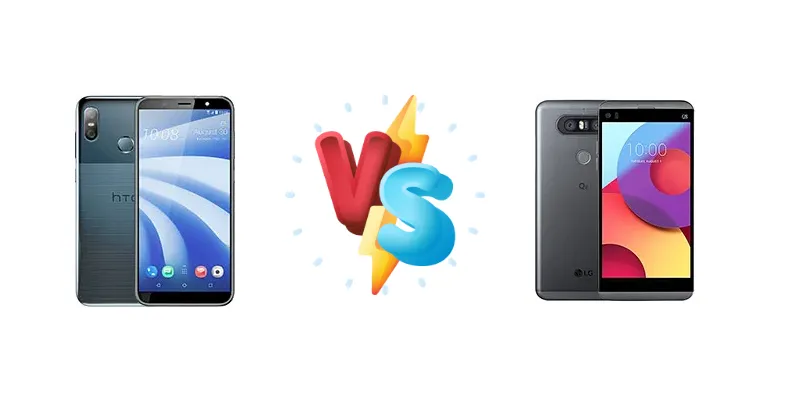
The HTC U12 life and LG Q8 (2017) represent different approaches to the mid-range smartphone market. The U12 life, released later, aimed for efficiency with a Snapdragon 636, while the Q8 (2017) leveraged the older, but more powerful, Snapdragon 820. This comparison dissects their key differences to determine which device offers the best value today.
🏆 Quick Verdict
For the average user prioritizing sustained performance and faster charging, the LG Q8 (2017) is the better choice. While the HTC U12 life offers a more modern chipset architecture, the Snapdragon 820 in the Q8 delivers a noticeable performance edge, especially in demanding tasks, and its 18W Quick Charge 3.0 support is a significant advantage.
| Network |
|---|
| 2G bands | GSM 850 / 900 / 1800 / 1900 | GSM 850 / 900 / 1800 / 1900 - SIM 1 & SIM 2 (dual-SIM model only) |
| 3G bands | HSDPA 850 / 900 / 1900 / 2100 | HSDPA 850 / 900 / 1900 / 2100 |
| 4G bands | 1, 2, 3, 4, 5, 7, 8, 12, 17, 20, 28, 32, 38, 40, 66 | LTE |
| Speed | HSPA 42.2/5.76 Mbps, LTE (3CA) Cat11 600/75 Mbps | HSPA 42.2/5.76 Mbps, LTE (2CA) Cat6 300/50 Mbps |
| Technology | GSM / HSPA / LTE | GSM / HSPA / LTE |
| Launch |
|---|
| Announced | 2018, August. Released 2018, September | 2017, July. Released 2017, August |
| Status | Discontinued | Discontinued |
| Body |
|---|
| Build | Glass front, plastic back, plastic frame | Glass front (Gorilla Glass 4), aluminum/plastic back, aluminum frame |
| Dimensions | 158.5 x 75.4 x 8.3 mm (6.24 x 2.97 x 0.33 in) | 149 x 71.9 x 8 mm (5.87 x 2.83 x 0.31 in) |
| SIM | · Nano-SIM· Nano-SIM + Nano-SIM | · Nano-SIM· Nano-SIM + Nano-SIM |
| Weight | 175 g (6.17 oz) | 146 g (5.15 oz) |
| | - | IP67 dust/water resistant (up to 1m for 30 min) |
| Display |
|---|
| Protection | - | Corning Gorilla Glass 4 |
| Resolution | 1080 x 2160 pixels, 18:9 ratio (~402 ppi density) | 1440 x 2560 pixels, 16:9 ratio (~564 ppi density) |
| Size | 6.0 inches, 92.9 cm2 (~77.7% screen-to-body ratio) | 5.2 inches, 74.8 cm2 (~69.8% screen-to-body ratio) |
| Type | IPS LCD | IPS LCD |
| | - | Secondary display, 160 x 1040 pixels, 1.8 inches
Always-on display |
| Platform |
|---|
| CPU | Octa-core (4x1.8 GHz Kryo 260 Gold & 4x1.6 GHz Kryo 260 Silver) | Quad-core (2x2.15 GHz Kryo & 2x1.6 GHz Kryo) |
| Chipset | Qualcomm SDM636 Snapdragon 636 (14 nm) | Qualcomm MSM8996 Snapdragon 820 (14 nm) |
| GPU | Adreno 509 | Adreno 530 |
| OS | Android 8.1 (Oreo) | Android 7.0 (Nougat) |
| Memory |
|---|
| Card slot | microSDXC (uses shared SIM slot) | microSDXC (dedicated slot) - single-SIM modelmicroSDXC (uses shared SIM slot) - dual-SIM model |
| Internal | 64GB 4GB RAM, 128GB 6GB RAM | 32GB 4GB RAM |
| | eMMC 5.1 | - |
| Main Camera |
|---|
| Dual | 16 MP, f/2.0, PDAF
Auxiliary lens | 16 MP, f/1.8, 28mm (wide), 1/2.6", 3-axis OIS
8 MP, f/2.4, 10mm (ultrawide), 1/4.0" |
| Features | Dual-LED flash, HDR, panorama | Laser AF, Dual-LED flash, panorama, HDR |
| Triple | - | 13 MP, f/1.8, (wide), PDAF
2 MP, f/2.4, (macro)
2 MP, f/2.4, (depth) |
| Video | 4K@30fps, 1080p@30fps | 4K@30fps, 1080p@30/60fps, 720p@120fps, 24-bit/48kHz stereo sound rec. |
| Selfie camera |
|---|
| Features | LED flash, HDR, panorama | - |
| Single | 13 MP, f/2.0 | 5 MP, f/1.9, 1/5.0", 1.12µm |
| Video | 1080p@30fps | 1080p@30fps |
| Sound |
|---|
| 3.5mm jack | Yes | Yes |
| 35mm jack | Yes | Yes |
| Loudspeaker | Yes, with stereo speakers | Yes |
| | - | 32-bit/192kHz audio
24-bit/192kHz audio recording
|
| Comms |
|---|
| Bluetooth | 5.0, A2DP, LE | 4.2, A2DP, LE |
| Infrared port | - | Yes |
| NFC | Yes | Yes |
| Positioning | GPS, GLONASS | GPS, GLONASS |
| Radio | No | FM radio, RDS |
| USB | USB Type-C 2.0 | USB Type-C |
| WLAN | Wi-Fi 802.11 a/b/g/n/ac, dual-band, Wi-Fi Direct | Wi-Fi 802.11 a/b/g/n/ac, dual-band, Wi-Fi Direct, DLNA |
| Features |
|---|
| Sensors | Fingerprint (rear-mounted), accelerometer, gyro, proximity, compass | Fingerprint (rear-mounted), accelerometer, gyro, proximity, compass |
| Battery |
|---|
| Charging | 10W wired | 18W wired, QC3 |
| Type | Li-Ion 3600 mAh, non-removable | Li-Ion 3000 mAh, non-removable |
| Misc |
|---|
| Colors | Moonlight Blue, Twilight Purple | Titan |
| Models | U12 life, 2Q6E1 | H970 |
| Price | About 230 EUR | About 200 EUR |
HTC U12 life
- More modern Snapdragon 636 architecture
- Potentially longer software support (depending on HTC's update schedule)
- Likely more power efficient under light loads
- Slower 10W charging
- Less powerful processor compared to the Snapdragon 820
- Potentially inferior camera performance
LG Q8 (2017)
- More powerful Snapdragon 820 processor
- Faster 18W Quick Charge 3.0 charging
- Likely superior camera image processing
- Older chipset architecture
- Potentially shorter software support
- May run slightly warmer under heavy load
Display Comparison
Neither device boasts a particularly standout display. Both likely utilize IPS LCD panels, common for their price points. However, detailed specs like resolution and brightness are missing. The LG Q8 (2017), being a flagship-adjacent device, *may* have had a slightly higher peak brightness, but without concrete data, it's speculative. Bezels were also likely larger on both, typical of 2017-2018 designs. Color accuracy is also unknown, but both would likely fall within acceptable ranges for everyday use.
Camera Comparison
Without detailed camera specs, a direct comparison is difficult. However, the LG Q8 (2017), originating from LG’s flagship line, likely featured a more sophisticated camera system. Sensor size is a critical factor, and it’s probable the Q8 had a larger main sensor, capturing more light and detail. The Snapdragon 820 also includes a more powerful ISP (Image Signal Processor) than the 636, enabling better image processing and noise reduction. The U12 life may have relied more on software algorithms to compensate for a potentially less capable sensor. We can assume both phones had standard features like HDR, but the Q8 likely offered a more refined overall camera experience.
Performance
The core difference lies in the chipsets. The LG Q8 (2017) features the Qualcomm MSM8996 Snapdragon 820, a quad-core processor built on a 14nm process. This chip, while older, boasts higher clock speeds (2x2.15 GHz Kryo & 2x1.6 GHz Kryo) than the HTC U12 life’s Snapdragon 636 (Octa-core 4x1.8 GHz Kryo 260 Gold & 4x1.6 GHz Kryo 260 Silver). The 820’s architecture, despite having fewer cores, delivers superior single-core performance, crucial for responsive UI and app loading. The U12 life’s 636 benefits from a more efficient architecture, but the 820’s raw power is likely to translate to smoother multitasking and gaming. The 636's advantage is power efficiency, potentially leading to slightly better battery life under light loads.
Battery Life
Battery capacity is unknown for both devices. However, the charging capabilities are a clear win for the LG Q8 (2017) with its 18W wired charging and Quick Charge 3.0 support. The HTC U12 life is limited to 10W charging, resulting in significantly longer charge times. Even if the U12 life had a slightly larger battery, the Q8’s faster charging would be more convenient for most users. Quick Charge 3.0 allows for rapid top-ups, crucial for users who frequently find themselves needing a quick boost of power.
Buying Guide
Buy the HTC U12 life if you prioritize a newer chipset architecture and potentially longer software support, understanding that you'll trade off some raw processing power. Buy the LG Q8 (2017) if you prefer a phone that can handle more demanding applications and games with greater ease, and value the convenience of faster 18W Quick Charge 3.0 charging. The Q8 is ideal for users who still appreciate a more powerful processor in a mid-range device.
Frequently Asked Questions
❓ Will the Snapdragon 820 in the LG Q8 (2017) struggle with modern apps?
While the Snapdragon 820 is an older chip, it remains capable of handling most modern apps and tasks smoothly. It may not perform as well as the latest processors in extremely demanding games or applications, but for everyday use, it provides a sufficient level of performance. The 820's architecture is still quite capable.
❓ Is the 10W charging on the HTC U12 life a dealbreaker?
For users who frequently need to quickly recharge their phone, the 10W charging on the U12 life is a significant drawback. It will take considerably longer to reach a full charge compared to the LG Q8 (2017)'s 18W Quick Charge 3.0 support. If you're often away from a charger, the Q8 is the better choice.
❓ How does the Snapdragon 636's efficiency impact real-world battery life on the U12 life?
The Snapdragon 636 is known for its power efficiency. This means the U12 life *could* offer slightly longer battery life than the Q8 under light usage scenarios, such as browsing the web or checking email. However, the Q8's faster charging capabilities may negate this advantage for many users.