
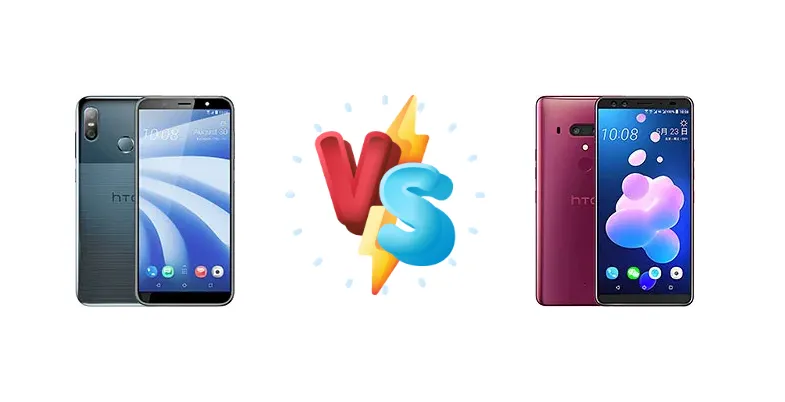
HTC U12+ vs U12 life: A Deep Dive into HTC's 2018 Lineup
| Phones Images | |||||
|---|---|---|---|---|---|
|
🏆 Quick Verdict
For most users, the HTC U12+ is the superior choice. Its Snapdragon 845 chipset delivers significantly faster performance and smoother multitasking, justifying the price premium. However, the U12 life remains a viable option for budget-conscious users prioritizing battery life and a more affordable entry point into the HTC ecosystem.
| PHONES | ||
|---|---|---|
| Phone Names | HTC U12 life | HTC U12+ |
| Network | ||
|---|---|---|
| 2G bands | GSM 850 / 900 / 1800 / 1900 | GSM 850 / 900 / 1800 / 1900 - SIM 1 & SIM 2 (dual-SIM model only) |
| 3G bands | HSDPA 850 / 900 / 1900 / 2100 | HSDPA 850 / 900 / 1700(AWS) / 1900 / 2100 |
| 4G bands | 1, 2, 3, 4, 5, 7, 8, 12, 17, 20, 28, 32, 38, 40, 66 | 1, 2, 3, 4, 5, 7, 8, 12, 13, 17, 20, 28, 32, 38, 39, 49, 41, 66 |
| Speed | HSPA 42.2/5.76 Mbps, LTE (3CA) Cat11 600/75 Mbps | HSPA 42.2/5.76 Mbps, LTE-A (5CA) Cat18 1200/150 Mbps |
| Technology | GSM / HSPA / LTE | GSM / HSPA / LTE |
| Launch | ||
|---|---|---|
| Announced | 2018, August. Released 2018, September | 2018, May 23 |
| Status | Discontinued | Available. Released 2018, June 29 |
| Body | ||
|---|---|---|
| Build | Glass front, plastic back, plastic frame | Glass front (Gorilla Glass 3), glass back, aluminum frame |
| Dimensions | 158.5 x 75.4 x 8.3 mm (6.24 x 2.97 x 0.33 in) | 156.6 x 73.9 x 8.7 mm (6.17 x 2.91 x 0.34 in) |
| SIM | · Nano-SIM· Nano-SIM + Nano-SIM | Single SIM (Nano-SIM) or Hybrid Dual SIM (Nano-SIM, dual stand-by) |
| Weight | 175 g (6.17 oz) | 188 g (6.63 oz) |
| - | IP68 dust/water resistant (up to 1.5m for 30 mins) Pressure-sensitive buttons | |
| Display | ||
|---|---|---|
| Protection | - | Corning Gorilla Glass 3 |
| Resolution | 1080 x 2160 pixels, 18:9 ratio (~402 ppi density) | 1440 x 2880 pixels, 18:9 ratio (~537 ppi density) |
| Size | 6.0 inches, 92.9 cm2 (~77.7% screen-to-body ratio) | 6.0 inches, 92.9 cm2 (~80.3% screen-to-body ratio) |
| Type | IPS LCD | Super LCD6, HDR10 |
| Platform | ||
|---|---|---|
| CPU | Octa-core (4x1.8 GHz Kryo 260 Gold & 4x1.6 GHz Kryo 260 Silver) | Octa-core (4x2.8 GHz Kryo 385 Gold & 4x1.7 GHz Kryo 385 Silver) |
| Chipset | Qualcomm SDM636 Snapdragon 636 (14 nm) | Qualcomm SDM845 Snapdragon 845 (10 nm) |
| GPU | Adreno 509 | Adreno 630 |
| OS | Android 8.1 (Oreo) | Android 8.0 (Oreo), upgradable to Android 9.0 (Pie), Sense UI |
| Memory | ||
|---|---|---|
| Card slot | microSDXC (uses shared SIM slot) | microSDXC (uses shared SIM slot) |
| Internal | 64GB 4GB RAM, 128GB 6GB RAM | 64GB 6GB RAM, 128GB 6GB RAM |
| eMMC 5.1 | - | |
| Main Camera | ||
|---|---|---|
| Dual | 16 MP, f/2.0, PDAF Auxiliary lens | 12 MP, f/1.8, 1/2.55", 1.4µm, dual pixel PDAF, Laser AF, OIS 16 MP (12 MP effective), f/2.6, 1/3.1", 1.0µm, 2x optical zoom, AF |
| Features | Dual-LED flash, HDR, panorama | Dual-LED dual-tone flash, HDR |
| Video | 4K@30fps, 1080p@30fps | 4K@60fps, 1080p@60/240fps, 1080p@30fps (gyro-EIS), HDR, 24-bit/96kHz stereo sound rec. |
| Selfie camera | ||
|---|---|---|
| Dual | - | 8 MP, f/2.0, 1/4", 1.12µm 8 MP, f/2.0, 1/4", 1.12µm |
| Features | LED flash, HDR, panorama | HDR, panorama |
| Single | 13 MP, f/2.0 | - |
| Video | 1080p@30fps | 1080p@30fps |
| Sound | ||
|---|---|---|
| 3.5mm jack | Yes | No |
| 35mm jack | Yes | - |
| Loudspeaker | Yes, with stereo speakers | Yes, with stereo speakers |
| - | 32-bit/384kHz audio | |
| Comms | ||
|---|---|---|
| Bluetooth | 5.0, A2DP, LE | 5.0, A2DP, aptX HD, LE |
| NFC | Yes | Yes |
| Positioning | GPS, GLONASS | GPS, GLONASS, GALILEO, BDS |
| Radio | No | No |
| USB | USB Type-C 2.0 | USB Type-C 3.1 |
| WLAN | Wi-Fi 802.11 a/b/g/n/ac, dual-band, Wi-Fi Direct | Wi-Fi 802.11 a/b/g/n/ac, dual-band, Wi-Fi Direct, DLNA |
| Features | ||
|---|---|---|
| Sensors | Fingerprint (rear-mounted), accelerometer, gyro, proximity, compass | Fingerprint (rear-mounted), accelerometer, gyro, proximity, compass |
| Battery | ||
|---|---|---|
| Charging | 10W wired | 18W wired, QC3, 50% in 35 min (advertised) |
| Talk time | - | Up to 24 h (3G) |
| Type | Li-Ion 3600 mAh, non-removable | Li-Ion 3500 mAh, non-removable |
| Misc | ||
|---|---|---|
| Colors | Moonlight Blue, Twilight Purple | Translucent Blue, Ceramic Black, Flame Red |
| Models | U12 life, 2Q6E1 | U12, 2Q55100 |
| Price | About 230 EUR | About 450 EUR |
| Tests | ||
|---|---|---|
| Audio quality | - | Noise -93.7dB / Crosstalk -52.7dB |
| Battery life | - | Endurance rating 64h |
| Camera | - | Photo / Video |
| Display | - | Contrast ratio: 1818:1 (nominal), 3.085 (sunlight) |
| Loudspeaker | - | Voice 77dB / Noise 73dB / Ring 99dB |
| Performance | - | AnTuTu: 263696 (v7) GeekBench: 9001 (v4.4) GFXBench: 20fps (ES 3.1 onscreen) |
HTC U12 life
- More affordable price point
- Potentially longer battery life due to efficient chipset
- Sufficient for everyday tasks
- Significantly slower performance
- Slower charging speeds
- Likely inferior camera quality
HTC U12+
- Flagship-level performance with Snapdragon 845
- Faster 18W charging with QC3
- Superior display contrast and likely quality
- Higher price
- Potentially shorter battery life under heavy load
- May be harder to find new
Display Comparison
The HTC U12+ boasts a superior display experience, though specific details beyond contrast ratio are missing. The advertised 1818:1 nominal contrast ratio and 3.085:1 sunlight contrast suggest significantly better visibility in bright conditions compared to what we'd expect from the U12 life's panel. While both likely utilize LCD technology, the U12+'s contrast indicates a higher quality panel. The U12 life's display specs are not provided, making a direct comparison of resolution and color accuracy impossible, but it's reasonable to assume it's a lower-tier panel to meet its price point.
Camera Comparison
Detailed camera specs beyond 'Photo / Video' are absent for both devices. However, given the U12+'s flagship positioning, it likely features a more advanced camera system with a larger sensor and potentially optical image stabilization (OIS). The U12 life likely relies on software processing to compensate for a less capable sensor. Without specific sensor sizes or aperture information, it's difficult to quantify the difference, but the U12+ is expected to deliver superior image quality, particularly in low-light conditions. The absence of details suggests the U12 life's camera is a cost-saving measure.
Performance
The performance gap between the U12+ and U12 life is substantial. The U12+’s Snapdragon 845, built on a 10nm process, offers a significant architectural advantage over the U12 life’s Snapdragon 636 (14nm). The 845’s Kryo 385 cores, clocked up to 2.8 GHz, deliver markedly faster CPU performance, while its Adreno 630 GPU provides a far superior gaming experience. The 636 is capable, but will struggle with demanding titles at higher settings. The 10nm process of the 845 also contributes to better thermal efficiency, reducing throttling during sustained workloads. This translates to smoother performance in demanding apps and games on the U12+.
Battery Life
The U12+’s 18W charging with Quick Charge 3.0 support is a clear advantage, promising a 50% charge in just 35 minutes (advertised). The U12 life is limited to 10W wired charging, resulting in significantly slower charging times. While battery capacity isn't specified for either device, the U12+'s endurance rating of 64 hours suggests a well-optimized battery system, likely coupled with intelligent power management features. The slower charging on the U12 life necessitates longer periods plugged in, potentially offsetting any gains from a larger battery capacity.
Buying Guide
Buy the HTC U12 life if you prioritize long battery life and a lower price point, and your primary use cases involve everyday tasks like browsing, social media, and light media consumption. You'll appreciate the efficiency of the Snapdragon 636. Buy the HTC U12+ if you demand flagship-level performance for gaming, demanding applications, and faster charging, and are willing to pay extra for the superior processing power and enhanced display contrast.