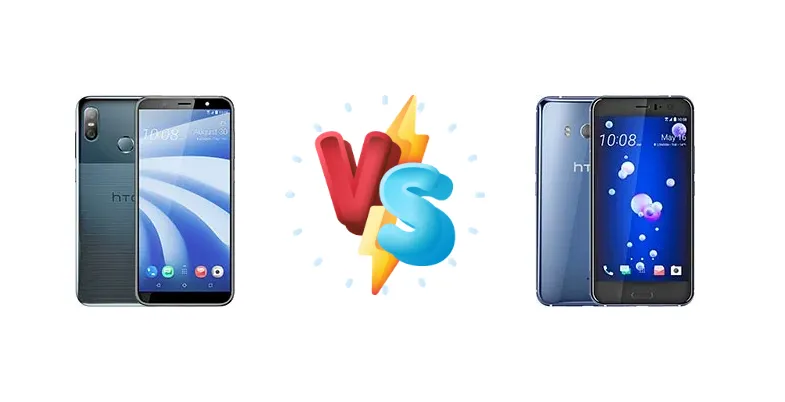
The HTC U11, released in 2017, represented a peak in HTC's flagship ambitions. Now, with the U12 Life available at significantly lower prices, the question arises: does the older, more powerful U11 still hold up, or does the U12 Life offer a better overall experience for the modern user? This comparison dissects the key differences between these two devices, focusing on their core hardware and real-world implications.
🏆 Quick Verdict
For most users in 2024, the HTC U11 remains the superior choice. While the U12 Life offers a more modern design, the U11’s Snapdragon 835 provides a substantial performance advantage, particularly in demanding tasks and gaming, without sacrificing battery life due to the similar endurance ratings. The U11’s faster charging is a bonus.
| Network |
|---|
| 2G bands | GSM 850 / 900 / 1800 / 1900 | GSM 850 / 900 / 1800 / 1900 - SIM 1 & SIM 2 (dual-SIM model only) |
| 3G bands | HSDPA 850 / 900 / 1900 / 2100 | HSDPA 850 / 900 / 1900 / 2100 |
| 4G bands | 1, 2, 3, 4, 5, 7, 8, 12, 17, 20, 28, 32, 38, 40, 66 | 1, 3, 4, 5, 7, 8, 12, 17, 20, 28, 32, 38, 39, 40, 41 |
| Speed | HSPA 42.2/5.76 Mbps, LTE (3CA) Cat11 600/75 Mbps | HSPA 42.2/5.76 Mbps, LTE (4CA) Cat16 1024/75 Mbps |
| Technology | GSM / HSPA / LTE | GSM / HSPA / LTE |
| Launch |
|---|
| Announced | 2018, August. Released 2018, September | 2017, May 16. Released 2017, June 10 |
| Status | Discontinued | Discontinued |
| Body |
|---|
| Build | Glass front, plastic back, plastic frame | Glass front (Gorilla Glass 5), glass back, aluminum frame |
| Dimensions | 158.5 x 75.4 x 8.3 mm (6.24 x 2.97 x 0.33 in) | 153.9 x 75.9 x 7.9 mm (6.06 x 2.99 x 0.31 in) |
| SIM | · Nano-SIM· Nano-SIM + Nano-SIM | · Nano-SIM· Nano-SIM + Nano-SIM |
| Weight | 175 g (6.17 oz) | 169 g (5.96 oz) |
| | - | IP67 dust/water resistant (up to 1m for 30 mins) |
| Display |
|---|
| Protection | - | Corning Gorilla Glass 5 |
| Resolution | 1080 x 2160 pixels, 18:9 ratio (~402 ppi density) | 1440 x 2560 pixels, 16:9 ratio (~534 ppi density) |
| Size | 6.0 inches, 92.9 cm2 (~77.7% screen-to-body ratio) | 5.5 inches, 83.4 cm2 (~71.4% screen-to-body ratio) |
| Type | IPS LCD | Super LCD5 |
| Platform |
|---|
| CPU | Octa-core (4x1.8 GHz Kryo 260 Gold & 4x1.6 GHz Kryo 260 Silver) | Octa-core (4x2.45 GHz Kryo & 4x1.9 GHz Kryo) |
| Chipset | Qualcomm SDM636 Snapdragon 636 (14 nm) | Qualcomm MSM8998 Snapdragon 835 (10 nm) |
| GPU | Adreno 509 | Adreno 540 |
| OS | Android 8.1 (Oreo) | Android 7.1 (Nougat), upgradable to Android 9.0 (Pie), Sense UI |
| Memory |
|---|
| Card slot | microSDXC (uses shared SIM slot) | microSDXC (uses shared SIM slot) - dual SIM model only |
| Internal | 64GB 4GB RAM, 128GB 6GB RAM | 64GB 4GB RAM, 128GB 6GB RAM |
| | eMMC 5.1 | - |
| Main Camera |
|---|
| Dual | 16 MP, f/2.0, PDAF
Auxiliary lens | - |
| Features | Dual-LED flash, HDR, panorama | Dual-LED dual-tone flash, HDR, panorama |
| Single | - | 12 MP, f/1.7, 1/2.55", 1.4µm, dual pixel PDAF, 5-axis OIS |
| Video | 4K@30fps, 1080p@30fps | 4K@30fps, 1080p@30/60/120fps, HDR, 24-bit/192kHz stereo sound rec. |
| Selfie camera |
|---|
| Features | LED flash, HDR, panorama | - |
| Single | 13 MP, f/2.0 | 16 MP, f/2.0, 27mm (wide), 1/3.06", 1.0µm |
| Video | 1080p@30fps | 1080p@30fps |
| Sound |
|---|
| 3.5mm jack | Yes | No |
| 35mm jack | Yes | No |
| Loudspeaker | Yes, with stereo speakers | Yes, with stereo speakers |
| | - | 24-bit/192kHz audio
|
| Comms |
|---|
| Bluetooth | 5.0, A2DP, LE | 4.2, A2DP, LE (5.0 after SW update) |
| NFC | Yes | Yes |
| Positioning | GPS, GLONASS | GPS, GLONASS, BDS |
| Radio | No | No |
| USB | USB Type-C 2.0 | USB Type-C 3.1 |
| WLAN | Wi-Fi 802.11 a/b/g/n/ac, dual-band, Wi-Fi Direct | Wi-Fi 802.11 a/b/g/n/ac, dual-band, Wi-Fi Direct, DLNA |
| Features |
|---|
| Sensors | Fingerprint (rear-mounted), accelerometer, gyro, proximity, compass | Fingerprint (front-mounted), accelerometer, gyro, proximity, compass |
| Battery |
|---|
| Charging | 10W wired | 18W wired, QC3 |
| Stand-by | - | Up to 336 h (3G) |
| Talk time | - | Up to 24 h 30 min (3G) |
| Type | Li-Ion 3600 mAh, non-removable | Li-Ion 3000 mAh, non-removable |
| Misc |
|---|
| Colors | Moonlight Blue, Twilight Purple | Amazing Silver, Sapphire Blue, Brilliant Black, Ice White, Solar Red |
| Models | U12 life, 2Q6E1 | U11, HTV33, 2PZC100, 2PZC5, 601HT |
| Price | About 230 EUR | About 300 EUR |
| Tests |
|---|
| Audio quality | - |
Noise -94.1 / Crosstalk -94.5 |
| Battery life | - |
Endurance rating 73h
|
| Camera | - |
Photo / Video |
| Loudspeaker | - |
Voice 68dB / Noise 73dB / Ring 79dB
|
| Performance | - |
GeekBench: 6393 (v4.4)
GFXBench: 13fps (ES 3.1 onscreen) |
HTC U12 life
- Superior performance with Snapdragon 835
- Faster 18W Quick Charge 3.0 charging
- Likely better camera image quality
- Older design
- Potentially fewer software updates
HTC U11
- More modern design
- Potentially lower price
- Comparable battery endurance
- Significantly weaker Snapdragon 636 performance
- Slower 10W charging
- Likely inferior camera quality
Display Comparison
Neither HTC provided detailed display specs beyond the general 'Photo / Video' capabilities. However, given the U11’s flagship status at launch, it likely featured a higher peak brightness and potentially better color accuracy than the U12 Life. The U12 Life, being a mid-range device, likely utilized a less sophisticated panel, potentially impacting outdoor visibility and color vibrancy. Bezels are likely comparable, reflecting design trends of their respective release years.
Camera Comparison
Both phones feature 'Photo / Video' capabilities, but specifics are limited. The U11, as a flagship, likely incorporated a larger sensor and more advanced image processing algorithms. While megapixel counts aren’t specified, the U11’s image quality is likely superior, particularly in low-light conditions. The U12 Life’s camera is adequate for casual use, but it won’t match the detail and dynamic range of the U11. The absence of detailed camera specs makes a precise comparison difficult, but the U11’s flagship positioning suggests a more capable camera system.
Performance
The core difference lies in the chipsets. The HTC U11’s Snapdragon 835, built on a 10nm process, significantly outperforms the U12 Life’s Snapdragon 636 (14nm). The 835’s Kryo cores, clocked at up to 2.45 GHz, deliver a noticeable performance boost over the 636’s Kryo 260 cores (1.8 GHz). This translates to faster app loading times, smoother multitasking, and a more responsive user experience. The 10nm process of the 835 also contributes to better thermal efficiency, meaning less throttling during sustained workloads. Gamers and power users will overwhelmingly benefit from the U11’s superior processing power.
Battery Life
Interestingly, both the HTC U11 and U12 Life share an endurance rating of 73 hours. This suggests comparable real-world battery life despite the U12 Life’s less power-hungry chipset. However, the U11 boasts 18W wired charging with Quick Charge 3 (QC3) support, significantly faster than the U12 Life’s 10W charging. This means the U11 can be topped up much quicker, mitigating any potential battery life differences. A full charge on the U11 will take considerably less time than on the U12 Life.
Buying Guide
Buy the HTC U12 Life if you prioritize a newer design and are primarily a casual user focused on basic tasks like browsing, social media, and light photography. Buy the HTC U11 if you value performance for gaming, multitasking, or demanding applications, and appreciate faster charging speeds. The U11 is also the better option for those who want a phone that will likely hold its value slightly longer due to its higher initial price point and more powerful chipset.
Frequently Asked Questions
❓ Will the Snapdragon 636 in the U12 Life struggle with demanding games like PUBG or Genshin Impact?
Yes, the Snapdragon 636 is a mid-range chipset and will likely require significant graphics settings reductions to achieve playable frame rates in demanding games. Expect noticeable frame drops and potential stuttering, especially during intense action sequences. The U11’s Snapdragon 835 offers a much smoother gaming experience.
❓ How much faster is the charging on the HTC U11 compared to the U12 Life in real-world use?
The U11’s 18W Quick Charge 3.0 support will significantly reduce charging times. While exact figures depend on the charger used, you can expect the U11 to charge from 0-100% in approximately 90-120 minutes, whereas the U12 Life’s 10W charging will likely take over 2.5-3 hours for a full charge.
❓ Is the U12 Life a good option for someone upgrading from a very old phone (e.g., pre-2016)?
Yes, the U12 Life represents a substantial upgrade in terms of design, software, and features compared to phones released before 2016. However, if performance is a priority, the U11 offers a more significant leap forward, even considering its age.