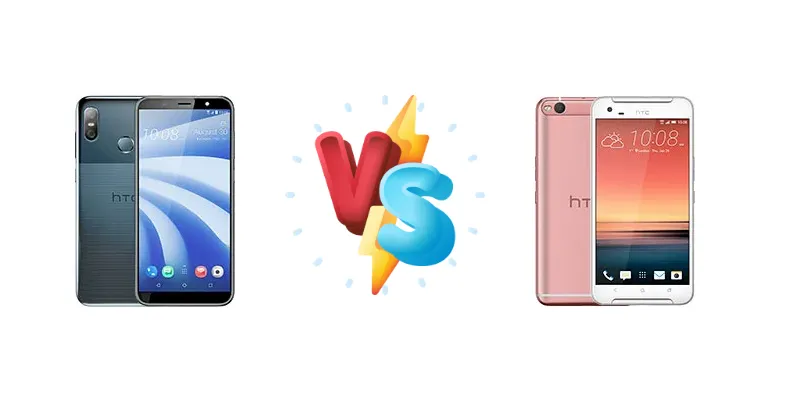
The HTC U12 life and One X9 represent different eras of HTC's mid-range strategy. The One X9, released in 2015, aimed for a premium feel with a powerful-for-its-time chipset. The U12 life, arriving in 2018, focused on a more modern design and efficient power management. This comparison dissects their key differences to determine which phone holds up better today.
🏆 Quick Verdict
For the average user in 2024, the HTC U12 life is the better choice. While the One X9 boasts faster wired charging, the U12 life’s more modern Snapdragon 636 chipset delivers superior efficiency and sustained performance, making it more suitable for everyday tasks and light gaming.
| Network |
|---|
| 2G bands | GSM 850 / 900 / 1800 / 1900 | GSM 850 / 900 / 1800 / 1900 - SIM 1 & SIM 2 |
| 3G bands | HSDPA 850 / 900 / 1900 / 2100 | HSDPA 850 / 900 / 1900 / 2100 |
| 4G bands | 1, 2, 3, 4, 5, 7, 8, 12, 17, 20, 28, 32, 38, 40, 66 | 1, 3, 5, 7, 8, 28, 38, 39, 40, 41 |
| Speed | HSPA 42.2/5.76 Mbps, LTE (3CA) Cat11 600/75 Mbps | HSPA, LTE Cat4 150/50 Mbps |
| Technology | GSM / HSPA / LTE | GSM / HSPA / LTE |
| Launch |
|---|
| Announced | 2018, August. Released 2018, September | 2015, December. Released 2016, January |
| Status | Discontinued | Discontinued |
| Body |
|---|
| Build | Glass front, plastic back, plastic frame | - |
| Dimensions | 158.5 x 75.4 x 8.3 mm (6.24 x 2.97 x 0.33 in) | 153.9 x 75.9 x 8 mm (6.06 x 2.99 x 0.31 in) |
| SIM | · Nano-SIM· Nano-SIM + Nano-SIM | Nano-SIM + Nano-SIM |
| Weight | 175 g (6.17 oz) | 170 g (6.00 oz) |
| Display |
|---|
| Protection | - | Corning Gorilla Glass (unspecified version) |
| Resolution | 1080 x 2160 pixels, 18:9 ratio (~402 ppi density) | 1080 x 1920 pixels, 16:9 ratio (~401 ppi density) |
| Size | 6.0 inches, 92.9 cm2 (~77.7% screen-to-body ratio) | 5.5 inches, 83.4 cm2 (~71.4% screen-to-body ratio) |
| Type | IPS LCD | Super LCD |
| Platform |
|---|
| CPU | Octa-core (4x1.8 GHz Kryo 260 Gold & 4x1.6 GHz Kryo 260 Silver) | Octa-core 2.2 GHz Cortex-A53 |
| Chipset | Qualcomm SDM636 Snapdragon 636 (14 nm) | Mediatek MT6795 Helio X10 (28 nm) |
| GPU | Adreno 509 | PowerVR G6200 |
| OS | Android 8.1 (Oreo) | Android 6.0 (Marshmallow) |
| Memory |
|---|
| Card slot | microSDXC (uses shared SIM slot) | microSDXC (dedicated slot) |
| Internal | 64GB 4GB RAM, 128GB 6GB RAM | 32GB 3GB RAM |
| | eMMC 5.1 | eMMC 5.0 |
| Main Camera |
|---|
| Dual | 16 MP, f/2.0, PDAF
Auxiliary lens | - |
| Features | Dual-LED flash, HDR, panorama | Dual-LED dual-tone flash, panorama, HDR |
| Single | - | 13 MP, f/2.0, 28mm (wide), AF, OIS |
| Video | 4K@30fps, 1080p@30fps | 4K@30fps, 1080p@30fps |
| Selfie camera |
|---|
| Features | LED flash, HDR, panorama | - |
| Single | 13 MP, f/2.0 | 5 MP, f/2.8, 34mm (standard) |
| Video | 1080p@30fps | 1080p@30fps |
| Sound |
|---|
| 3.5mm jack | Yes | Yes |
| 35mm jack | Yes | Yes |
| Loudspeaker | Yes, with stereo speakers | Yes, with stereo speakers |
| Comms |
|---|
| Bluetooth | 5.0, A2DP, LE | 4.2, A2DP, aptX |
| NFC | Yes | Yes (market dependent) |
| Positioning | GPS, GLONASS | GPS, GLONASS, BDS |
| Radio | No | FM radio |
| USB | USB Type-C 2.0 | microUSB 2.0 |
| WLAN | Wi-Fi 802.11 a/b/g/n/ac, dual-band, Wi-Fi Direct | Wi-Fi 802.11 a/b/g/n/ac, dual-band, Wi-Fi Direct, DLNA |
| Features |
|---|
| Sensors | Fingerprint (rear-mounted), accelerometer, gyro, proximity, compass | Accelerometer, gyro, proximity, compass |
| Battery |
|---|
| Charging | 10W wired | 18W wired |
| Music play | - | Up to 40 h |
| Talk time | - | Up to 15 h (3G) |
| Type | Li-Ion 3600 mAh, non-removable | Li-Ion 3000 mAh, non-removable |
| Misc |
|---|
| Colors | Moonlight Blue, Twilight Purple | Black, Silver, Gold, Pink |
| Models | U12 life, 2Q6E1 | One X9 dual sim, 2PS5200 |
| Price | About 230 EUR | About 300 EUR |
HTC U12 life
- More efficient Snapdragon 636 chipset
- Better sustained performance for gaming
- Likely improved camera image processing
- Slower wired charging (10W)
- Potentially less readily available replacement parts
HTC One X9
- Faster 18W wired charging
- Potentially lower purchase price (due to age)
- More classic HTC design aesthetic
- Less efficient MediaTek Helio X10 chipset
- Older software and limited updates
- Higher power consumption
Display Comparison
Neither HTC provides display specs beyond resolution in their marketing materials. However, given the release dates, the U12 life likely benefits from improved color accuracy and viewing angles compared to the One X9’s older panel. The U12 life’s more recent manufacturing process likely allows for thinner bezels, contributing to a more immersive experience. While neither phone is expected to have high peak brightness, the U12 life’s panel is likely more efficient.
Camera Comparison
Detailed camera specs are scarce for both devices. However, the U12 life likely benefits from more advanced image processing algorithms developed after the One X9’s release. While both phones likely feature similar megapixel counts in their primary sensors, the Snapdragon 636’s image signal processor (ISP) offers superior noise reduction and dynamic range. The U12 life’s newer software likely includes features like HDR enhancements and scene recognition, resulting in more consistently pleasing photos. Any 2MP auxiliary cameras on either device are unlikely to provide significant image quality improvements.
Performance
The core difference lies in the chipsets. The HTC One X9’s MediaTek Helio X10 (MT6795), built on a 28nm process, features eight Cortex-A53 cores clocked at 2.2 GHz. This architecture, while powerful for its time, lacks the efficiency of Qualcomm’s Kryo cores. The U12 life’s Snapdragon 636 (SDM636), fabricated on a 14nm process, utilizes a hybrid architecture with four Kryo 260 Gold cores at 1.8 GHz and four Kryo 260 Silver cores at 1.6 GHz. This allows for better performance scaling and significantly improved power efficiency. The Snapdragon 636’s Adreno 509 GPU also provides a substantial graphical advantage over the Helio X10’s Mali-T760 MP4, making the U12 life more capable in gaming scenarios.
Battery Life
The HTC One X9’s 18W wired charging is a clear advantage on paper. However, the Snapdragon 636’s superior power efficiency in the U12 life partially offsets the difference. The U12 life will likely offer longer screen-on time despite potentially having a similar or slightly smaller battery capacity. The Helio X10’s 28nm process consumes more power, leading to faster battery drain during intensive tasks. While the One X9 can charge faster, the U12 life will likely require less frequent charging overall.
Buying Guide
Buy the HTC U12 life if you prioritize battery life, smoother app performance, and a more modern software experience. It’s ideal for users who need a reliable daily driver for communication, social media, and casual entertainment. Buy the HTC One X9 if you absolutely need the fastest possible wired charging speeds and are willing to compromise on processing power and long-term software support. It might appeal to users who frequently find themselves needing a quick top-up and don't demand intensive app usage.
Frequently Asked Questions
❓ Is the Helio X10 in the One X9 still capable of running modern apps?
While the Helio X10 can run many apps, it will struggle with demanding games and multitasking. The Snapdragon 636 in the U12 life offers a significantly smoother experience with modern applications due to its more efficient architecture and higher processing power.
❓ Does the faster charging of the One X9 make a significant difference in daily use?
The 18W charging is beneficial for quick top-ups, but the U12 life’s superior power efficiency means you’ll likely need to charge it less frequently overall. The convenience of faster charging is offset by the shorter time between charges with the One X9.
❓ Which phone is more likely to receive software updates?
The HTC U12 life is more likely to have received more software updates, even if support has ended. The One X9 is an older device and has likely reached its end-of-life in terms of software support, potentially leaving it vulnerable to security risks.
❓ Will I notice a difference in gaming performance between these two phones?
Yes, the U12 life’s Snapdragon 636 and Adreno 509 GPU provide a substantial gaming advantage. You’ll experience higher frame rates, smoother gameplay, and the ability to play more demanding games compared to the One X9’s Helio X10 and Mali-T760 MP4.