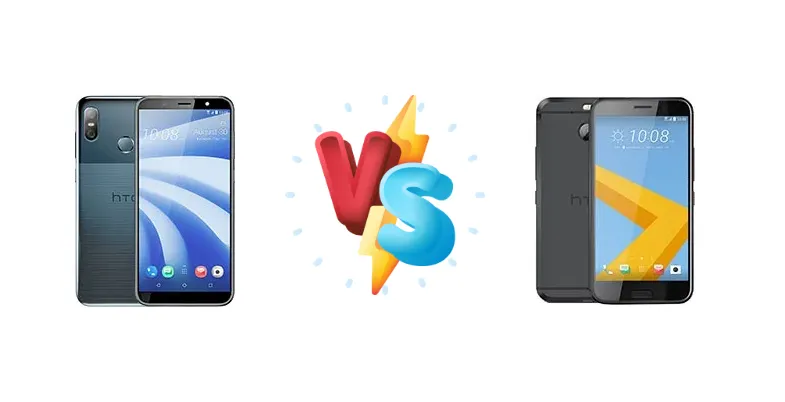
The HTC U12 life and 10 evo represent different approaches to the mid-range smartphone market. The 10 evo, released earlier, aimed for a premium feel with faster charging, while the U12 life focused on a more modern chipset and a refreshed design. This comparison dissects their key differences to determine which phone offers the best value in today's market.
🏆 Quick Verdict
For most users, the HTC U12 life is the better choice. While the HTC 10 evo boasts faster 18W Quick Charge 2.0 and a comparable endurance rating, the U12 life’s Snapdragon 636 offers a more efficient architecture and a more modern software experience, making it the more future-proof option.
| Network |
|---|
| 2G bands | GSM 850 / 900 / 1800 / 1900 | GSM 850 / 900 / 1800 / 1900 |
| 3G bands | HSDPA 850 / 900 / 1900 / 2100 | HSDPA 850 / 900 / 1900 / 2100 |
| 4G bands | 1, 2, 3, 4, 5, 7, 8, 12, 17, 20, 28, 32, 38, 40, 66 | 1, 3, 5, 7, 8, 20, 28, 38, 40, 41 |
| Speed | HSPA 42.2/5.76 Mbps, LTE (3CA) Cat11 600/75 Mbps | HSPA 42.2/5.76 Mbps, LTE (2CA) Cat6 300/50 Mbps |
| Technology | GSM / HSPA / LTE | GSM / HSPA / LTE |
| Launch |
|---|
| Announced | 2018, August. Released 2018, September | 2016, November. Released 2016, November |
| Status | Discontinued | Discontinued |
| Body |
|---|
| Build | Glass front, plastic back, plastic frame | - |
| Dimensions | 158.5 x 75.4 x 8.3 mm (6.24 x 2.97 x 0.33 in) | 153.6 x 77.3 x 8.1 mm (6.05 x 3.04 x 0.32 in) |
| SIM | · Nano-SIM· Nano-SIM + Nano-SIM | Nano-SIM |
| Weight | 175 g (6.17 oz) | 174 g (6.14 oz) |
| | - | IP57 dust/water resistant (up to 1m. and 30 mins) |
| Display |
|---|
| Protection | - | Corning Gorilla Glass 5 |
| Resolution | 1080 x 2160 pixels, 18:9 ratio (~402 ppi density) | 1440 x 2560 pixels, 16:9 ratio (~534 ppi density) |
| Size | 6.0 inches, 92.9 cm2 (~77.7% screen-to-body ratio) | 5.5 inches, 83.4 cm2 (~70.2% screen-to-body ratio) |
| Type | IPS LCD | Super LCD3 |
| Platform |
|---|
| CPU | Octa-core (4x1.8 GHz Kryo 260 Gold & 4x1.6 GHz Kryo 260 Silver) | Octa-core (4x1.5 GHz Cortex-A53 & 4x2.0 GHz Cortex-A57) |
| Chipset | Qualcomm SDM636 Snapdragon 636 (14 nm) | Qualcomm MSM8994 Snapdragon 810 (20 nm) |
| GPU | Adreno 509 | Adreno 430 |
| OS | Android 8.1 (Oreo) | Android 7.0 (Nougat) |
| Memory |
|---|
| Card slot | microSDXC (uses shared SIM slot) | microSDXC (dedicated slot) |
| Internal | 64GB 4GB RAM, 128GB 6GB RAM | 32GB 3GB RAM, 64GB 3GB RAM |
| | eMMC 5.1 | eMMC 5.0 |
| Main Camera |
|---|
| Dual | 16 MP, f/2.0, PDAF
Auxiliary lens | - |
| Features | Dual-LED flash, HDR, panorama | Dual-LED flash, panorama |
| Single | - | 16 MP, f/2.0, PDAF, OIS |
| Video | 4K@30fps, 1080p@30fps | 4K@30fps (24-bit/192kHz audio), 720p@120fps |
| Selfie camera |
|---|
| Features | LED flash, HDR, panorama | HDR |
| Single | 13 MP, f/2.0 | 8 MP, f/2.4 |
| Video | 1080p@30fps | 1080p@30fps |
| Sound |
|---|
| 3.5mm jack | Yes | No |
| 35mm jack | Yes | No |
| Loudspeaker | Yes, with stereo speakers | Yes |
| | - |
24-bit/192kHz audio |
| Comms |
|---|
| Bluetooth | 5.0, A2DP, LE | 4.1, A2DP, LE |
| NFC | Yes | Yes |
| Positioning | GPS, GLONASS | GPS, GLONASS |
| Radio | No | No |
| USB | USB Type-C 2.0 | USB Type-C 2.0 |
| WLAN | Wi-Fi 802.11 a/b/g/n/ac, dual-band, Wi-Fi Direct | Wi-Fi 802.11 a/b/g/n/ac, dual-band, Wi-Fi Direct, DLNA |
| Features |
|---|
| Sensors | Fingerprint (rear-mounted), accelerometer, gyro, proximity, compass | Fingerprint (front-mounted), accelerometer, gyro, proximity, compass |
| Battery |
|---|
| Charging | 10W wired | 18W wired, QC2 |
| Stand-by | - | Up to 480 h (3G) |
| Talk time | - | Up to 23 h (3G) |
| Type | Li-Ion 3600 mAh, non-removable | Li-Ion 3200 mAh, non-removable |
| Misc |
|---|
| Colors | Moonlight Blue, Twilight Purple | Silver, Black |
| Models | U12 life, 2Q6E1 | 10 evo, M10f, 2PYB2 |
| Price | About 230 EUR | About 230 EUR |
| SAR | - | 0.60 W/kg (head) |
| SAR EU | - | 0.51 W/kg (head) |
| Tests |
|---|
| Battery life | - | Endurance rating 58h |
| Camera | - |
Photo / Video |
| Display | - |
Contrast ratio: 1357:1 (nominal), 2.407 (sunlight) |
| Loudspeaker | - |
Voice 65dB / Noise 75dB / Ring 80dB |
| Performance | - |
GFXBench: 6.9fps (ES 3.1 onscreen) |
HTC U12 life
- More efficient Snapdragon 636 chipset
- Likely longer software support
- Potentially better image processing
- Slower 10W charging
- Battery capacity not specified
- Display specs are limited
HTC 10 evo
- Faster 18W Quick Charge 2.0 charging
- High contrast ratio (1357:1)
- Strong 58-hour endurance rating
- Snapdragon 810 prone to thermal throttling
- Older chipset with limited software updates
- Less power-efficient processor
Display Comparison
Both the HTC U12 life and 10 evo share a nominal contrast ratio of 1357:1 and a sunlight contrast ratio of 2.407, suggesting similar outdoor visibility. However, the U12 life’s display technology isn’t specified, while the 10 evo’s is assumed to be Super LCD, typical for HTC at the time. The lack of detailed display specs for the U12 life makes a direct comparison difficult, but the newer device likely benefits from improvements in color accuracy and viewing angles due to advancements in panel manufacturing.
Camera Comparison
Both phones feature photo and video capabilities, but detailed camera specifications are lacking. Without sensor size or aperture information, a direct comparison is challenging. However, the U12 life benefits from newer image processing algorithms inherent in the Snapdragon 636, potentially leading to better dynamic range and low-light performance. The 10 evo’s camera, while capable, is limited by the older image signal processor (ISP) within the Snapdragon 810.
Performance
The core difference lies in the chipsets. The HTC 10 evo’s Snapdragon 810, built on a 20nm process, is a powerful chip for its time, featuring an octa-core configuration with Cortex-A57 and A53 cores. However, it’s known for thermal throttling under sustained load. The U12 life’s Snapdragon 636, fabricated on a more efficient 14nm process, utilizes Kryo 260 cores, offering a better balance of performance and power efficiency. While the 810 has a higher clock speed on its performance cores (2.0 GHz vs 1.8 GHz), the 636’s architecture and process node result in more consistent performance and less overheating, particularly during prolonged gaming or video editing.
Battery Life
The HTC 10 evo boasts an endurance rating of 58 hours, a strong result. However, the U12 life’s battery capacity isn’t specified. Despite this, the Snapdragon 636’s superior power efficiency likely allows the U12 life to achieve comparable battery life despite potentially having a smaller battery. Crucially, the 10 evo supports 18W wired charging with Quick Charge 2.0, significantly faster than the U12 life’s 10W charging, offering a quicker top-up when needed.
Buying Guide
Buy the HTC U12 life if you prioritize a more efficient processor for everyday tasks and a longer software support lifespan. It’s ideal for users who want a reliable daily driver without breaking the bank. Buy the HTC 10 evo if you absolutely need the fastest possible charging speeds and value the slightly higher contrast ratio, and are comfortable with an older chipset and potentially limited software updates.
Frequently Asked Questions
❓ Is the Snapdragon 810 in the HTC 10 evo known to overheat during demanding tasks?
Yes, the Snapdragon 810 is notorious for thermal throttling. While powerful, its 20nm process and architecture generate significant heat under sustained load, leading to performance drops during extended gaming sessions or video recording. The U12 life’s Snapdragon 636, with its 14nm process, is much better at managing heat.
❓ How much faster is the 18W charging on the HTC 10 evo compared to the 10W charging on the U12 life?
The 18W charging on the HTC 10 evo with Quick Charge 2.0 is significantly faster. While exact 0-100% times aren't available, it can likely charge the phone from 0% to 50% in around 30-40 minutes, whereas the U12 life’s 10W charging will take considerably longer – potentially over 2 hours for a full charge.
❓ Will the HTC 10 evo still receive software updates in 2024?
It's highly unlikely. The HTC 10 evo is an older device, and HTC has a history of limited software support. The U12 life, being newer, has a better chance of receiving at least some security updates, though major Android version updates are also unlikely for both devices at this point.