
HTC U11+ vs Samsung Galaxy S7 edge: A Deep Dive into Two Flagship Contenders
| Phones Images | |||||
|---|---|---|---|---|---|
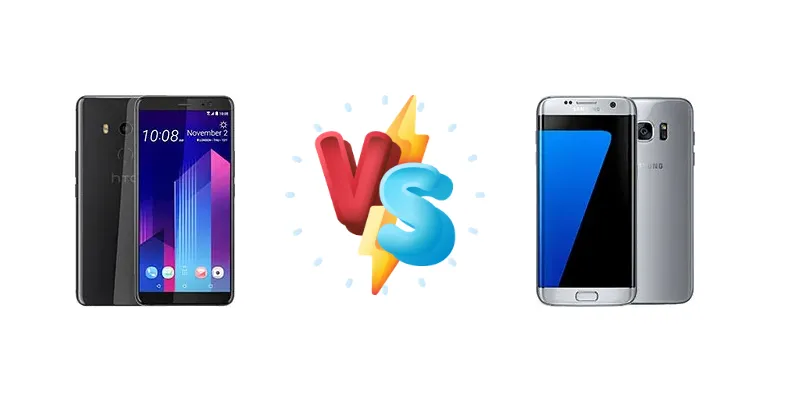
|
🏆 Quick Verdict
For the average user in 2024, the Samsung Galaxy S7 edge edges out the HTC U11+. While the U11+ benefits from the newer Snapdragon 835, the S7 edge’s superior battery endurance (92h vs 73h) and significantly higher display contrast (Infinite vs 1626:1) provide a more consistently enjoyable daily experience. The S7 edge’s wireless charging is also a convenience the U11+ lacks.
| PHONES | ||
|---|---|---|
| Phone Names | HTC U11+ | Samsung Galaxy S7 edge |
| Network | ||
|---|---|---|
| 2G bands | GSM 850 / 900 / 1800 / 1900 - SIM 1 & SIM 2 (dual-SIM model only) | GSM 850 / 900 / 1800 / 1900 - SIM 1 & SIM 2 - G935FD, G9350 |
| 3G bands | HSDPA 850 / 900 / 1900 / 2100 | HSDPA 850 / 900 / 1700(AWS) / 1900 / 2100 - G935F, G935FD, G935W8 |
| 4G bands | 1, 3, 4, 5, 7, 8, 12, 17, 20, 28, 32, 38, 39, 40, 41 | 1, 2, 3, 4, 5, 7, 8, 12, 13, 17, 18, 19, 20, 25, 26, 28, 38, 39, 40, 41 - G935F, G935FD |
| Speed | HSPA 42.2/5.76 Mbps, LTE (4CA) Cat15 800/150 Mbps | HSPA 42.2/5.76 Mbps, LTE (3CA) Cat9 450/50 Mbps |
| Technology | GSM / HSPA / LTE | GSM / HSPA / LTE |
| Launch | ||
|---|---|---|
| Announced | 2017, November 02. Released 2017, November 22 | 2016, February 21. Released 2016, March 11 |
| Status | Discontinued | Discontinued |
| Body | ||
|---|---|---|
| Build | Glass front (Gorilla Glass 5), glass back, aluminum frame | Glass front (Gorilla Glass 4), glass back (Gorilla Glass 4), aluminum frame |
| Dimensions | 158.5 x 74.9 x 8.5 mm (6.24 x 2.95 x 0.33 in) | 150.9 x 72.6 x 7.7 mm (5.94 x 2.86 x 0.30 in) |
| SIM | · Nano-SIM· Nano-SIM + Nano-SIM | · Nano-SIM (G935F, G935W8)· Nano-SIM + Nano-SIM (G935FD) |
| Weight | 188 g (6.63 oz) | 157 g (5.54 oz) |
| IP68 dust/water resistant (up to 1.5m for 30 mins) | - | |
| Display | ||
|---|---|---|
| Protection | Corning Gorilla Glass 5 | Corning Gorilla Glass 4 |
| Resolution | 1440 x 2880 pixels, 18:9 ratio (~537 ppi density) | 1440 x 2560 pixels, 16:9 ratio (~534 ppi density) |
| Size | 6.0 inches, 92.9 cm2 (~78.3% screen-to-body ratio) | 5.5 inches, 83.4 cm2 (~76.1% screen-to-body ratio) |
| Type | Super LCD6 | Super AMOLED |
| Platform | ||
|---|---|---|
| CPU | Octa-core (4x2.45 GHz Kryo & 4x1.9 GHz Kryo) | Quad-core (2x2.15 GHz Kryo & 2x1.6 GHz Kryo) - G9350Octa-core (4x2.3 GHz Mongoose & 4x1.6 GHz Cortex-A53) - G935FD, G935F, G935W8 |
| Chipset | Qualcomm MSM8998 Snapdragon 835 (10 nm) | Qualcomm MSM8996 Snapdragon 820 (14 nm) - G9350Exynos 8890 Octa (14 nm) - G935FD, G935F, G935W8 |
| GPU | Adreno 540 | Adreno 530 - G9350Mali-T880 MP12 - G935FD, G935F, G935W8 |
| OS | Android 8.0 (Oreo), upgradable to Android 9.0 (Pie), Sense UI | Android 6.0 (Marshmallow), upgradable to Android 8.0 (Oreo), TouchWiz UI |
| Memory | ||
|---|---|---|
| Card slot | microSDXC (uses shared SIM slot) - dual SIM model only | microSDXC (uses shared SIM slot) - dual SIM model only |
| Internal | 64GB 4GB RAM, 128GB 6GB RAM | 32GB 4GB RAM, 64GB 4GB RAM, 128GB 4GB RAM |
| Main Camera | ||
|---|---|---|
| Features | Dual-LED dual-tone flash, HDR, panorama | LED flash, auto-HDR, panorama |
| Single | 12 MP, f/1.7, 1/2.55", 1.4µm, dual pixel PDAF, OIS | 12 MP, f/1.7, 26mm (wide), 1/2.55", 1.4µm, dual pixel PDAF, OIS |
| Video | 4K@30fps, 1080p@30/60/120fps, HDR, 24-bit/192kHz stereo sound rec. | 4K@30fps, 1080p@30fps (gyro-EIS), 1080p@60fps, 720p@240fps, HDR, stereo sound rec., OIS |
| Selfie camera | ||
|---|---|---|
| Features | HDR, panorama | HDR |
| Single | 8 MP, f/2.0 | 5 MP, f/1.7, 22mm (wide), 1/4.1", 1.34µm |
| Video | 1080p@30fps | - |
| Sound | ||
|---|---|---|
| 3.5mm jack | No | Yes |
| 35mm jack | No | Yes |
| Loudspeaker | Yes, with stereo speakers | Yes |
| 24-bit/192kHz audio | - | |
| Comms | ||
|---|---|---|
| Bluetooth | 5.0, A2DP, aptX HD, LE | 4.2, A2DP, LE, aptX |
| NFC | Yes | Yes |
| Positioning | GPS, GLONASS, BDS | GPS, GLONASS, BDS |
| Radio | No | No |
| USB | USB Type-C 3.1 | microUSB 2.0, OTG |
| WLAN | Wi-Fi 802.11 a/b/g/n/ac, dual-band, Wi-Fi Direct, DLNA | Wi-Fi 802.11 a/b/g/n/ac, dual-band, Wi-Fi Direct |
| Features | ||
|---|---|---|
| Sensors | Fingerprint (rear-mounted), accelerometer, gyro, proximity, compass | Fingerprint (front-mounted), accelerometer, gyro, proximity, compass, barometer, heart rate, SpO2 |
| Battery | ||
|---|---|---|
| Charging | 18W wired, QC3 | 15W wired, QC2 Wireless (Qi) (market dependent) |
| Music play | - | Up to 74 h |
| Talk time | Up to 25 h (3G) | Up to 27 h (3G) |
| Type | Li-Ion 3930 mAh, non-removable | Li-Ion 3600 mAh, non-removable |
| Misc | ||
|---|---|---|
| Colors | Translucent Black, Ceramic Black, Amazing Silver | Black, White, Gold, Silver, Pink Gold, Black Pearl, Coral Blue |
| Models | U11 plus, htc_2q4d100 | SM-G935F, SM-G935FD, SM-G935W8, SM-G9350, SM-G935S, SC-02H, SM-G935K, SM-G935L, SM-G935R4, SCV33, SM-G935X, SM-G935VC, SM-G935D |
| Price | About 450 EUR | About 330 EUR |
| SAR | - | 0.56 W/kg (head) 0.66 W/kg (body) |
| SAR EU | - | 0.26 W/kg (head) 1.43 W/kg (body) |
| Tests | ||
|---|---|---|
| Audio quality | Noise -93.9dB / Crosstalk -94.0dB | Noise -92.5dB / Crosstalk -92.2dB |
| Battery life | Endurance rating 73h | Endurance rating 92h |
| Camera | Photo / Video | Photo / Video |
| Display | Contrast ratio: 1626:1 (nominal), 2.556 (sunlight) | Contrast ratio: Infinite (nominal), 4.439 (sunlight) |
| Loudspeaker | Voice 91dB / Noise 75dB / Ring 90dB | Voice 70dB / Noise 69dB / Ring 71dB |
| Performance | GeekBench: 6654 (v4.4) GFXBench: 13fps (ES 3.1 onscreen) | GFXBench: 8.3fps (ES 3.1 onscreen) |
HTC U11+
- Newer Snapdragon 835 processor
- Cleaner Android experience (historically)
- Liquid Glass design offers unique aesthetics
- Inferior battery life compared to S7 edge
- No wireless charging support
- Lower display contrast ratio
Samsung Galaxy S7 edge
- Superior battery endurance (92h rating)
- Stunning Super AMOLED display with high contrast
- Wireless charging (Qi) support
- Older Snapdragon 820/Exynos 8890 processor
- Software updates have likely ceased
- Curved display can be prone to accidental touches
Display Comparison
The Samsung Galaxy S7 edge’s Super AMOLED display boasts an ‘Infinite’ contrast ratio and a sunlight contrast ratio of 4.439, significantly outperforming the HTC U11+’s 1626:1 nominal and 2.556 sunlight contrast ratios. This translates to deeper blacks, more vibrant colors, and superior readability in direct sunlight. While both displays offer excellent quality, the S7 edge’s higher contrast ratio provides a more visually immersive experience. The S7 edge’s curved edges, while aesthetically pleasing, don’t offer any functional advantage over the U11+’s flat display.
Camera Comparison
Both devices offer capable camera systems, but detailed analysis is hampered by the lack of specific sensor information in the provided data. Both are described as having Photo/Video capabilities. The S7 edge’s camera was known for its fast autofocus and pleasing image processing, while the U11+ aimed for more natural colors. Without sensor size or aperture details, it’s difficult to definitively declare a winner. The U11+’s camera likely benefits from the newer ISP within the Snapdragon 835, potentially offering improved noise reduction and dynamic range. However, the S7 edge’s camera was consistently praised for its low-light performance.
Performance
The HTC U11+ utilizes the Qualcomm MSM8998 Snapdragon 835 (10nm), a generation ahead of the Snapdragon 820 (14nm) found in the Samsung Galaxy S7 edge (G9350 variant). The 835’s Kryo cores (4x2.45 GHz & 4x1.9 GHz) offer improved performance and efficiency compared to the 820’s (2x2.15 GHz & 2x1.6 GHz). However, the S7 edge also came with an Exynos 8890 Octa (14nm) variant, offering comparable performance. The 10nm process of the Snapdragon 835 provides better thermal efficiency, potentially leading to less throttling during sustained workloads. Despite this, real-world performance differences are likely to be minimal for most users, as both phones are showing their age.
Battery Life
The Samsung Galaxy S7 edge holds a significant advantage in battery endurance, achieving a rating of 92 hours compared to the HTC U11+’s 73 hours. This difference is substantial and translates to a noticeable improvement in real-world usage. While the U11+ supports 18W Quick Charge 3.0, the S7 edge offers 15W Quick Charge 2.0 and, crucially, wireless charging (Qi), a feature absent on the U11+. The S7 edge’s larger battery capacity, combined with the more efficient display technology, contributes to its superior battery life.
Buying Guide
Buy the HTC U11+ if you prioritize a more modern processor for slightly better app loading times and occasional gaming, and if you value a cleaner Android experience. Buy the Samsung Galaxy S7 edge if you prioritize all-day battery life, a stunningly vibrant display with exceptional outdoor visibility, and the convenience of wireless charging. The S7 edge is the better choice for media consumption and general usability.