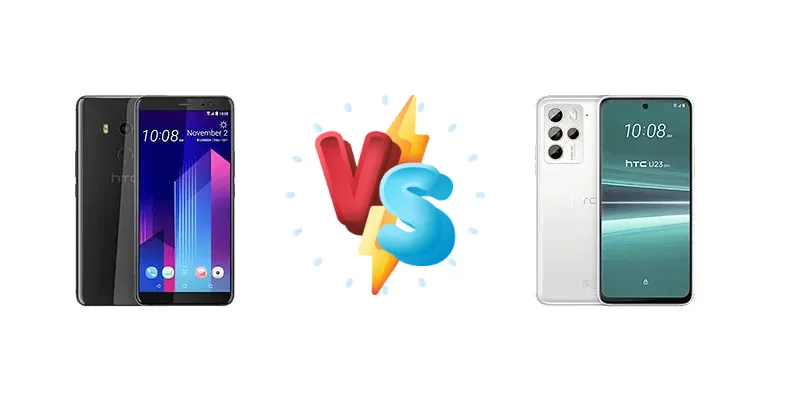
The HTC U11+, released in 2017, was a flagship contender known for its excellent display and solid performance. Now, years later, the HTC U23 Pro arrives as a modern mid-range offering. This comparison dissects the key differences between these two devices, helping you determine if the U23 Pro justifies an upgrade or if the U11+ still holds value in today's market.
🏆 Quick Verdict
For most users, the HTC U23 Pro is the better choice. While the U11+ remains a capable device, the U23 Pro’s more efficient Snapdragon 7 Gen 1 chipset, improved battery life (83h endurance vs 73h), and addition of wireless charging provide a more modern and versatile experience.
| Network |
|---|
| 2G bands | GSM 850 / 900 / 1800 / 1900 - SIM 1 & SIM 2 (dual-SIM model only) | GSM 850 / 900 / 1800 / 1900 |
| 3G bands | HSDPA 850 / 900 / 1900 / 2100 | HSDPA 850 / 900 / 1700(AWS) / 1900 / 2100 |
| 4G bands | 1, 3, 4, 5, 7, 8, 12, 17, 20, 28, 32, 38, 39, 40, 41 | 1, 3, 5, 7, 8, 12, 17, 20, 28, 38, 39, 40, 41 |
| 5G bands | - | 1, 3, 7, 20, 28, 41, 78 SA/NSA |
| Speed | HSPA 42.2/5.76 Mbps, LTE (4CA) Cat15 800/150 Mbps | HSPA, LTE, 5G |
| Technology | GSM / HSPA / LTE | GSM / HSPA / LTE / 5G |
| Launch |
|---|
| Announced | 2017, November 02. Released 2017, November 22 | 2023, May 18 |
| Status | Discontinued | Available. Released 2023, May 18 |
| Body |
|---|
| Build | Glass front (Gorilla Glass 5), glass back, aluminum frame | Glass front (Gorilla Glass Victus), plastic frame, plastic back |
| Dimensions | 158.5 x 74.9 x 8.5 mm (6.24 x 2.95 x 0.33 in) | 166.6 x 77.1 x 8.9 mm (6.56 x 3.04 x 0.35 in) |
| SIM | · Nano-SIM· Nano-SIM + Nano-SIM | Nano-SIM + Nano-SIM |
| Weight | 188 g (6.63 oz) | 205 g (7.23 oz) |
| | IP68 dust/water resistant (up to 1.5m for 30 mins) | IP67 dust/water resistant (up to 1m for 30 min) |
| Display |
|---|
| Protection | Corning Gorilla Glass 5 | Corning Gorilla Glass Victus |
| Resolution | 1440 x 2880 pixels, 18:9 ratio (~537 ppi density) | 1080 x 2400 pixels, 20:9 ratio (~393 ppi density) |
| Size | 6.0 inches, 92.9 cm2 (~78.3% screen-to-body ratio) | 6.7 inches, 108.4 cm2 (~84.4% screen-to-body ratio) |
| Type | Super LCD6 | OLED, 120Hz |
| Platform |
|---|
| CPU | Octa-core (4x2.45 GHz Kryo & 4x1.9 GHz Kryo) | Octa-core (1x2.4 GHz Cortex-A710 & 3x2.36 GHz Cortex-A710 & 4x1.8 GHz Cortex-A510) |
| Chipset | Qualcomm MSM8998 Snapdragon 835 (10 nm) | Qualcomm SM7450-AB Snapdragon 7 Gen 1 (4 nm) |
| GPU | Adreno 540 | Adreno 644 |
| OS | Android 8.0 (Oreo), upgradable to Android 9.0 (Pie), Sense UI | Android 13 |
| Memory |
|---|
| Card slot | microSDXC (uses shared SIM slot) - dual SIM model only | microSDXC |
| Internal | 64GB 4GB RAM, 128GB 6GB RAM | 256GB 8GB RAM, 256GB 12GB RAM |
| Main Camera |
|---|
| Features | Dual-LED dual-tone flash, HDR, panorama | Dual-LED flash, HDR, panorama |
| Quad | - | 108 MP, f/1.7, (wide), 1/1.67", 0.64μm, PDAF, OIS
8 MP, f/2.4, 120˚ (ultrawide), 1/4.0", 1.12µm
5 MP (macro)
Auxiliary lens |
| Single | 12 MP, f/1.7, 1/2.55", 1.4µm, dual pixel PDAF, OIS | - |
| Video | 4K@30fps, 1080p@30/60/120fps, HDR, 24-bit/192kHz stereo sound rec. | 4K@30fps, 1080p@30fps, gyro-EIS |
| Selfie camera |
|---|
| Features | HDR, panorama | HDR |
| Single | 8 MP, f/2.0 | 32 MP, f/2.5, (wide), 1/3.2", 0.7µm |
| Video | 1080p@30fps | 1080p@30fps |
| Sound |
|---|
| 3.5mm jack | No | Yes |
| 35mm jack | No | Yes |
| Loudspeaker | Yes, with stereo speakers | Yes |
| | 24-bit/192kHz audio
| - |
| Comms |
|---|
| Bluetooth | 5.0, A2DP, aptX HD, LE | 5.2, A2DP, LE |
| NFC | Yes | Yes |
| Positioning | GPS, GLONASS, BDS | GPS, GLONASS, GALILEO, BDS |
| Radio | No | No |
| USB | USB Type-C 3.1 | USB Type-C 3.0 |
| WLAN | Wi-Fi 802.11 a/b/g/n/ac, dual-band, Wi-Fi Direct, DLNA | Wi-Fi 802.11 a/b/g/n/ac/6, dual-band |
| Features |
|---|
| Sensors | Fingerprint (rear-mounted), accelerometer, gyro, proximity, compass | Fingerprint (side-mounted), accelerometer, gyro, proximity, compass |
| Battery |
|---|
| Charging | 18W wired, QC3 | 30W wired
15W wireless
5W reverse wireless
Reverse wired |
| Talk time | Up to 25 h (3G) | - |
| Type | Li-Ion 3930 mAh, non-removable | Li-Ion 4600 mAh |
| Misc |
|---|
| Colors | Translucent Black, Ceramic Black, Amazing Silver | Snow White, Coffee Black |
| Models | U11 plus, htc_2q4d100 | 2QC9200, 2QC9100, 2QCB100 |
| Price | About 450 EUR | About 220 EUR |
| Tests |
|---|
| Audio quality |
Noise -93.9dB / Crosstalk -94.0dB | - |
| Battery life | Endurance rating 73h | - |
| Camera |
Photo / Video | - |
| Display |
Contrast ratio: 1626:1 (nominal), 2.556 (sunlight) | - |
| Loudspeaker |
Voice 91dB / Noise 75dB / Ring 90dB | - |
| Performance |
GeekBench: 6654 (v4.4)
GFXBench: 13fps (ES 3.1 onscreen) | - |
HTC U11+
- Excellent display contrast ratio (1626:1)
- Proven Snapdragon 835 performance
- Solid build quality (based on brand reputation)
- Older chipset and software
- Limited battery life compared to U23 Pro
- No wireless or reverse wireless charging
HTC U23 Pro
- Longer battery life (83h endurance)
- Faster charging (30W wired, 15W wireless)
- More efficient Snapdragon 7 Gen 1 processor
- Reverse wireless charging capability
- Potentially lower peak performance compared to Snapdragon 835
- Camera details are limited
- May lack some of the premium features of a flagship
Display Comparison
The HTC U11+ boasts a strong contrast ratio of 1626:1 (nominal) and 2.556 in sunlight, indicating excellent visibility even outdoors. However, the U23 Pro counters with a measured peak brightness of 727 nits, likely offering a brighter image in many real-world scenarios. While the U11+’s contrast is impressive, the U23 Pro’s higher peak brightness and potentially more modern panel technology (though specifics are missing) give it an edge for users who consume a lot of content in bright environments. The absence of refresh rate data for both devices makes a direct comparison difficult, but the U23 Pro’s newer panel likely benefits from advancements in color accuracy and viewing angles.
Camera Comparison
Both devices feature photo and video capabilities, but detailed camera specifications are lacking. Without sensor size, aperture, or image processing details, a direct comparison is challenging. However, the U23 Pro benefits from a more modern image signal processor (ISP) within the Snapdragon 7 Gen 1, potentially leading to improved image quality, especially in low-light conditions. The U11+’s camera system, while capable, is limited by its age and older processing technology. The absence of information regarding OIS (Optical Image Stabilization) on either device makes it difficult to assess video stability.
Performance
The U11+’s Snapdragon 835, built on a 10nm process, was a powerhouse in its day, featuring an octa-core CPU clocked up to 2.45 GHz. However, the U23 Pro’s Snapdragon 7 Gen 1 (4nm) represents a significant leap in efficiency. While the 7 Gen 1 doesn’t match the raw processing power of the 835 in some benchmarks, its 4nm fabrication process results in lower power consumption and reduced thermal throttling. The U23 Pro’s CPU configuration – a 1x2.4 GHz Cortex-A710 and 3x2.36 GHz Cortex-A710, plus 4x1.8 GHz Cortex-A510 – is designed for sustained performance, making it better suited for extended gaming sessions and multitasking. The U11+ may offer a slight edge in peak performance, but the U23 Pro provides a more consistent and efficient experience.
Battery Life
The HTC U23 Pro delivers an endurance rating of 83 hours, a noticeable improvement over the U11+’s 73 hours. This translates to longer usage between charges. The U23 Pro also boasts significantly faster charging capabilities with 30W wired charging, 15W wireless charging, and even 5W reverse wireless charging – features entirely absent on the U11+’s 18W QC3 wired charging. The addition of wireless and reverse wireless charging on the U23 Pro adds considerable convenience for users who frequently rely on wireless accessories or need to top up other devices on the go.
Buying Guide
Buy the HTC U11+ if you prioritize a proven, albeit older, flagship experience and can find it at a significantly discounted price. It’s a good option for users who don’t need the latest features and are comfortable with an older chipset. Buy the HTC U23 Pro if you value longer battery life, faster charging (including wireless), and a more modern processor with improved efficiency, making it ideal for daily use and moderate gaming.
Frequently Asked Questions
❓ Does the Snapdragon 7 Gen 1 in the U23 Pro struggle with demanding games like Genshin Impact?
While the Snapdragon 7 Gen 1 isn't as powerful as flagship chips, it's capable of running Genshin Impact at medium settings with stable frame rates. The 4nm process helps mitigate thermal throttling, allowing for sustained performance during gaming sessions. However, users seeking the highest possible graphics settings may experience some limitations.
❓ How practical is the reverse wireless charging feature on the U23 Pro?
The 5W reverse wireless charging on the U23 Pro is best suited for topping up smaller devices like wireless earbuds or smartwatches. It's not designed for quickly charging smartphones, but it provides a convenient way to share power in a pinch. The U11+ lacks this feature entirely.
❓ Is the U11+ still receiving software updates?
No, the HTC U11+ is no longer receiving official software updates from HTC. This means it's vulnerable to security risks and won't benefit from the latest Android features. The U23 Pro, being a newer device, will receive updates for a longer period.
❓ What kind of charging cable does the U23 Pro use, and is a charger included in the box?
The HTC U23 Pro uses a USB-C charging cable. Whether a charger is included in the box varies by region; it's best to confirm with the retailer before purchasing. The U11+ uses a USB-C cable as well, and typically included a charger in the box at launch.