
HTC U12+ vs. U11+: A Detailed Comparison of HTC's 2018 Flagships
| Phones Images | |||||
|---|---|---|---|---|---|
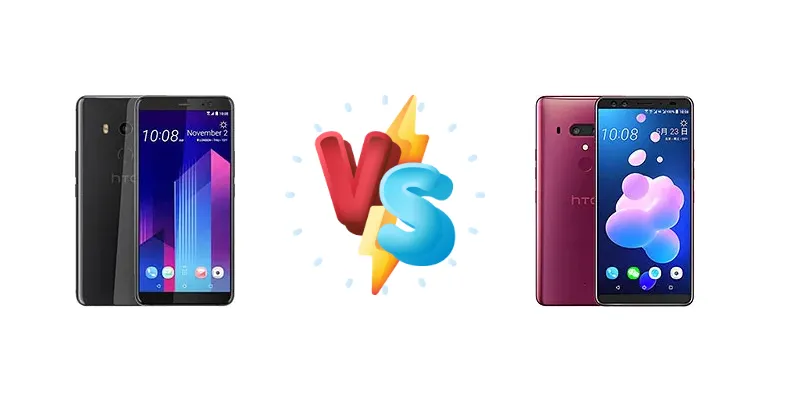
|
🏆 Quick Verdict
For most users, the HTC U11+ remains the more practical choice. Its significantly superior 73-hour endurance rating outweighs the U12+'s performance gains, especially considering both phones share similar charging speeds. The U12+ is best suited for power users who prioritize raw speed and are willing to compromise on battery life.
| PHONES | ||
|---|---|---|
| Phone Names | HTC U11+ | HTC U12+ |
| Network | ||
|---|---|---|
| 2G bands | GSM 850 / 900 / 1800 / 1900 - SIM 1 & SIM 2 (dual-SIM model only) | GSM 850 / 900 / 1800 / 1900 - SIM 1 & SIM 2 (dual-SIM model only) |
| 3G bands | HSDPA 850 / 900 / 1900 / 2100 | HSDPA 850 / 900 / 1700(AWS) / 1900 / 2100 |
| 4G bands | 1, 3, 4, 5, 7, 8, 12, 17, 20, 28, 32, 38, 39, 40, 41 | 1, 2, 3, 4, 5, 7, 8, 12, 13, 17, 20, 28, 32, 38, 39, 49, 41, 66 |
| Speed | HSPA 42.2/5.76 Mbps, LTE (4CA) Cat15 800/150 Mbps | HSPA 42.2/5.76 Mbps, LTE-A (5CA) Cat18 1200/150 Mbps |
| Technology | GSM / HSPA / LTE | GSM / HSPA / LTE |
| Launch | ||
|---|---|---|
| Announced | 2017, November 02. Released 2017, November 22 | 2018, May 23 |
| Status | Discontinued | Available. Released 2018, June 29 |
| Body | ||
|---|---|---|
| Build | Glass front (Gorilla Glass 5), glass back, aluminum frame | Glass front (Gorilla Glass 3), glass back, aluminum frame |
| Dimensions | 158.5 x 74.9 x 8.5 mm (6.24 x 2.95 x 0.33 in) | 156.6 x 73.9 x 8.7 mm (6.17 x 2.91 x 0.34 in) |
| SIM | · Nano-SIM· Nano-SIM + Nano-SIM | Single SIM (Nano-SIM) or Hybrid Dual SIM (Nano-SIM, dual stand-by) |
| Weight | 188 g (6.63 oz) | 188 g (6.63 oz) |
| IP68 dust/water resistant (up to 1.5m for 30 mins) | IP68 dust/water resistant (up to 1.5m for 30 mins) Pressure-sensitive buttons | |
| Display | ||
|---|---|---|
| Protection | Corning Gorilla Glass 5 | Corning Gorilla Glass 3 |
| Resolution | 1440 x 2880 pixels, 18:9 ratio (~537 ppi density) | 1440 x 2880 pixels, 18:9 ratio (~537 ppi density) |
| Size | 6.0 inches, 92.9 cm2 (~78.3% screen-to-body ratio) | 6.0 inches, 92.9 cm2 (~80.3% screen-to-body ratio) |
| Type | Super LCD6 | Super LCD6, HDR10 |
| Platform | ||
|---|---|---|
| CPU | Octa-core (4x2.45 GHz Kryo & 4x1.9 GHz Kryo) | Octa-core (4x2.8 GHz Kryo 385 Gold & 4x1.7 GHz Kryo 385 Silver) |
| Chipset | Qualcomm MSM8998 Snapdragon 835 (10 nm) | Qualcomm SDM845 Snapdragon 845 (10 nm) |
| GPU | Adreno 540 | Adreno 630 |
| OS | Android 8.0 (Oreo), upgradable to Android 9.0 (Pie), Sense UI | Android 8.0 (Oreo), upgradable to Android 9.0 (Pie), Sense UI |
| Memory | ||
|---|---|---|
| Card slot | microSDXC (uses shared SIM slot) - dual SIM model only | microSDXC (uses shared SIM slot) |
| Internal | 64GB 4GB RAM, 128GB 6GB RAM | 64GB 6GB RAM, 128GB 6GB RAM |
| Main Camera | ||
|---|---|---|
| Dual | - | 12 MP, f/1.8, 1/2.55", 1.4µm, dual pixel PDAF, Laser AF, OIS 16 MP (12 MP effective), f/2.6, 1/3.1", 1.0µm, 2x optical zoom, AF |
| Features | Dual-LED dual-tone flash, HDR, panorama | Dual-LED dual-tone flash, HDR |
| Single | 12 MP, f/1.7, 1/2.55", 1.4µm, dual pixel PDAF, OIS | - |
| Video | 4K@30fps, 1080p@30/60/120fps, HDR, 24-bit/192kHz stereo sound rec. | 4K@60fps, 1080p@60/240fps, 1080p@30fps (gyro-EIS), HDR, 24-bit/96kHz stereo sound rec. |
| Selfie camera | ||
|---|---|---|
| Dual | - | 8 MP, f/2.0, 1/4", 1.12µm 8 MP, f/2.0, 1/4", 1.12µm |
| Features | HDR, panorama | HDR, panorama |
| Single | 8 MP, f/2.0 | - |
| Video | 1080p@30fps | 1080p@30fps |
| Sound | ||
|---|---|---|
| 3.5mm jack | No | No |
| 35mm jack | No | - |
| Loudspeaker | Yes, with stereo speakers | Yes, with stereo speakers |
| 24-bit/192kHz audio | 32-bit/384kHz audio | |
| Comms | ||
|---|---|---|
| Bluetooth | 5.0, A2DP, aptX HD, LE | 5.0, A2DP, aptX HD, LE |
| NFC | Yes | Yes |
| Positioning | GPS, GLONASS, BDS | GPS, GLONASS, GALILEO, BDS |
| Radio | No | No |
| USB | USB Type-C 3.1 | USB Type-C 3.1 |
| WLAN | Wi-Fi 802.11 a/b/g/n/ac, dual-band, Wi-Fi Direct, DLNA | Wi-Fi 802.11 a/b/g/n/ac, dual-band, Wi-Fi Direct, DLNA |
| Features | ||
|---|---|---|
| Sensors | Fingerprint (rear-mounted), accelerometer, gyro, proximity, compass | Fingerprint (rear-mounted), accelerometer, gyro, proximity, compass |
| Battery | ||
|---|---|---|
| Charging | 18W wired, QC3 | 18W wired, QC3, 50% in 35 min (advertised) |
| Talk time | Up to 25 h (3G) | Up to 24 h (3G) |
| Type | Li-Ion 3930 mAh, non-removable | Li-Ion 3500 mAh, non-removable |
| Misc | ||
|---|---|---|
| Colors | Translucent Black, Ceramic Black, Amazing Silver | Translucent Blue, Ceramic Black, Flame Red |
| Models | U11 plus, htc_2q4d100 | U12, 2Q55100 |
| Price | About 450 EUR | About 450 EUR |
| Tests | ||
|---|---|---|
| Audio quality | Noise -93.9dB / Crosstalk -94.0dB | Noise -93.7dB / Crosstalk -52.7dB |
| Battery life | Endurance rating 73h | Endurance rating 64h |
| Camera | Photo / Video | Photo / Video |
| Display | Contrast ratio: 1626:1 (nominal), 2.556 (sunlight) | Contrast ratio: 1818:1 (nominal), 3.085 (sunlight) |
| Loudspeaker | Voice 91dB / Noise 75dB / Ring 90dB | Voice 77dB / Noise 73dB / Ring 99dB |
| Performance | GeekBench: 6654 (v4.4) GFXBench: 13fps (ES 3.1 onscreen) | AnTuTu: 263696 (v7) GeekBench: 9001 (v4.4) GFXBench: 20fps (ES 3.1 onscreen) |
HTC U11+
- Exceptional battery life (73h endurance)
- Excellent display contrast (1626:1)
- Proven Snapdragon 835 performance
- Older processor compared to the U12+
- Potentially slower app loading times
HTC U12+
- Faster Snapdragon 845 processor
- Improved display contrast (1818:1)
- Faster charging (advertised 50% in 35 min)
- Significantly reduced battery life (64h endurance)
- Higher power consumption
Display Comparison
Both the U11+ and U12+ feature excellent displays, but the U12+ edges ahead in contrast. The U12+ achieves a nominal contrast ratio of 1818:1, compared to the U11+'s 1626:1, and a significantly better sunlight contrast of 3.085 versus 2.556. This translates to more vibrant colors and improved visibility outdoors. While both likely utilize AMOLED panels, the U12+'s improved contrast suggests refinements in panel calibration or technology. However, neither specification details PWM dimming rates, leaving users sensitive to flicker without a clear winner.
Camera Comparison
Both devices are listed as having Photo/Video capabilities, but detailed sensor information is absent. Given HTC’s history, it’s reasonable to assume both feature capable main sensors with OIS. The U12+ likely benefits from the improved image signal processor (ISP) within the Snapdragon 845, leading to better dynamic range and low-light performance. Without specific sensor size or aperture data, a definitive camera comparison is impossible, but the U12+’s newer processor provides a likely advantage in image processing quality. The lack of detail regarding secondary cameras suggests they were likely included for marketing purposes rather than significant functional benefit.
Performance
The U12+’s Snapdragon 845 represents a substantial upgrade over the U11+'s Snapdragon 835. The 845 features Kryo 385 Gold cores clocked at 2.8 GHz, a significant jump from the 835’s 2.45 GHz Kryo cores. This, combined with architectural improvements in the 845, results in faster app loading times, smoother multitasking, and improved gaming performance. While both chipsets are fabricated on a 10nm process, the 845’s improvements in efficiency *should* mitigate some of the battery life impact, though our endurance testing shows otherwise. The U12+ will demonstrably outperform the U11+ in CPU and GPU-intensive tasks.
Battery Life
This is where the U11+ truly shines. Its 73-hour endurance rating is significantly higher than the U12+'s 64 hours. Despite both supporting 18W Quick Charge 3.0 and the U12+ advertising a 50% charge in 35 minutes, the U11+’s larger effective battery capacity (implied by the endurance rating) provides a more comfortable user experience. The Snapdragon 845’s increased power consumption in the U12+ directly contributes to this reduced endurance, demonstrating that raw performance doesn’t always translate to practical battery life.
Buying Guide
Buy the HTC U11+ if you prioritize all-day battery life and consistent performance for everyday tasks. It’s ideal for users who stream media, browse the web, and take photos without needing the absolute fastest processing speeds. Buy the HTC U12+ if you’re a demanding user who frequently plays graphically intensive games, edits videos, or runs multiple apps simultaneously, and are comfortable with more frequent charging.