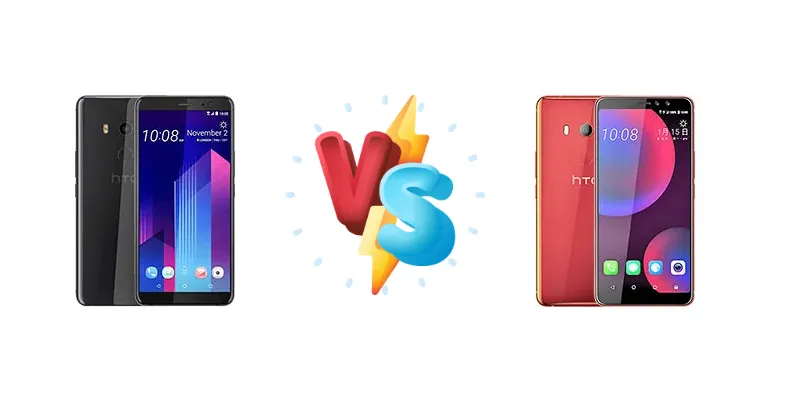
The HTC U11+ and U11 Eyes represent divergent strategies from HTC. The U11+ aimed for flagship status with top-tier specs, while the U11 Eyes targeted a more budget-conscious market. This comparison dissects the core differences, focusing on how the chipset choice impacts real-world performance and user experience.
🏆 Quick Verdict
For users prioritizing performance and a superior display, the HTC U11+ is the clear winner. Its Snapdragon 835 delivers significantly faster processing and graphics capabilities. However, the U11 Eyes offers a compelling value proposition for those seeking a functional HTC experience at a lower price point.
| Network |
|---|
| 2G bands | GSM 850 / 900 / 1800 / 1900 - SIM 1 & SIM 2 (dual-SIM model only) | GSM 850 / 900 / 1800 / 1900 - SIM 1 & SIM 2 |
| 3G bands | HSDPA 850 / 900 / 1900 / 2100 | HSDPA 850 / 900 / 1900 / 2100 |
| 4G bands | 1, 3, 4, 5, 7, 8, 12, 17, 20, 28, 32, 38, 39, 40, 41 | 1, 2, 3, 4, 5, 7, 8, 12, 17, 20, 28, 32 |
| Speed | HSPA 42.2/5.76 Mbps, LTE (4CA) Cat15 800/150 Mbps | HSPA 42.2/5.76 Mbps, LTE (2CA) Cat6 300/50 Mbps |
| Technology | GSM / HSPA / LTE | GSM / HSPA / LTE |
| Launch |
|---|
| Announced | 2017, November 02. Released 2017, November 22 | 2018, January. Released 2018, January |
| Status | Discontinued | Discontinued |
| Body |
|---|
| Build | Glass front (Gorilla Glass 5), glass back, aluminum frame | - |
| Dimensions | 158.5 x 74.9 x 8.5 mm (6.24 x 2.95 x 0.33 in) | 157.9 x 75 x 8.5 mm (6.22 x 2.95 x 0.33 in) |
| SIM | · Nano-SIM· Nano-SIM + Nano-SIM | Nano-SIM + Nano-SIM |
| Weight | 188 g (6.63 oz) | 185 g (6.53 oz) |
| | IP68 dust/water resistant (up to 1.5m for 30 mins) | IP67 dust/water resistant (up to 1m for 30 mins) |
| Display |
|---|
| Protection | Corning Gorilla Glass 5 | Corning Gorilla Glass 3 |
| Resolution | 1440 x 2880 pixels, 18:9 ratio (~537 ppi density) | 1080 x 2160 pixels, 18:9 ratio (~402 ppi density) |
| Size | 6.0 inches, 92.9 cm2 (~78.3% screen-to-body ratio) | 6.0 inches, 92.9 cm2 (~78.4% screen-to-body ratio) |
| Type | Super LCD6 | Super LCD3 |
| Platform |
|---|
| CPU | Octa-core (4x2.45 GHz Kryo & 4x1.9 GHz Kryo) | Octa-core |
| Chipset | Qualcomm MSM8998 Snapdragon 835 (10 nm) | Qualcomm MSM8976 Snapdragon 652 (28 nm) |
| GPU | Adreno 540 | Adreno 510 |
| OS | Android 8.0 (Oreo), upgradable to Android 9.0 (Pie), Sense UI | Android 8.0 (Oreo), Sense UI |
| Memory |
|---|
| Card slot | microSDXC (uses shared SIM slot) - dual SIM model only | microSDXC (uses shared SIM slot) |
| Internal | 64GB 4GB RAM, 128GB 6GB RAM | 64GB 4GB RAM |
| | - | eMMC 5.1 |
| Main Camera |
|---|
| Features | Dual-LED dual-tone flash, HDR, panorama | Dual-LED dual-tone flash, HDR, panorama |
| Single | 12 MP, f/1.7, 1/2.55", 1.4µm, dual pixel PDAF, OIS | 12 MP, f/1.7, 1.4 μm, PDAF, OIS |
| Video | 4K@30fps, 1080p@30/60/120fps, HDR, 24-bit/192kHz stereo sound rec. | 4K@30fps, 1080p@120fps |
| Selfie camera |
|---|
| Dual | - | 5 MP, f/2.2
5 MP |
| Features | HDR, panorama | - |
| Single | 8 MP, f/2.0 | - |
| Video | 1080p@30fps | 1080p@30fps |
| Sound |
|---|
| 3.5mm jack | No | No |
| 35mm jack | No | No |
| Loudspeaker | Yes, with stereo speakers | Yes |
| | 24-bit/192kHz audio
| 24-bit/192kHz audio
|
| Comms |
|---|
| Bluetooth | 5.0, A2DP, aptX HD, LE | 4.2, A2DP, LE |
| NFC | Yes | Yes |
| Positioning | GPS, GLONASS, BDS | GPS, GLONASS, BDS |
| Radio | No | No |
| USB | USB Type-C 3.1 | USB Type-C 2.0 |
| WLAN | Wi-Fi 802.11 a/b/g/n/ac, dual-band, Wi-Fi Direct, DLNA | Wi-Fi 802.11 a/b/g/n/ac, dual-band, Wi-Fi Direct, DLNA |
| Features |
|---|
| Sensors | Fingerprint (rear-mounted), accelerometer, gyro, proximity, compass | Fingerprint (rear-mounted), accelerometer, gyro, proximity, compass |
| Battery |
|---|
| Charging | 18W wired, QC3 | 18W wired, QC3 |
| Talk time | Up to 25 h (3G) | - |
| Type | Li-Ion 3930 mAh, non-removable | Li-Ion 3930 mAh, non-removable |
| Misc |
|---|
| Colors | Translucent Black, Ceramic Black, Amazing Silver | Black, Red, Blue |
| Models | U11 plus, htc_2q4d100 | 2Q4R100 |
| Price | About 450 EUR | About 300 EUR |
| Tests |
|---|
| Audio quality |
Noise -93.9dB / Crosstalk -94.0dB | - |
| Battery life | Endurance rating 73h | - |
| Camera |
Photo / Video | - |
| Display |
Contrast ratio: 1626:1 (nominal), 2.556 (sunlight) | - |
| Loudspeaker |
Voice 91dB / Noise 75dB / Ring 90dB | - |
| Performance |
GeekBench: 6654 (v4.4)
GFXBench: 13fps (ES 3.1 onscreen) | - |
HTC U11+
- Significantly faster processor for demanding tasks
- Superior display quality and color accuracy
- Faster charging with Quick Charge 3.0
- Likely higher price point
- Potentially larger and heavier build
HTC U11 Eyes
- More affordable price
- Potentially longer battery life in light usage
- Compact and lightweight design (assumed)
- Noticeably slower performance
- Less capable camera system
- Less efficient chipset leading to potential throttling
Display Comparison
Both devices share an 18:9 aspect ratio, but the U11+ boasts a significantly superior display experience. While both feature a contrast ratio of 1626:1 (nominal) and 2.556 (sunlight), the U11+’s panel likely benefits from the more powerful image signal processor in the Snapdragon 835, resulting in more accurate color reproduction. The U11 Eyes, lacking detailed display specifications, likely utilizes a less advanced panel, impacting color vibrancy and viewing angles.
Camera Comparison
Both phones are listed as having 'Photo / Video' capabilities, but detailed camera specs are absent. Given the U11+'s flagship positioning, it likely features a more advanced camera system with a larger sensor and improved image stabilization. The Snapdragon 835’s superior image signal processor (ISP) would also contribute to better image quality, particularly in low-light conditions. The U11 Eyes, constrained by its lower-tier chipset, likely has a more basic camera setup focused on everyday snapshots.
Performance
The core difference lies in the chipsets. The HTC U11+ is powered by the Qualcomm MSM8998 Snapdragon 835 (10nm), an octa-core processor built on a smaller, more efficient manufacturing process. This translates to higher clock speeds (up to 2.45 GHz) and improved thermal management compared to the U11 Eyes’ Qualcomm MSM8976 Snapdragon 652 (28nm). The 28nm process of the Snapdragon 652 is significantly less efficient, meaning the U11 Eyes will likely experience more throttling under sustained load. This difference is critical for gamers and power users.
Battery Life
The HTC U11+ achieves an endurance rating of 73 hours, indicating excellent battery life. While the U11 Eyes’ battery life isn’t specified, the less power-hungry Snapdragon 652 could potentially offer comparable or even slightly better endurance in light usage scenarios. However, the U11+'s 18W Quick Charge 3.0 support ensures faster charging times, mitigating any potential battery life disadvantage. Both devices share the same charging technology, but the U11+’s larger battery will take longer to fully replenish.
Buying Guide
Buy the HTC U11+ if you need a phone capable of handling demanding tasks like gaming, video editing, or running multiple apps simultaneously. Its superior chipset and display will provide a smoother, more responsive experience. Buy the HTC U11 Eyes if you prioritize battery life and a lower price tag, and your usage primarily revolves around basic communication, social media, and light web browsing. It's a solid option for users who don't require cutting-edge performance.
Frequently Asked Questions
❓ Will the Snapdragon 652 in the U11 Eyes struggle with modern mobile games?
Yes, the Snapdragon 652 is a mid-range chipset that will likely struggle with graphically demanding games at higher settings. You may need to lower graphics settings and resolution to achieve playable frame rates. The U11+ with its Snapdragon 835 will provide a much smoother gaming experience.
❓ Does the HTC U11+ offer any significant advantages for video recording compared to the U11 Eyes?
The HTC U11+ benefits from the Snapdragon 835’s advanced image signal processor, which provides superior video stabilization and dynamic range. This results in clearer, more professional-looking videos, especially in challenging lighting conditions. The U11 Eyes will likely produce adequate video, but it won't match the quality of the U11+.
❓ How does the 28nm process of the Snapdragon 652 affect the U11 Eyes' long-term performance?
The 28nm process is less efficient than the 10nm process used in the Snapdragon 835. This means the U11 Eyes will generate more heat under load, potentially leading to performance throttling and a shorter lifespan for the chipset over time.