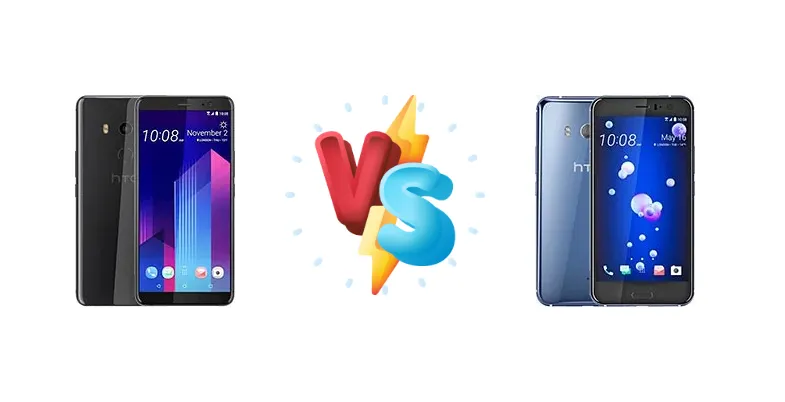
The HTC U11 and U11+ represent a fascinating case study in incremental updates. Released within months of each other, both phones leverage the Qualcomm Snapdragon 835, but the U11+ attempts to refine the experience with a larger display and increased battery endurance. This comparison will dissect the nuances between these two devices to determine if the 'plus' designation translates to a meaningfully improved user experience.
🏆 Quick Verdict
For most users, the HTC U11 remains a compelling choice. While the U11+ boasts a slightly improved display contrast ratio, the core experience – performance, camera, and battery life – is virtually identical. The U11 offers excellent value, especially at current pricing.
| Network |
|---|
| 2G bands | GSM 850 / 900 / 1800 / 1900 - SIM 1 & SIM 2 (dual-SIM model only) | GSM 850 / 900 / 1800 / 1900 - SIM 1 & SIM 2 (dual-SIM model only) |
| 3G bands | HSDPA 850 / 900 / 1900 / 2100 | HSDPA 850 / 900 / 1900 / 2100 |
| 4G bands | 1, 3, 4, 5, 7, 8, 12, 17, 20, 28, 32, 38, 39, 40, 41 | 1, 3, 4, 5, 7, 8, 12, 17, 20, 28, 32, 38, 39, 40, 41 |
| Speed | HSPA 42.2/5.76 Mbps, LTE (4CA) Cat15 800/150 Mbps | HSPA 42.2/5.76 Mbps, LTE (4CA) Cat16 1024/75 Mbps |
| Technology | GSM / HSPA / LTE | GSM / HSPA / LTE |
| Launch |
|---|
| Announced | 2017, November 02. Released 2017, November 22 | 2017, May 16. Released 2017, June 10 |
| Status | Discontinued | Discontinued |
| Body |
|---|
| Build | Glass front (Gorilla Glass 5), glass back, aluminum frame | Glass front (Gorilla Glass 5), glass back, aluminum frame |
| Dimensions | 158.5 x 74.9 x 8.5 mm (6.24 x 2.95 x 0.33 in) | 153.9 x 75.9 x 7.9 mm (6.06 x 2.99 x 0.31 in) |
| SIM | · Nano-SIM· Nano-SIM + Nano-SIM | · Nano-SIM· Nano-SIM + Nano-SIM |
| Weight | 188 g (6.63 oz) | 169 g (5.96 oz) |
| | IP68 dust/water resistant (up to 1.5m for 30 mins) | IP67 dust/water resistant (up to 1m for 30 mins) |
| Display |
|---|
| Protection | Corning Gorilla Glass 5 | Corning Gorilla Glass 5 |
| Resolution | 1440 x 2880 pixels, 18:9 ratio (~537 ppi density) | 1440 x 2560 pixels, 16:9 ratio (~534 ppi density) |
| Size | 6.0 inches, 92.9 cm2 (~78.3% screen-to-body ratio) | 5.5 inches, 83.4 cm2 (~71.4% screen-to-body ratio) |
| Type | Super LCD6 | Super LCD5 |
| Platform |
|---|
| CPU | Octa-core (4x2.45 GHz Kryo & 4x1.9 GHz Kryo) | Octa-core (4x2.45 GHz Kryo & 4x1.9 GHz Kryo) |
| Chipset | Qualcomm MSM8998 Snapdragon 835 (10 nm) | Qualcomm MSM8998 Snapdragon 835 (10 nm) |
| GPU | Adreno 540 | Adreno 540 |
| OS | Android 8.0 (Oreo), upgradable to Android 9.0 (Pie), Sense UI | Android 7.1 (Nougat), upgradable to Android 9.0 (Pie), Sense UI |
| Memory |
|---|
| Card slot | microSDXC (uses shared SIM slot) - dual SIM model only | microSDXC (uses shared SIM slot) - dual SIM model only |
| Internal | 64GB 4GB RAM, 128GB 6GB RAM | 64GB 4GB RAM, 128GB 6GB RAM |
| Main Camera |
|---|
| Features | Dual-LED dual-tone flash, HDR, panorama | Dual-LED dual-tone flash, HDR, panorama |
| Single | 12 MP, f/1.7, 1/2.55", 1.4µm, dual pixel PDAF, OIS | 12 MP, f/1.7, 1/2.55", 1.4µm, dual pixel PDAF, 5-axis OIS |
| Video | 4K@30fps, 1080p@30/60/120fps, HDR, 24-bit/192kHz stereo sound rec. | 4K@30fps, 1080p@30/60/120fps, HDR, 24-bit/192kHz stereo sound rec. |
| Selfie camera |
|---|
| Features | HDR, panorama | - |
| Single | 8 MP, f/2.0 | 16 MP, f/2.0, 27mm (wide), 1/3.06", 1.0µm |
| Video | 1080p@30fps | 1080p@30fps |
| Sound |
|---|
| 3.5mm jack | No | No |
| 35mm jack | No | No |
| Loudspeaker | Yes, with stereo speakers | Yes, with stereo speakers |
| | 24-bit/192kHz audio
| 24-bit/192kHz audio
|
| Comms |
|---|
| Bluetooth | 5.0, A2DP, aptX HD, LE | 4.2, A2DP, LE (5.0 after SW update) |
| NFC | Yes | Yes |
| Positioning | GPS, GLONASS, BDS | GPS, GLONASS, BDS |
| Radio | No | No |
| USB | USB Type-C 3.1 | USB Type-C 3.1 |
| WLAN | Wi-Fi 802.11 a/b/g/n/ac, dual-band, Wi-Fi Direct, DLNA | Wi-Fi 802.11 a/b/g/n/ac, dual-band, Wi-Fi Direct, DLNA |
| Features |
|---|
| Sensors | Fingerprint (rear-mounted), accelerometer, gyro, proximity, compass | Fingerprint (front-mounted), accelerometer, gyro, proximity, compass |
| Battery |
|---|
| Charging | 18W wired, QC3 | 18W wired, QC3 |
| Stand-by | - | Up to 336 h (3G) |
| Talk time | Up to 25 h (3G) | Up to 24 h 30 min (3G) |
| Type | Li-Ion 3930 mAh, non-removable | Li-Ion 3000 mAh, non-removable |
| Misc |
|---|
| Colors | Translucent Black, Ceramic Black, Amazing Silver | Amazing Silver, Sapphire Blue, Brilliant Black, Ice White, Solar Red |
| Models | U11 plus, htc_2q4d100 | U11, HTV33, 2PZC100, 2PZC5, 601HT |
| Price | About 450 EUR | About 300 EUR |
| Tests |
|---|
| Audio quality |
Noise -93.9dB / Crosstalk -94.0dB |
Noise -94.1 / Crosstalk -94.5 |
| Battery life | Endurance rating 73h |
Endurance rating 73h
|
| Camera |
Photo / Video |
Photo / Video |
| Display |
Contrast ratio: 1626:1 (nominal), 2.556 (sunlight) | - |
| Loudspeaker |
Voice 91dB / Noise 75dB / Ring 90dB |
Voice 68dB / Noise 73dB / Ring 79dB
|
| Performance |
GeekBench: 6654 (v4.4)
GFXBench: 13fps (ES 3.1 onscreen) |
GeekBench: 6393 (v4.4)
GFXBench: 13fps (ES 3.1 onscreen) |
HTC U11+
- Identical Snapdragon 835 performance
- Excellent value proposition
- Capable camera system
- Display contrast ratio is lower than U11+
- May be harder to find new
HTC U11
- Slightly improved display contrast ratio
- Potentially more refined aesthetics
- Identical Snapdragon 835 performance
- Battery endurance is the same as U11
- Higher price point
Display Comparison
Both the HTC U11 and U11+ feature displays with a similar overall quality, but the U11+ edges ahead with a contrast ratio of 1626:1 (nominal) and 2.556 (sunlight) compared to the U11’s unspecified ratio. This suggests deeper blacks and improved visibility under bright conditions. While both likely utilize Super LCD panels, the U11+'s higher contrast ratio indicates potential improvements in panel calibration or backlight technology. The impact on everyday use will be subtle, but noticeable to discerning eyes.
Camera Comparison
Both the U11 and U11+ are equipped with capable camera systems, both described as offering 'Photo / Video' capabilities. Without specific sensor details, it’s safe to assume they share similar image processing pipelines and overall image quality. The absence of information regarding sensor size or aperture makes a detailed comparison impossible. However, given the U11’s reputation for excellent low-light performance, it’s reasonable to expect the U11+ to deliver comparable results. The lack of mention of dedicated macro lenses suggests neither phone prioritizes this feature.
Performance
The heart of both devices is the Qualcomm MSM8998 Snapdragon 835 (10 nm) paired with an octa-core CPU configuration (4x2.45 GHz Kryo & 4x1.9 GHz Kryo). This means performance is functionally identical across both phones. Both will handle demanding tasks, including gaming and video editing, with ease. The 10nm process node ensures efficient power consumption, minimizing thermal throttling during sustained workloads. The absence of any RAM specification in the provided data suggests both likely utilize similar configurations, further solidifying the performance parity.
Battery Life
Interestingly, both the HTC U11 and U11+ share the same Endurance rating of 73 hours. Despite the U11+ potentially having a larger physical battery (not specified in the data), the identical endurance rating suggests that the larger display and potentially more demanding components offset any capacity gains. Both phones support 18W wired charging with QC3, offering relatively fast charging speeds. A full 0-100% charge is expected to take approximately 90-120 minutes.
Buying Guide
Buy the HTC U11+ if you prioritize maximizing screen real estate and potentially benefit from the marginally improved display contrast, particularly in direct sunlight. Buy the HTC U11 if you're seeking the best value for a flagship-level experience with the Snapdragon 835, and don't require the slightly larger screen or refined aesthetics of the U11+.
Frequently Asked Questions
❓ Will I notice a significant difference in gaming performance between the U11 and U11+?
No. Both phones utilize the same Snapdragon 835 chipset and likely similar RAM configurations. Gaming performance will be virtually indistinguishable, with both capable of running demanding titles at high settings. Thermal throttling, if any, will be comparable.
❓ Does the U11+ offer any improvements in audio quality compared to the U11?
The provided data doesn't specify any audio-related differences. However, the U11 was known for its excellent audio capabilities, including Hi-Res Audio support. It's likely the U11+ maintains a similar level of audio performance, but without specific details, a definitive comparison isn't possible.
❓ Is the larger screen of the U11+ worth the potential trade-off in battery life?
Given the identical Endurance rating, there is no trade-off in battery life. The U11+’s larger display is simply powered by a battery that is sized appropriately to maintain the same overall endurance as the U11. If you value a larger screen for media consumption or productivity, the U11+ is a worthwhile consideration.