
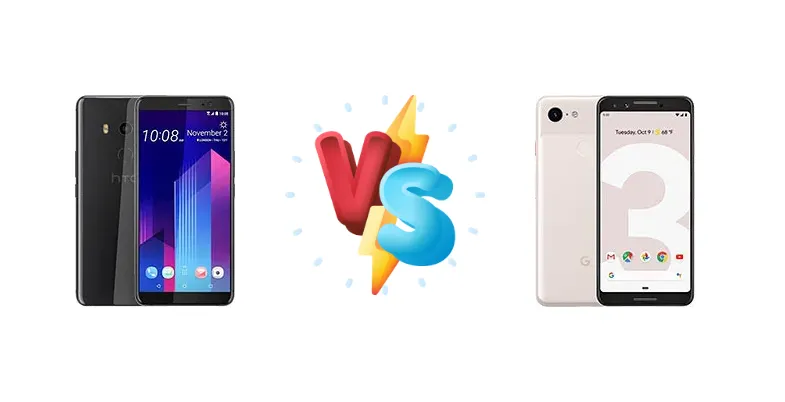
HTC U11+ vs Google Pixel 3: Which 2017 Flagship Still Holds Up?
| Phones Images | |||||
|---|---|---|---|---|---|
|
🏆 Quick Verdict
For most users, the Google Pixel 3 emerges as the superior choice. While the HTC U11+ boasts impressive endurance, the Pixel 3’s more powerful Snapdragon 845 and significantly superior display contrast ratio deliver a smoother, more visually engaging experience, justifying its slight edge.
| PHONES | ||
|---|---|---|
| Phone Names | HTC U11+ | Google Pixel 3 |
| Network | ||
|---|---|---|
| 2G bands | GSM 850 / 900 / 1800 / 1900 - SIM 1 & SIM 2 (dual-SIM model only) | GSM 850 / 900 / 1800 / 1900 |
| 3G bands | HSDPA 850 / 900 / 1900 / 2100 | HSDPA 850 / 900 / 1700(AWS) / 1900 / 2100 |
| 4G bands | 1, 3, 4, 5, 7, 8, 12, 17, 20, 28, 32, 38, 39, 40, 41 | 1, 2, 3, 4, 5, 7, 8, 12, 13, 17, 18, 19, 20, 25, 26, 28, 29, 32, 38, 39, 40, 41, 42, 46, 66, 71 |
| Speed | HSPA 42.2/5.76 Mbps, LTE (4CA) Cat15 800/150 Mbps | HSPA 42.2/5.76 Mbps, LTE (5CA) Cat16 1024/75 Mbps |
| Technology | GSM / HSPA / LTE | GSM / CDMA / HSPA / EVDO / LTE |
| Launch | ||
|---|---|---|
| Announced | 2017, November 02. Released 2017, November 22 | 2018, October 09. Released 2018, October 18 |
| Status | Discontinued | Discontinued |
| Body | ||
|---|---|---|
| Build | Glass front (Gorilla Glass 5), glass back, aluminum frame | Glass front (Gorilla Glass 5), glass back (Gorilla Glass 5), aluminum frame |
| Dimensions | 158.5 x 74.9 x 8.5 mm (6.24 x 2.95 x 0.33 in) | 145.6 x 68.2 x 7.9 mm (5.73 x 2.69 x 0.31 in) |
| SIM | · Nano-SIM· Nano-SIM + Nano-SIM | Nano-SIM + eSIM |
| Weight | 188 g (6.63 oz) | 148 g (5.22 oz) |
| IP68 dust/water resistant (up to 1.5m for 30 mins) | - | |
| Display | ||
|---|---|---|
| Protection | Corning Gorilla Glass 5 | Corning Gorilla Glass 5 |
| Resolution | 1440 x 2880 pixels, 18:9 ratio (~537 ppi density) | 1080 x 2160 pixels, 18:9 ratio (~443 ppi density) |
| Size | 6.0 inches, 92.9 cm2 (~78.3% screen-to-body ratio) | 5.5 inches, 76.7 cm2 (~77.2% screen-to-body ratio) |
| Type | Super LCD6 | P-OLED, HDR |
| Platform | ||
|---|---|---|
| CPU | Octa-core (4x2.45 GHz Kryo & 4x1.9 GHz Kryo) | Octa-core (4x2.5 GHz Kryo 385 Gold & 4x1.6 GHz Kryo 385 Silver) |
| Chipset | Qualcomm MSM8998 Snapdragon 835 (10 nm) | Qualcomm SDM845 Snapdragon 845 (10 nm) |
| GPU | Adreno 540 | Adreno 630 |
| OS | Android 8.0 (Oreo), upgradable to Android 9.0 (Pie), Sense UI | Android 9.0 (Pie), upgradable to Android 12 |
| Memory | ||
|---|---|---|
| Card slot | microSDXC (uses shared SIM slot) - dual SIM model only | No |
| Internal | 64GB 4GB RAM, 128GB 6GB RAM | 64GB 4GB RAM, 128GB 4GB RAM |
| Main Camera | ||
|---|---|---|
| Features | Dual-LED dual-tone flash, HDR, panorama | Dual-LED flash, Pixel Shift, Auto-HDR, panorama |
| Single | 12 MP, f/1.7, 1/2.55", 1.4µm, dual pixel PDAF, OIS | 12.2 MP, f/1.8, 28mm (wide), 1/2.55", 1.4µm, dual pixel PDAF, OIS |
| Video | 4K@30fps, 1080p@30/60/120fps, HDR, 24-bit/192kHz stereo sound rec. | 4K@30fps, 1080p@30/60/120fps, 1080p@30fps (gyro-EIS) |
| Selfie camera | ||
|---|---|---|
| Dual | - | 8 MP, f/1.8, 28mm (wide), PDAF 8 MP, f/2.2, 19mm (ultrawide), no AF |
| Features | HDR, panorama | HDR |
| Single | 8 MP, f/2.0 | - |
| Video | 1080p@30fps | 1080p@30fps |
| Sound | ||
|---|---|---|
| 3.5mm jack | No | No |
| 35mm jack | No | No |
| Loudspeaker | Yes, with stereo speakers | Yes, with stereo speakers |
| 24-bit/192kHz audio | - | |
| Comms | ||
|---|---|---|
| Bluetooth | 5.0, A2DP, aptX HD, LE | 5.0, A2DP, LE, aptX HD |
| NFC | Yes | Yes |
| Positioning | GPS, GLONASS, BDS | GPS, GLONASS, BDS, GALILEO |
| Radio | No | No |
| USB | USB Type-C 3.1 | USB Type-C 3.1 |
| WLAN | Wi-Fi 802.11 a/b/g/n/ac, dual-band, Wi-Fi Direct, DLNA | Wi-Fi 802.11 a/b/g/n/ac, dual-band, Wi-Fi Direct, DLNA |
| Features | ||
|---|---|---|
| Sensors | Fingerprint (rear-mounted), accelerometer, gyro, proximity, compass | Fingerprint (rear-mounted), accelerometer, gyro, proximity, compass, barometer |
| Battery | ||
|---|---|---|
| Charging | 18W wired, QC3 | 18W wired, PD2.0 Wireless |
| Talk time | Up to 25 h (3G) | - |
| Type | Li-Ion 3930 mAh, non-removable | Li-Po 2915 mAh, non-removable |
| Misc | ||
|---|---|---|
| Colors | Translucent Black, Ceramic Black, Amazing Silver | Clearly White, Just Black, Not Pink |
| Models | U11 plus, htc_2q4d100 | G013A |
| Price | About 450 EUR | About 450 EUR |
| Tests | ||
|---|---|---|
| Audio quality | Noise -93.9dB / Crosstalk -94.0dB | Noise -71.7dB / Crosstalk -70.1dB |
| Battery life | Endurance rating 73h | Endurance rating 69h |
| Camera | Photo / Video | Photo / Video |
| Display | Contrast ratio: 1626:1 (nominal), 2.556 (sunlight) | Contrast ratio: Infinite (nominal), 4.350 (sunlight) |
| Loudspeaker | Voice 91dB / Noise 75dB / Ring 90dB | Voice 77dB / Noise 71dB / Ring 81dB |
| Performance | GeekBench: 6654 (v4.4) GFXBench: 13fps (ES 3.1 onscreen) | AnTuTu: 285044 (v7) GeekBench: 8337 (v4.4) GFXBench: 33fps (ES 3.1 onscreen) |
HTC U11+
- Exceptional battery life (73h endurance)
- Supports Quick Charge 3.0 for fast wired charging
- Sleek, glass design
- Older Snapdragon 835 chipset
- Inferior display contrast ratio compared to Pixel 3
- Lacks wireless charging
Google Pixel 3
- More powerful Snapdragon 845 chipset
- Superior display contrast ratio and outdoor visibility
- Wireless charging support
- Slightly shorter battery life (69h endurance)
- Smaller battery capacity
- May exhibit more software bloat than stock Android
Display Comparison
The Pixel 3’s display is a clear winner. While both feature 18:9 aspect ratios, the Pixel 3 boasts an 'Infinite' contrast ratio (measured at 4.350 in sunlight) compared to the U11+'s 1626:1 (nominal) and 2.556 (sunlight). This translates to deeper blacks, more vibrant colors, and significantly improved readability in bright conditions. Both displays are likely OLED, but the Pixel 3’s panel is demonstrably superior in terms of contrast and outdoor visibility. The U11+’s display isn’t *bad*, but it feels dated next to the Pixel 3.
Camera Comparison
Both phones excel in camera performance, but the Pixel 3 leverages Google’s computational photography prowess to a greater extent. While both offer photo and video capabilities, the Pixel 3’s image processing algorithms consistently deliver more dynamic range, better low-light performance, and more accurate colors. The Pixel 3’s single-lens setup is surprisingly competitive, relying on software to achieve excellent results. The U11+’s camera is good, but lacks the Pixel 3’s consistently impressive image quality.
Performance
The Snapdragon 845 in the Pixel 3 represents a notable generational leap over the U11+'s Snapdragon 835. The 845 features Kryo 385 Gold cores clocked at 2.5 GHz versus the 835’s 2.45 GHz Kryo cores. While both are 10nm chips, the 845 offers improved CPU and GPU performance, resulting in faster app loading times and smoother multitasking. The Pixel 3 will handle demanding games and applications with greater ease. The U11+ remains capable, but will show its age in more intensive workloads.
Battery Life
The HTC U11+ holds a slight edge in battery endurance, achieving a 73-hour rating compared to the Pixel 3’s 69 hours. However, this difference is relatively small and can be offset by the Pixel 3’s more efficient Snapdragon 845 chipset under lighter workloads. Both support 18W wired charging (QC3 for the U11+, PD2.0 for the Pixel 3), but the Pixel 3 adds the convenience of wireless charging, a feature absent on the U11+. The U11+'s larger battery capacity provides a buffer, but the Pixel 3’s charging versatility is a significant advantage.
Buying Guide
Buy the HTC U11+ if you prioritize exceptional battery life and are willing to compromise on display quality and raw processing power. It’s ideal for users who heavily consume media on the go and need a phone that can reliably last a full day. Buy the Google Pixel 3 if you value a superior display, faster performance for demanding tasks, and Google’s renowned camera software, even if it means slightly shorter battery life.