
HTC U11+ vs. Google Pixel 2 XL: A Detailed Comparison of Flagship Android Phones
| Phones Images | |||||
|---|---|---|---|---|---|
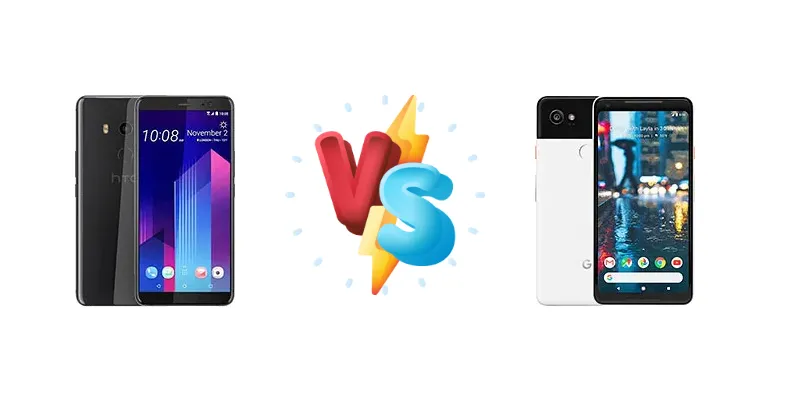
|
🏆 Quick Verdict
For the average user prioritizing longevity and a consistently excellent camera experience, the Google Pixel 2 XL emerges as the better choice. Its superior battery endurance (88h vs 73h) and renowned image processing outweigh the U11+'s higher nominal display contrast.
| PHONES | ||
|---|---|---|
| Phone Names | HTC U11+ | Google Pixel 2 XL |
| Network | ||
|---|---|---|
| 2G bands | GSM 850 / 900 / 1800 / 1900 - SIM 1 & SIM 2 (dual-SIM model only) | GSM 850 / 900 / 1800 / 1900 |
| 3G bands | HSDPA 850 / 900 / 1900 / 2100 | HSDPA 850 / 900 / 1700(AWS) / 1900 / 2100 |
| 4G bands | 1, 3, 4, 5, 7, 8, 12, 17, 20, 28, 32, 38, 39, 40, 41 | 1, 2, 3, 4, 5, 7, 8, 12, 13, 17, 20, 25, 26, 28, 29, 30, 32, 38, 40, 41, 66 |
| Speed | HSPA 42.2/5.76 Mbps, LTE (4CA) Cat15 800/150 Mbps | HSPA 42.2/5.76 Mbps, LTE (3CA) Cat15 800/75 Mbps |
| Technology | GSM / HSPA / LTE | GSM / CDMA / HSPA / EVDO / LTE |
| Launch | ||
|---|---|---|
| Announced | 2017, November 02. Released 2017, November 22 | 2017, October 04. Released 2017, October 17 |
| Status | Discontinued | Discontinued |
| Body | ||
|---|---|---|
| Build | Glass front (Gorilla Glass 5), glass back, aluminum frame | Glass front (Gorilla Glass 5), aluminum/glass back, aluminum frame |
| Dimensions | 158.5 x 74.9 x 8.5 mm (6.24 x 2.95 x 0.33 in) | 157.9 x 76.7 x 7.9 mm (6.22 x 3.02 x 0.31 in) |
| SIM | · Nano-SIM· Nano-SIM + Nano-SIM | Nano-SIM + eSIM |
| Weight | 188 g (6.63 oz) | 175 g (6.17 oz) |
| IP68 dust/water resistant (up to 1.5m for 30 mins) | - | |
| Display | ||
|---|---|---|
| Protection | Corning Gorilla Glass 5 | Corning Gorilla Glass 5 |
| Resolution | 1440 x 2880 pixels, 18:9 ratio (~537 ppi density) | 1440 x 2880 pixels, 18:9 ratio (~538 ppi density) |
| Size | 6.0 inches, 92.9 cm2 (~78.3% screen-to-body ratio) | 6.0 inches, 92.6 cm2 (~76.4% screen-to-body ratio) |
| Type | Super LCD6 | P-OLED |
| Platform | ||
|---|---|---|
| CPU | Octa-core (4x2.45 GHz Kryo & 4x1.9 GHz Kryo) | Octa-core (4x2.35 GHz Kryo & 4x1.9 GHz Kryo) |
| Chipset | Qualcomm MSM8998 Snapdragon 835 (10 nm) | Qualcomm MSM8998 Snapdragon 835 (10 nm) |
| GPU | Adreno 540 | Adreno 540 |
| OS | Android 8.0 (Oreo), upgradable to Android 9.0 (Pie), Sense UI | Android 8.0 (Oreo), upgradable to Android 11 |
| Memory | ||
|---|---|---|
| Card slot | microSDXC (uses shared SIM slot) - dual SIM model only | No |
| Internal | 64GB 4GB RAM, 128GB 6GB RAM | 64GB 4GB RAM, 128GB 4GB RAM |
| Main Camera | ||
|---|---|---|
| Features | Dual-LED dual-tone flash, HDR, panorama | Laser AF, Dual-LED flash, HDR, panorama |
| Single | 12 MP, f/1.7, 1/2.55", 1.4µm, dual pixel PDAF, OIS | 12.2 MP, f/1.8, 27mm (wide), 1/2.55", 1.4µm, dual pixel PDAF, OIS |
| Video | 4K@30fps, 1080p@30/60/120fps, HDR, 24-bit/192kHz stereo sound rec. | 4K@30fps (gyro-EIS), 1080p@30/60/120fps (gyro-EIS), 720p@240fps (gyro-EIS) |
| Selfie camera | ||
|---|---|---|
| Features | HDR, panorama | HDR |
| Single | 8 MP, f/2.0 | 8 MP, f/2.4, 25mm (wide), 1/3.2", 1.4µm |
| Video | 1080p@30fps | 1080p@30fps |
| Sound | ||
|---|---|---|
| 3.5mm jack | No | No |
| 35mm jack | No | No |
| Loudspeaker | Yes, with stereo speakers | Yes, with stereo speakers |
| 24-bit/192kHz audio | - | |
| Comms | ||
|---|---|---|
| Bluetooth | 5.0, A2DP, aptX HD, LE | 5.0, A2DP, LE, aptX HD |
| NFC | Yes | Yes |
| Positioning | GPS, GLONASS, BDS | GPS, GLONASS, BDS, GALILEO |
| Radio | No | No |
| USB | USB Type-C 3.1 | USB Type-C 3.1 |
| WLAN | Wi-Fi 802.11 a/b/g/n/ac, dual-band, Wi-Fi Direct, DLNA | Wi-Fi 802.11 a/b/g/n/ac, dual-band, Wi-Fi Direct, DLNA |
| Features | ||
|---|---|---|
| Sensors | Fingerprint (rear-mounted), accelerometer, gyro, proximity, compass | Fingerprint (rear-mounted), accelerometer, gyro, proximity, compass, barometer |
| Battery | ||
|---|---|---|
| Charging | 18W wired, QC3 | 10.5W wired (capped), PD2.0 |
| Talk time | Up to 25 h (3G) | - |
| Type | Li-Ion 3930 mAh, non-removable | Li-Ion 3520 mAh, non-removable |
| Misc | ||
|---|---|---|
| Colors | Translucent Black, Ceramic Black, Amazing Silver | Just Black, Black & White |
| Models | U11 plus, htc_2q4d100 | G011C |
| Price | About 450 EUR | About 520 EUR |
| Tests | ||
|---|---|---|
| Audio quality | Noise -93.9dB / Crosstalk -94.0dB | Noise - 93.7 / Crosstalk - 79.7 |
| Battery life | Endurance rating 73h | Endurance rating 88h |
| Camera | Photo / Video | Photo / Video |
| Display | Contrast ratio: 1626:1 (nominal), 2.556 (sunlight) | Contrast ratio: ∞ |
| Loudspeaker | Voice 91dB / Noise 75dB / Ring 90dB | Voice 66dB / Noise 70dB / Ring 78dB |
| Performance | GeekBench: 6654 (v4.4) GFXBench: 13fps (ES 3.1 onscreen) | AnTuTu: 206711 (v7) GeekBench: 6055 (v4.4) GFXBench: 13fps (ES 3.1 onscreen) |
HTC U11+
- Faster wired charging (18W with QC3)
- Higher nominal display contrast ratio
- Slightly faster CPU clock speed
- Lower battery endurance (73h)
- Potentially less refined camera processing
Google Pixel 2 XL
- Superior battery life (88h endurance)
- Exceptional camera image processing
- Infinite display contrast ratio (OLED)
- Slower wired charging (10.5W, capped)
- Lower CPU clock speed
Display Comparison
Both the U11+ and Pixel 2 XL feature 6-inch displays powered by the Snapdragon 835, but their approaches differ. The U11+ boasts a nominal contrast ratio of 1626:1, peaking at 2556:1 in sunlight, suggesting deeper blacks and better visibility outdoors. However, the Pixel 2 XL’s display has an infinite contrast ratio, indicating a true black level achieved through its OLED panel. While the U11+ offers a quantifiable contrast advantage, the Pixel 2 XL’s OLED technology delivers superior color accuracy and viewing angles. The lack of specified refresh rates on either device means neither offers the smoothness of modern high-refresh displays.
Camera Comparison
Both phones feature capable camera systems, but Google’s computational photography prowess gives the Pixel 2 XL a significant edge. While both offer photo and video capabilities, the Pixel 2 XL’s image processing is renowned for its dynamic range and low-light performance. The U11+ likely relies more on hardware capabilities, while the Pixel 2 XL leverages software algorithms to enhance image quality. Sensor sizes and lens apertures are not specified in the provided data, making a direct hardware comparison difficult, but Google’s software advantage is a key differentiator.
Performance
Both devices are equipped with the Qualcomm MSM8998 Snapdragon 835 (10 nm) chipset, but the Pixel 2 XL’s CPU is clocked slightly lower at 2.35 GHz compared to the U11+'s 2.45 GHz. This difference is unlikely to be noticeable in everyday use. Both utilize an octa-core configuration (4x2.45 GHz Kryo & 4x1.9 GHz Kryo for the U11+, 4x2.35 GHz Kryo & 4x1.9 GHz Kryo for the Pixel 2 XL). The real-world performance will be largely dictated by software optimization and thermal management, areas where Google historically excels. Neither device specifies RAM speed, but both likely utilize LPDDR4X, standard for the time.
Battery Life
The Pixel 2 XL’s endurance rating of 88 hours significantly surpasses the U11+'s 73 hours, indicating a substantial advantage in battery life. This difference is likely due to a combination of software optimization and potentially more efficient power management. The U11+ supports 18W wired charging with Quick Charge 3.0, offering faster charging speeds than the Pixel 2 XL’s capped 10.5W charging with PD2.0. However, the Pixel 2 XL’s longer battery life may negate the need for frequent charging, making the slower charging speed less of a concern.
Buying Guide
Buy the HTC U11+ if you prioritize a higher contrast display for media consumption and value fast charging capabilities. It's a strong contender for users who frequently watch videos or game on their phones and need quick power top-ups. Buy the Google Pixel 2 XL if you prioritize exceptional camera performance, particularly in low-light conditions, and require the longest possible battery life between charges. It’s ideal for users who rely heavily on their phone throughout the day and want a hassle-free experience.