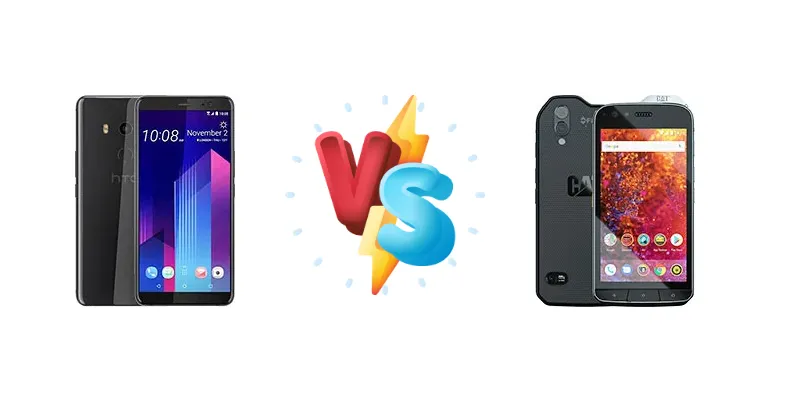
The HTC U11+ represented a peak in HTC's flagship ambitions, boasting a powerful Snapdragon 835. The Cat S61, however, prioritizes resilience and a rugged design. This comparison isn't about raw specs; it's about understanding which phone best suits your lifestyle – a power user demanding performance, or someone needing a device that can withstand harsh conditions.
🏆 Quick Verdict
For the average user prioritizing performance and a refined experience, the HTC U11+ is the clear winner. Its Snapdragon 835 offers significantly more processing power. However, if durability and a rugged form factor are paramount, the Cat S61 is the only viable option.
| Network |
|---|
| 2G bands | GSM 850 / 900 / 1800 / 1900 - SIM 1 & SIM 2 (dual-SIM model only) | GSM 850 / 900 / 1800 / 1900 |
| 3G bands | HSDPA 850 / 900 / 1900 / 2100 | HSDPA 850 / 900 / 1700 / 1900 / 2100 - EU/ROW |
| 4G bands | 1, 3, 4, 5, 7, 8, 12, 17, 20, 28, 32, 38, 39, 40, 41 | 1, 2, 3, 5, 7, 8, 19, 20, 26, 28, 38, 39, 40, 41 - EU/ROW |
| Speed | HSPA 42.2/5.76 Mbps, LTE (4CA) Cat15 800/150 Mbps | HSPA 42.2/5.76 Mbps, LTE (3CA) Cat12 600/150 Mbps |
| Technology | GSM / HSPA / LTE | GSM / HSPA / LTE |
| | - | 1, 2, 3, 4, 5, 7, 8, 12, 13, 17, 25, 26, 28, 29, 66 - USA |
| Launch |
|---|
| Announced | 2017, November 02. Released 2017, November 22 | 2018, February. Released 2018, June |
| Status | Discontinued | Discontinued |
| Body |
|---|
| Build | Glass front (Gorilla Glass 5), glass back, aluminum frame | Glass front (Gorilla Glass 5), plastic back, aluminum frame |
| Dimensions | 158.5 x 74.9 x 8.5 mm (6.24 x 2.95 x 0.33 in) | 163 x 78 x 13 mm (6.42 x 3.07 x 0.51 in) |
| SIM | · Nano-SIM· Nano-SIM + Nano-SIM | · Nano-SIM (South Africa only)· Nano-SIM + Nano-SIM |
| Weight | 188 g (6.63 oz) | 250 g (8.82 oz) |
| | IP68 dust/water resistant (up to 1.5m for 30 mins) | IP68 dust/water resistant (up to 3m for 60 min)
Drop-to-concrete resistance from up to 1.8m
MIL-STD-810G compliant |
| Display |
|---|
| Protection | Corning Gorilla Glass 5 | Corning Gorilla Glass 5 |
| Resolution | 1440 x 2880 pixels, 18:9 ratio (~537 ppi density) | 1080 x 1920 pixels, 16:9 ratio (~424 ppi density) |
| Size | 6.0 inches, 92.9 cm2 (~78.3% screen-to-body ratio) | 5.2 inches, 74.5 cm2 (~58.6% screen-to-body ratio) |
| Type | Super LCD6 | IPS LCD |
| Platform |
|---|
| CPU | Octa-core (4x2.45 GHz Kryo & 4x1.9 GHz Kryo) | Octa-core 2.2 GHz Cortex-A53 |
| Chipset | Qualcomm MSM8998 Snapdragon 835 (10 nm) | Qualcomm SDM630 Snapdragon 630 (14 nm) |
| GPU | Adreno 540 | Adreno 508 |
| OS | Android 8.0 (Oreo), upgradable to Android 9.0 (Pie), Sense UI | Android 8.0 (Oreo), upgradable to Android 9.0 (Pie) |
| Memory |
|---|
| Card slot | microSDXC (uses shared SIM slot) - dual SIM model only | microSDXC (uses shared SIM slot) |
| Internal | 64GB 4GB RAM, 128GB 6GB RAM | 64GB 4GB RAM |
| Main Camera |
|---|
| Features | Dual-LED dual-tone flash, HDR, panorama | Thermal imaging, heat palettes, temp. spot meter, dual-LED dual-tone flash, panorama |
| Single | 12 MP, f/1.7, 1/2.55", 1.4µm, dual pixel PDAF, OIS | 16 MP, PDAF, FLIR thermal camera (Lepton module) |
| Video | 4K@30fps, 1080p@30/60/120fps, HDR, 24-bit/192kHz stereo sound rec. | 4K@30fps, 1080p@30fps |
| Selfie camera |
|---|
| Features | HDR, panorama | - |
| Single | 8 MP, f/2.0 | 8 MP |
| Video | 1080p@30fps | 1080p@30fps |
| Sound |
|---|
| 3.5mm jack | No | Yes |
| 35mm jack | No | Yes |
| Loudspeaker | Yes, with stereo speakers | Yes |
| | 24-bit/192kHz audio
| - |
| Comms |
|---|
| Bluetooth | 5.0, A2DP, aptX HD, LE | 5.0, A2DP, LE |
| NFC | Yes | Yes |
| Positioning | GPS, GLONASS, BDS | GPS, GLONASS, GALILEO, QZSS, SBAS |
| Radio | No | FM radio |
| USB | USB Type-C 3.1 | USB Type-C 2.0, OTG |
| WLAN | Wi-Fi 802.11 a/b/g/n/ac, dual-band, Wi-Fi Direct, DLNA | Wi-Fi 802.11 a/b/g/n/ac, dual-band, Wi-Fi Direct |
| Features |
|---|
| Sensors | Fingerprint (rear-mounted), accelerometer, gyro, proximity, compass | Accelerometer, gyro, proximity, compass, barometer, indoor air quality sensor |
| | - | Laser-assisted distance measurement tool |
| Battery |
|---|
| Charging | 18W wired, QC3 | 18W wired, QC4 |
| Stand-by | - | Up to 888 h (3G) |
| Talk time | Up to 25 h (3G) | Up to 35 h (3G) |
| Type | Li-Ion 3930 mAh, non-removable | Li-Ion 4500 mAh, non-removable |
| Misc |
|---|
| Colors | Translucent Black, Ceramic Black, Amazing Silver | Black |
| Models | U11 plus, htc_2q4d100 | - |
| Price | About 450 EUR | About 900 EUR |
| Tests |
|---|
| Audio quality |
Noise -93.9dB / Crosstalk -94.0dB | - |
| Battery life | Endurance rating 73h | - |
| Camera |
Photo / Video | - |
| Display |
Contrast ratio: 1626:1 (nominal), 2.556 (sunlight) | - |
| Loudspeaker |
Voice 91dB / Noise 75dB / Ring 90dB | - |
| Performance |
GeekBench: 6654 (v4.4)
GFXBench: 13fps (ES 3.1 onscreen) | - |
HTC U11+
- Significantly faster processor for demanding tasks
- Superior display quality with high contrast ratios
- Faster overall system responsiveness
- Less durable build quality
- More susceptible to damage from drops and water
Cat S61
- Extremely rugged and durable design
- Quick Charge 4 support for potentially faster charging
- Designed for harsh environments
- Significantly slower processor
- Lower display quality
- Limited performance for demanding applications
Display Comparison
The HTC U11+ boasts a superior display experience, evidenced by its contrast ratios of 1626:1 (nominal) and 2.556 (sunlight). While the Cat S61's display specs are unavailable, its focus on ruggedness likely means a less vibrant, more utilitarian panel. The U11+'s higher contrast ratio translates to deeper blacks and more vivid colors, making it better for media consumption. Sunlight readability is also significantly improved, crucial for outdoor use where the Cat S61 might struggle.
Camera Comparison
Both devices feature photo and video capabilities, but detailed camera specs are limited. Given the U11+'s flagship status, it likely incorporates a more advanced camera system with a larger sensor and better image processing. The Cat S61’s camera is likely geared towards functional image capture rather than high-quality photography. Without specific sensor size or aperture information for either device, it’s difficult to make a precise comparison, but the U11+ is expected to deliver superior image quality in most scenarios.
Performance
The core difference lies in the chipsets. The HTC U11+ utilizes the Qualcomm MSM8998 Snapdragon 835 (10nm), an octa-core processor with a split core configuration (4x2.45 GHz Kryo & 4x1.9 GHz Kryo). This is a substantial leap over the Cat S61’s Qualcomm SDM630 Snapdragon 630 (14nm) with its octa-core 2.2 GHz Cortex-A53 CPUs. The 10nm process node of the Snapdragon 835 offers superior power efficiency and thermal performance, meaning the U11+ can sustain peak performance for longer periods without throttling. The U11+ will handle demanding games and applications with ease, while the S61 will likely exhibit noticeable slowdowns under heavy load.
Battery Life
The HTC U11+ achieves an endurance rating of 73 hours, a respectable figure. Both phones support 18W wired charging, but the Cat S61 utilizes Quick Charge 4 (QC4) while the U11+ uses Quick Charge 3 (QC3). QC4 is generally more efficient and can potentially offer slightly faster charging speeds, though the difference may be marginal. The U11+'s endurance rating suggests optimized power management despite the more powerful processor, but the Cat S61’s lower power chipset may offer comparable real-world battery life for less demanding users.
Buying Guide
Buy the HTC U11+ if you need a phone for demanding tasks like gaming, video editing, or running complex applications, and value a high-quality display and fast charging. Buy the Cat S61 if you work in construction, outdoor professions, or frequently find yourself in environments where a standard smartphone would be vulnerable to damage, and prioritize longevity over peak performance.
Frequently Asked Questions
❓ Does the Snapdragon 630 in the Cat S61 struggle with modern mobile games?
Yes, the Snapdragon 630 is a mid-range chipset and will likely exhibit noticeable lag and reduced frame rates in graphically demanding games. While it can handle less intensive titles, the U11+'s Snapdragon 835 provides a far smoother gaming experience.
❓ Is the Cat S61's ruggedness worth the trade-off in performance?
That depends entirely on your needs. If you work in a profession where your phone is likely to be exposed to harsh conditions (construction, field work, etc.), the S61's durability is a significant benefit. However, if you primarily use your phone for everyday tasks and entertainment, the U11+'s superior performance is a better choice.
❓ How much faster is Quick Charge 4 (QC4) on the Cat S61 compared to Quick Charge 3 (QC3) on the HTC U11+?
QC4 generally offers improved efficiency and can potentially charge slightly faster than QC3, but the difference in real-world charging times between these two devices is likely to be minimal, perhaps a 10-15 minute difference for a full charge.