
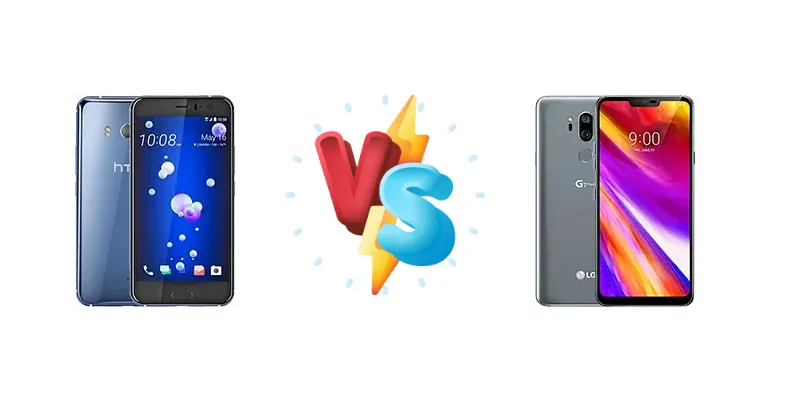
HTC U11 vs LG G7 ThinQ: A Deep Dive into Flagship Performance
| Phones Images | |||||
|---|---|---|---|---|---|
|
🏆 Quick Verdict
For the average user prioritizing sustained performance and slightly better battery life, the LG G7 ThinQ emerges as the winner. Its Snapdragon 845 chipset offers a noticeable performance uplift over the U11’s Snapdragon 835, and the G7’s display boasts superior sunlight readability. However, the U11 remains a viable option for those seeking a more compact form factor.
| PHONES | ||
|---|---|---|
| Phone Names | HTC U11 | LG G7 ThinQ |
| Network | ||
|---|---|---|
| 2G bands | GSM 850 / 900 / 1800 / 1900 - SIM 1 & SIM 2 (dual-SIM model only) | GSM 850 / 900 / 1800 / 1900 |
| 3G bands | HSDPA 850 / 900 / 1900 / 2100 | HSDPA 850 / 900 / 1900 / 2100 - Global |
| 4G bands | 1, 3, 4, 5, 7, 8, 12, 17, 20, 28, 32, 38, 39, 40, 41 | 1, 3, 4, 5, 7, 8, 12, 17, 20, 28, 32, 38, 40, 42, 46 - Global |
| Speed | HSPA 42.2/5.76 Mbps, LTE (4CA) Cat16 1024/75 Mbps | HSPA 42.2/5.76 Mbps, LTE (3CA) Cat16 1024/150 Mbps or Cat15 800/150 Mbps (region dependant) |
| Technology | GSM / HSPA / LTE | GSM / CDMA / HSPA / LTE |
| - | 1, 3, 5, 7, 8, 28, 38, 39, 40, 41 - G710EMW, G710EAW1,2,3,4,5,7,8,12,13,17,20,25,29,30,38,41,46,66 - G710AWM | |
| Launch | ||
|---|---|---|
| Announced | 2017, May 16. Released 2017, June 10 | 2018, May 02. Released 2018, June 01 |
| Status | Discontinued | Discontinued |
| Body | ||
|---|---|---|
| Build | Glass front (Gorilla Glass 5), glass back, aluminum frame | Glass front (Gorilla Glass 5), glass back (Gorilla Glass 5), aluminum frame |
| Dimensions | 153.9 x 75.9 x 7.9 mm (6.06 x 2.99 x 0.31 in) | 153.2 x 71.9 x 7.9 mm (6.03 x 2.83 x 0.31 in) |
| SIM | · Nano-SIM· Nano-SIM + Nano-SIM | · Nano-SIM· Nano-SIM + Nano-SIM |
| Weight | 169 g (5.96 oz) | 162 g (5.71 oz) |
| IP67 dust/water resistant (up to 1m for 30 mins) | IP68 dust/water resistant (up to 1.5m for 30 min) MIL-STD-810G compliant* *does not guarantee ruggedness or use in extreme conditions | |
| Display | ||
|---|---|---|
| Protection | Corning Gorilla Glass 5 | Corning Gorilla Glass 5 |
| Resolution | 1440 x 2560 pixels, 16:9 ratio (~534 ppi density) | 1440 x 3120 pixels, 19.5:9 ratio (~564 ppi density) |
| Size | 5.5 inches, 83.4 cm2 (~71.4% screen-to-body ratio) | 6.1 inches, 91.0 cm2 (~82.6% screen-to-body ratio) |
| Type | Super LCD5 | IPS LCD, HDR10 |
| - | Always-on display | |
| Platform | ||
|---|---|---|
| CPU | Octa-core (4x2.45 GHz Kryo & 4x1.9 GHz Kryo) | Octa-core (4x2.8 GHz Kryo 385 Gold & 4x1.7 GHz Kryo 385 Silver) |
| Chipset | Qualcomm MSM8998 Snapdragon 835 (10 nm) | Qualcomm SDM845 Snapdragon 845 (10 nm) |
| GPU | Adreno 540 | Adreno 630 |
| OS | Android 7.1 (Nougat), upgradable to Android 9.0 (Pie), Sense UI | Android 8.0 (Oreo), upgradable to Android 10 |
| Memory | ||
|---|---|---|
| Card slot | microSDXC (uses shared SIM slot) - dual SIM model only | microSDXC (dedicated slot) - single-SIM modelmicroSDXC (uses shared SIM slot) - dual-SIM model |
| Internal | 64GB 4GB RAM, 128GB 6GB RAM | 64GB 4GB RAM, 128GB 6GB RAM |
| - | UFS 2.1 | |
| Main Camera | ||
|---|---|---|
| Dual | - | 16 MP, f/1.6, 30mm (standard), 1/3.1", 1.0µm, PDAF, OIS 16 MP, f/1.9, 16mm (ultrawide), 1/3.1", no AF |
| Features | Dual-LED dual-tone flash, HDR, panorama | Laser AF, LED flash, HDR, panorama |
| Single | 12 MP, f/1.7, 1/2.55", 1.4µm, dual pixel PDAF, 5-axis OIS | - |
| Video | 4K@30fps, 1080p@30/60/120fps, HDR, 24-bit/192kHz stereo sound rec. | 4K@30/60fps, 1080p@30/60fps, 720p@240fps, HDR, 24-bit/192kHz stereo sound rec. |
| Selfie camera | ||
|---|---|---|
| Single | 16 MP, f/2.0, 27mm (wide), 1/3.06", 1.0µm | 8 MP, f/1.9, 26mm (wide) |
| Video | 1080p@30fps | 1080p@60fps |
| Sound | ||
|---|---|---|
| 3.5mm jack | No | Yes |
| 35mm jack | No | Yes |
| Loudspeaker | Yes, with stereo speakers | Yes |
| 24-bit/192kHz audio | 32-bit/192kHz audio | |
| Comms | ||
|---|---|---|
| Bluetooth | 4.2, A2DP, LE (5.0 after SW update) | 5.0, A2DP, LE, aptX HD |
| NFC | Yes | Yes |
| Positioning | GPS, GLONASS, BDS | GPS, GLONASS, BDS |
| Radio | No | FM radio |
| USB | USB Type-C 3.1 | USB Type-C 3.1, OTG |
| WLAN | Wi-Fi 802.11 a/b/g/n/ac, dual-band, Wi-Fi Direct, DLNA | Wi-Fi 802.11 a/b/g/n/ac, dual-band, Wi-Fi Direct, DLNA |
| Features | ||
|---|---|---|
| Sensors | Fingerprint (front-mounted), accelerometer, gyro, proximity, compass | Fingerprint (rear-mounted), accelerometer, gyro, proximity, compass, barometer |
| Battery | ||
|---|---|---|
| Charging | 18W wired, QC3 | 18W wired, QC3 Wireless (USA) |
| Stand-by | Up to 336 h (3G) | - |
| Talk time | Up to 24 h 30 min (3G) | - |
| Type | Li-Ion 3000 mAh, non-removable | Li-Po 3000 mAh, non-removable |
| Misc | ||
|---|---|---|
| Colors | Amazing Silver, Sapphire Blue, Brilliant Black, Ice White, Solar Red | New Platinum Gray, New Aurora Black, New Moroccan Blue, Raspberry Rose |
| Models | U11, HTV33, 2PZC100, 2PZC5, 601HT | LM-G710, LM-G710N, LM-G710VM, G710, SM-G710, LM-G710V |
| Price | About 300 EUR | About 370 EUR |
| SAR EU | - | 0.24 W/kg (head) 1.47 W/kg (body) |
| Tests | ||
|---|---|---|
| Audio quality | Noise -94.1 / Crosstalk -94.5 | Noise -94.0dB / Crosstalk -93.0dB |
| Battery life | Endurance rating 73h | Endurance rating 77h |
| Camera | Photo / Video | Photo / Video |
| Display | - | Contrast ratio: 2044:1 (nominal), 3.978 (sunlight) |
| Loudspeaker | Voice 68dB / Noise 73dB / Ring 79dB | -24.5 LUFS (Very good) |
| Performance | GeekBench: 6393 (v4.4) GFXBench: 13fps (ES 3.1 onscreen) | AnTuTu: 259393 (v7), 297116 (v8) GeekBench: 8865 (v4.4), 2047 (v5.1) GFXBench: 18fps (ES 3.1 onscreen) |
HTC U11
- Compact and ergonomic design
- Unique squeeze-to-launch feature
- Strong audio quality
- Older Snapdragon 835 chipset
- No wireless charging
- Less sunlight readable display
LG G7 ThinQ
- More powerful Snapdragon 845 chipset
- Superior sunlight readability
- Wireless charging (USA models)
- Larger form factor
- Potentially more prone to software bloat (LG history)
- AI camera features may be over-processed for some users
Display Comparison
The LG G7 ThinQ distinguishes itself with a contrast ratio of 2044:1 (nominal) and a significantly improved 3.978 contrast ratio in direct sunlight, making it far more usable outdoors. While both devices lack detailed display specs like peak brightness, the G7’s higher contrast ratio suggests a more vibrant and readable experience, particularly for users frequently exposed to bright environments. The U11’s display specs are not provided, making a direct comparison difficult, but the G7’s sunlight performance is a clear advantage.
Camera Comparison
Both the HTC U11 and LG G7 ThinQ offer capable photo and video recording, but detailed sensor information is lacking for both. Without specifics on sensor size or aperture, it’s difficult to declare a definitive winner. However, LG’s emphasis on AI-powered camera features in the G7 ThinQ suggests more sophisticated image processing algorithms, potentially leading to better dynamic range and low-light performance. The U11’s camera was well-regarded at launch, but the G7’s software enhancements likely provide an edge. We can assume both phones offer similar video capabilities given the chipsets.
Performance
The LG G7 ThinQ’s Snapdragon 845 (10nm) represents a generational leap over the HTC U11’s Snapdragon 835 (10nm). The 845 features Kryo 385 Gold cores clocked at 2.8 GHz, compared to the U11’s 2.45 GHz Kryo cores. This translates to a roughly 10-15% performance increase in CPU-intensive tasks and a more substantial improvement in GPU performance. Both utilize the same 10nm process, but the 845’s architectural improvements lead to better thermal efficiency, potentially reducing throttling during extended gaming sessions. The G7’s chipset is a clear win for power users.
Battery Life
The LG G7 ThinQ boasts a slightly better endurance rating of 77 hours compared to the HTC U11’s 73 hours. Both support 18W wired charging with Quick Charge 3.0, and the G7 ThinQ adds wireless charging (USA models only). While the difference in endurance isn’t massive, the G7’s combination of slightly larger battery capacity and more efficient chipset contributes to longer real-world usage. The addition of wireless charging on select G7 models adds a convenience factor the U11 lacks.
Buying Guide
Buy the HTC U11 if you prioritize a more compact flagship experience and appreciate its unique squeeze-to-launch functionality. It’s a good choice for users who value one-handed usability. Buy the LG G7 ThinQ if you prefer a larger display with excellent sunlight visibility, and demand the best possible performance from a Snapdragon 845 chipset for demanding applications and gaming.