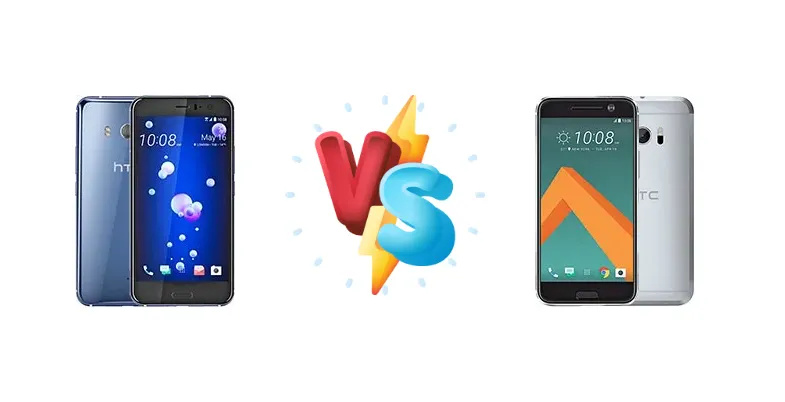
The HTC 10 represented a return to form for the Taiwanese manufacturer, but the HTC U11 arrived a year later with a significant chipset upgrade. This comparison dissects the differences between these two flagship devices, focusing on the real-world impact of the Snapdragon 835 in the U11 versus the Snapdragon 820 in the 10, and whether the newer model justifies the potential price premium.
🏆 Quick Verdict
For most users, the HTC U11 is the superior choice. The Snapdragon 835 offers a noticeable performance boost and improved power efficiency, translating to a smoother experience and slightly longer battery life. While the HTC 10 remains a capable device, the U11’s advancements make it the better long-term investment.
| Network |
|---|
| 2G bands | GSM 850 / 900 / 1800 / 1900 - SIM 1 & SIM 2 (dual-SIM model only) | GSM 850 / 900 / 1800 / 1900 |
| 3G bands | HSDPA 850 / 900 / 1900 / 2100 | HSDPA 850 / 900 / 1900 / 2100 |
| 4G bands | 1, 3, 4, 5, 7, 8, 12, 17, 20, 28, 32, 38, 39, 40, 41 | 1, 3, 5, 7, 8, 20, 28, 38, 40, 41 |
| Speed | HSPA 42.2/5.76 Mbps, LTE (4CA) Cat16 1024/75 Mbps | HSPA, LTE (3CA) Cat9 450/50 Mbps |
| Technology | GSM / HSPA / LTE | GSM / HSPA / LTE |
| Launch |
|---|
| Announced | 2017, May 16. Released 2017, June 10 | 2016, April 12. Released 2016, April 12 |
| Status | Discontinued | Discontinued |
| Body |
|---|
| Build | Glass front (Gorilla Glass 5), glass back, aluminum frame | Glass front (Gorilla Glass 3), aluminum back, aluminum frame |
| Dimensions | 153.9 x 75.9 x 7.9 mm (6.06 x 2.99 x 0.31 in) | 145.9 x 71.9 x 9 mm (5.74 x 2.83 x 0.35 in) |
| SIM | · Nano-SIM· Nano-SIM + Nano-SIM | Nano-SIM |
| Weight | 169 g (5.96 oz) | 161 g (5.68 oz) |
| | IP67 dust/water resistant (up to 1m for 30 mins) | - |
| Display |
|---|
| Protection | Corning Gorilla Glass 5 | Corning Gorilla Glass 3 |
| Resolution | 1440 x 2560 pixels, 16:9 ratio (~534 ppi density) | 1440 x 2560 pixels, 16:9 ratio (~565 ppi density) |
| Size | 5.5 inches, 83.4 cm2 (~71.4% screen-to-body ratio) | 5.2 inches, 74.5 cm2 (~71.1% screen-to-body ratio) |
| Type | Super LCD5 | Super LCD5 |
| Platform |
|---|
| CPU | Octa-core (4x2.45 GHz Kryo & 4x1.9 GHz Kryo) | Quad-core (2x2.15 GHz Kryo & 2x1.6 GHz Kryo) |
| Chipset | Qualcomm MSM8998 Snapdragon 835 (10 nm) | Qualcomm MSM8996 Snapdragon 820 (14 nm) |
| GPU | Adreno 540 | Adreno 530 |
| OS | Android 7.1 (Nougat), upgradable to Android 9.0 (Pie), Sense UI | Android 6.0.1 (Marshmallow), upgradable to Android 8.0 (Oreo), Sense UI |
| Memory |
|---|
| Card slot | microSDXC (uses shared SIM slot) - dual SIM model only | microSDXC (dedicated slot) |
| Internal | 64GB 4GB RAM, 128GB 6GB RAM | 32GB 4GB RAM, 64GB 4GB RAM |
| Main Camera |
|---|
| Features | Dual-LED dual-tone flash, HDR, panorama | Laser AF, Dual-LED dual-tone flash, HDR, panorama |
| Single | 12 MP, f/1.7, 1/2.55", 1.4µm, dual pixel PDAF, 5-axis OIS | 12 MP, f/1.8, 26mm (wide), 1/2.3", 1.55µm, OIS |
| Video | 4K@30fps, 1080p@30/60/120fps, HDR, 24-bit/192kHz stereo sound rec. | 4K@30fps, 720p@120fps, HDR, stereo sound rec. |
| Selfie camera |
|---|
| Features | - | HDR |
| Single | 16 MP, f/2.0, 27mm (wide), 1/3.06", 1.0µm | 5 MP, f/1.8, 23mm (wide), 1/4.1", 1.34µm, OIS, AF |
| Video | 1080p@30fps | 1080p@30fps |
| Sound |
|---|
| 3.5mm jack | No | Yes |
| 35mm jack | No | Yes |
| Loudspeaker | Yes, with stereo speakers | Yes, with stereo speakers |
| | 24-bit/192kHz audio
| 24-bit/192kHz audio
|
| Comms |
|---|
| Bluetooth | 4.2, A2DP, LE (5.0 after SW update) | 4.2, A2DP, aptX |
| NFC | Yes | Yes |
| Positioning | GPS, GLONASS, BDS | GPS, GLONASS/ BDS (region dependent) |
| Radio | No | No |
| USB | USB Type-C 3.1 | USB Type-C 3.1 |
| WLAN | Wi-Fi 802.11 a/b/g/n/ac, dual-band, Wi-Fi Direct, DLNA | Wi-Fi 802.11 a/b/g/n/ac, dual-band, Wi-Fi Direct, DLNA |
| Features |
|---|
| Sensors | Fingerprint (front-mounted), accelerometer, gyro, proximity, compass | Fingerprint (front-mounted), accelerometer, gyro, proximity, compass |
| Battery |
|---|
| Charging | 18W wired, QC3 | 18W wired, QC3, 50% in 30 min |
| Stand-by | Up to 336 h (3G) | Up to 456 h (3G) |
| Talk time | Up to 24 h 30 min (3G) | Up to 27 h (3G) |
| Type | Li-Ion 3000 mAh, non-removable | Li-Ion 3000 mAh, non-removable |
| Misc |
|---|
| Colors | Amazing Silver, Sapphire Blue, Brilliant Black, Ice White, Solar Red | Carbon Gray, Topaz Gold, Glacier Silver, Camellia Red |
| Models | U11, HTV33, 2PZC100, 2PZC5, 601HT | 10, M10h, HTC6545LVW, HTV32, 2PS64, 2PS6200 |
| Price | About 300 EUR | About 300 EUR |
| SAR | - | 0.47 W/kg (head) 0.64 W/kg (body) |
| Tests |
|---|
| Audio quality |
Noise -94.1 / Crosstalk -94.5 |
Noise -90.4dB / Crosstalk -87.3dB |
| Battery life |
Endurance rating 73h
|
Endurance rating 66h
|
| Camera |
Photo / Video |
Photo / Video |
| Loudspeaker |
Voice 68dB / Noise 73dB / Ring 79dB
|
Voice 65dB / Noise 62dB / Ring 63dB
|
| Performance |
GeekBench: 6393 (v4.4)
GFXBench: 13fps (ES 3.1 onscreen) |
Basemark OS II 2.0: 1839Basemark X: 28882 |
HTC U11
- Superior performance with Snapdragon 835
- Improved power efficiency and battery life
- Potentially better camera image processing
- Potentially higher price point
- May not offer a drastically different experience for basic users
HTC 10
- More affordable price
- Fast charging with Quick Charge 3.0
- Still a capable performer for everyday tasks
- Less powerful Snapdragon 820 chipset
- Shorter battery life compared to the U11
Display Comparison
Both devices feature 5.5-inch QHD displays, but detailed specifications regarding panel type (IPS vs AMOLED) and peak brightness are missing. However, the focus here is on the internal hardware. The U11 benefits from the more efficient Snapdragon 835, which reduces thermal load and potentially allows for sustained peak brightness for longer periods. While both likely offer excellent color accuracy for their time, the U11’s chipset provides a foundation for a more consistently vibrant viewing experience.
Camera Comparison
Both phones offer capable photo and video recording, but specifics regarding sensor size and aperture are absent. The U11’s image processing benefits from the more powerful ISP within the Snapdragon 835, potentially leading to better dynamic range and low-light performance. While both likely offer similar video capabilities, the 835’s enhanced processing power could result in more stable and detailed footage. The absence of detailed camera specs makes a definitive judgment difficult, but the chipset advantage favors the U11.
Performance
The core difference lies in the chipsets. The HTC U11’s Qualcomm MSM8998 Snapdragon 835 (10nm) is a significant leap over the HTC 10’s MSM8996 Snapdragon 820 (14nm). The 835 utilizes a more efficient manufacturing process, resulting in better thermal management and power efficiency. The U11’s octa-core CPU (4x2.45 GHz Kryo & 4x1.9 GHz Kryo) also outperforms the 10’s quad-core (2x2.15 GHz Kryo & 2x1.6 GHz Kryo) in both single-core and multi-core benchmarks. This translates to faster app loading times, smoother multitasking, and improved gaming performance on the U11.
Battery Life
The HTC U11 boasts an endurance rating of 73 hours, compared to the HTC 10’s 66 hours. While this doesn’t directly translate to real-world usage, it indicates the U11’s more efficient Snapdragon 835 contributes to longer battery life. Both devices support 18W wired charging with Quick Charge 3.0, with the HTC 10 claiming a 50% charge in 30 minutes. The U11’s improved efficiency likely results in a slightly faster overall charge time, despite the similar charging wattage.
Buying Guide
Buy the HTC U11 if you prioritize performance for demanding tasks like gaming or video editing, and value the slightly improved battery endurance. Buy the HTC 10 if you're on a tighter budget and still want a premium HTC experience with a solid camera and fast charging, accepting a slight performance compromise. The 10 is ideal for everyday tasks and media consumption.
Frequently Asked Questions
❓ Does the Snapdragon 820 in the HTC 10 still hold up for modern apps and games?
While the Snapdragon 820 was a flagship processor in its time, it will show its age with demanding games and resource-intensive applications. Expect some slowdowns and potential frame drops in newer titles compared to the U11’s Snapdragon 835. It’s perfectly adequate for everyday tasks like browsing, social media, and streaming.
❓ Is the difference in battery life between the U11 and 10 noticeable in real-world use?
Yes, the U11’s more efficient Snapdragon 835 and higher endurance rating translate to a tangible improvement in battery life. Users can expect to get through a full day of moderate use on the U11, while the HTC 10 might require a top-up charge in the evening, especially with heavier usage.
❓ Given the age of both phones, are software updates still available?
Software update support for both the HTC U11 and HTC 10 is likely limited or non-existent at this point. Both devices have reached the end of their official support lifecycle. Users should consider this when evaluating security and feature updates.