
HTC U11 vs Google Pixel 2: A Detailed Comparison of 2017 Flagships
| Phones Images | |||||
|---|---|---|---|---|---|
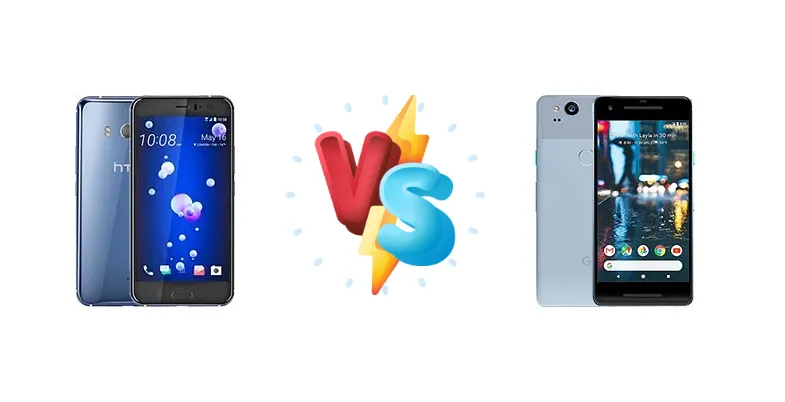
|
🏆 Quick Verdict
For the average user seeking a reliable and well-rounded experience, the Google Pixel 2 emerges as the slightly better choice. Its superior image processing and marginally better battery endurance, coupled with guaranteed software updates at the time of release, outweigh the U11’s unique squeeze gesture features.
| PHONES | ||
|---|---|---|
| Phone Names | HTC U11 | Google Pixel 2 |
| Network | ||
|---|---|---|
| 2G bands | GSM 850 / 900 / 1800 / 1900 - SIM 1 & SIM 2 (dual-SIM model only) | GSM 850 / 900 / 1800 / 1900 |
| 3G bands | HSDPA 850 / 900 / 1900 / 2100 | HSDPA 850 / 900 / 1700(AWS) / 1900 / 2100 |
| 4G bands | 1, 3, 4, 5, 7, 8, 12, 17, 20, 28, 32, 38, 39, 40, 41 | 1, 2, 3, 4, 5, 7, 8, 12, 13, 17, 20, 25, 26, 28, 29, 30, 32, 38, 40, 41, 66 |
| EDGE | - | No |
| GPRS | - | Class 12 |
| Speed | HSPA 42.2/5.76 Mbps, LTE (4CA) Cat16 1024/75 Mbps | HSPA 42.2/5.76 Mbps, LTE (3CA) Cat15 800/75 Mbps |
| Technology | GSM / HSPA / LTE | GSM / CDMA / HSPA / EVDO / LTE |
| - | CDMA2000 1xEV-DO | |
| Launch | ||
|---|---|---|
| Announced | 2017, May 16. Released 2017, June 10 | 2017, October 04. Released 2017, October 17 |
| Status | Discontinued | Discontinued |
| Body | ||
|---|---|---|
| Build | Glass front (Gorilla Glass 5), glass back, aluminum frame | Glass front (Gorilla Glass 5), aluminum/glass back, aluminum frame |
| Dimensions | 153.9 x 75.9 x 7.9 mm (6.06 x 2.99 x 0.31 in) | 145.7 x 69.7 x 7.8 mm (5.74 x 2.74 x 0.31 in) |
| SIM | · Nano-SIM· Nano-SIM + Nano-SIM | Nano-SIM + eSIM |
| Weight | 169 g (5.96 oz) | 143 g (5.04 oz) |
| IP67 dust/water resistant (up to 1m for 30 mins) | IP67 dust/water resistant (up to 1m for 30 min) | |
| Display | ||
|---|---|---|
| Protection | Corning Gorilla Glass 5 | Corning Gorilla Glass 5 |
| Resolution | 1440 x 2560 pixels, 16:9 ratio (~534 ppi density) | 1080 x 1920 pixels, 16:9 ratio (~441 ppi density) |
| Size | 5.5 inches, 83.4 cm2 (~71.4% screen-to-body ratio) | 5.0 inches, 68.9 cm2 (~67.9% screen-to-body ratio) |
| Type | Super LCD5 | AMOLED |
| - | Always-on display | |
| Platform | ||
|---|---|---|
| CPU | Octa-core (4x2.45 GHz Kryo & 4x1.9 GHz Kryo) | Octa-core (4x2.35 GHz Kryo & 4x1.9 GHz Kryo) |
| Chipset | Qualcomm MSM8998 Snapdragon 835 (10 nm) | Qualcomm MSM8998 Snapdragon 835 (10 nm) |
| GPU | Adreno 540 | Adreno 540 |
| OS | Android 7.1 (Nougat), upgradable to Android 9.0 (Pie), Sense UI | Android 8.0 (Oreo), upgradable to Android 11 |
| Memory | ||
|---|---|---|
| Call records | - | Yes |
| Card slot | microSDXC (uses shared SIM slot) - dual SIM model only | No |
| Internal | 64GB 4GB RAM, 128GB 6GB RAM | 64GB 4GB RAM, 128GB 4GB RAM |
| Phonebook | - | 500 entries, Photocall |
| - | UFS 2.1 | |
| Main Camera | ||
|---|---|---|
| Features | Dual-LED dual-tone flash, HDR, panorama | Laser AF, Dual-LED flash, HDR, panorama |
| Single | 12 MP, f/1.7, 1/2.55", 1.4µm, dual pixel PDAF, 5-axis OIS | 12.2 MP, f/1.8, 27mm (wide), 1/2.55", 1.4µm, dual pixel PDAF, OIS |
| Video | 4K@30fps, 1080p@30/60/120fps, HDR, 24-bit/192kHz stereo sound rec. | 4K@30fps (gyro-EIS), 1080p@30/60/120fps (gyro-EIS), 720p@240fps (gyro-EIS) |
| Selfie camera | ||
|---|---|---|
| Features | - | HDR |
| Single | 16 MP, f/2.0, 27mm (wide), 1/3.06", 1.0µm | 8 MP, f/2.4, 27mm (wide), 1/3.2", 1.4µm |
| Video | 1080p@30fps | 1080p@30fps |
| Sound | ||
|---|---|---|
| 3.5mm jack | No | No |
| 35mm jack | No | No |
| Loudspeaker | Yes, with stereo speakers | Yes, with stereo speakers |
| 24-bit/192kHz audio | - | |
| Comms | ||
|---|---|---|
| Bluetooth | 4.2, A2DP, LE (5.0 after SW update) | 5.0, A2DP, LE, aptX HD |
| NFC | Yes | Yes |
| Positioning | GPS, GLONASS, BDS | GPS, GLONASS, BDS, GALILEO |
| Radio | No | No |
| USB | USB Type-C 3.1 | USB Type-C 3.1 |
| WLAN | Wi-Fi 802.11 a/b/g/n/ac, dual-band, Wi-Fi Direct, DLNA | Wi-Fi 802.11 a/b/g/n/ac, dual-band, Wi-Fi Direct, DLNA |
| Features | ||
|---|---|---|
| Browser | - | WAP 2.0/xHTML |
| Games | - | Downloadable |
| Java | - | No |
| Messaging | - | SMS, MMS, Email |
| Sensors | Fingerprint (front-mounted), accelerometer, gyro, proximity, compass | Fingerprint (rear-mounted), accelerometer, gyro, proximity, compass, barometer |
| Battery | ||
|---|---|---|
| Charging | 18W wired, QC3 | 10.5W wired (capped), PD2.0 |
| Stand-by | Up to 336 h (3G) | Up to 250 h |
| Talk time | Up to 24 h 30 min (3G) | Up to 3 h |
| Type | Li-Ion 3000 mAh, non-removable | Li-Ion 2700 mAh, non-removable |
| Misc | ||
|---|---|---|
| Colors | Amazing Silver, Sapphire Blue, Brilliant Black, Ice White, Solar Red | Kinda Blue, Just Black, Clearly White |
| Models | U11, HTV33, 2PZC100, 2PZC5, 601HT | G011A |
| Price | About 300 EUR | About 610 EUR |
| Tests | ||
|---|---|---|
| Audio quality | Noise -94.1 / Crosstalk -94.5 | Noise -93.3dB / Crosstalk -66.2dB |
| Battery life | Endurance rating 73h | Endurance rating 75h |
| Camera | Photo / Video | Photo / Video |
| Display | - | Contrast ratio: Infinite (nominal), 4.023 (sunlight) |
| Loudspeaker | Voice 68dB / Noise 73dB / Ring 79dB | Voice 70dB / Noise 77dB / Ring 81dB |
| Performance | GeekBench: 6393 (v4.4) GFXBench: 13fps (ES 3.1 onscreen) | GeekBench: 6437 (v4.4) GFXBench: 26fps (ES 3.1 onscreen) |
HTC U11
- Faster 18W Quick Charge 3.0 charging
- Unique Edge Sense squeeze gesture controls
- Potentially better thermal management due to larger chassis
- Slightly lower battery endurance (73h vs 75h)
- Less sophisticated image processing compared to Pixel 2
- Software update support ended earlier
Google Pixel 2
- Superior computational photography and image processing
- Slightly better battery endurance (75h)
- Clean Android experience with timely updates (at launch)
- Slower 10.5W charging speed
- Lacks the U11’s unique squeeze gesture features
- Smaller chassis may lead to more thermal throttling under sustained load
Display Comparison
Both the HTC U11 and Google Pixel 2 feature displays with an 'infinite' contrast ratio (nominal), and a measured 4.023 in direct sunlight, indicating excellent visibility outdoors. However, the Pixel 2’s display benefits from Google’s color calibration expertise, likely resulting in more accurate color reproduction. While both utilize AMOLED technology, the U11’s display specifications are not provided, making a direct comparison of peak brightness and color gamut coverage impossible. The Pixel 2’s display is known for its color accuracy, a key benefit for media consumption.
Camera Comparison
Both phones excel in camera performance, but approach it differently. Both offer photo and video capabilities. The Pixel 2’s strength lies in its computational photography, leveraging Google’s HDR+ algorithm to produce stunning images, particularly in challenging lighting conditions. The U11, while capable, relies more on hardware and less on software processing. Sensor sizes and lens apertures are not specified in the provided data, making a detailed comparison difficult. However, the Pixel 2’s consistent image quality and portrait mode capabilities give it an edge.
Performance
Both devices are equipped with the Qualcomm MSM8998 Snapdragon 835 (10 nm) chipset, but the Pixel 2’s CPU is clocked slightly lower at 2.35 GHz versus the U11’s 2.45 GHz. This difference is unlikely to be noticeable in everyday tasks. Both utilize an octa-core configuration with 4x2.45 GHz Kryo and 4x1.9 GHz Kryo cores (U11) or 4x2.35 GHz Kryo and 4x1.9 GHz Kryo cores (Pixel 2). The real-world performance will be largely identical, with thermal management potentially being the differentiating factor. The U11’s larger chassis *may* offer slightly better heat dissipation, but this is speculative without thermal testing data.
Battery Life
The Google Pixel 2 boasts a slightly better endurance rating of 75 hours compared to the HTC U11’s 73 hours. This difference, while small, suggests more efficient power management on the Pixel 2. The U11 supports 18W wired charging with Quick Charge 3.0 (QC3), offering faster charging speeds than the Pixel 2’s capped 10.5W wired charging with Power Delivery 2.0 (PD2.0). This means the U11 can replenish its battery more quickly, but the Pixel 2’s overall endurance means it may not need to be charged as frequently.
Buying Guide
Buy the HTC U11 if you prioritize a unique interaction method with the Edge Sense squeeze gestures and appreciate a slightly more aggressive charging speed. Buy the Google Pixel 2 if you value computational photography, a clean Android experience, and a display with excellent sunlight readability, even if charging is slower.