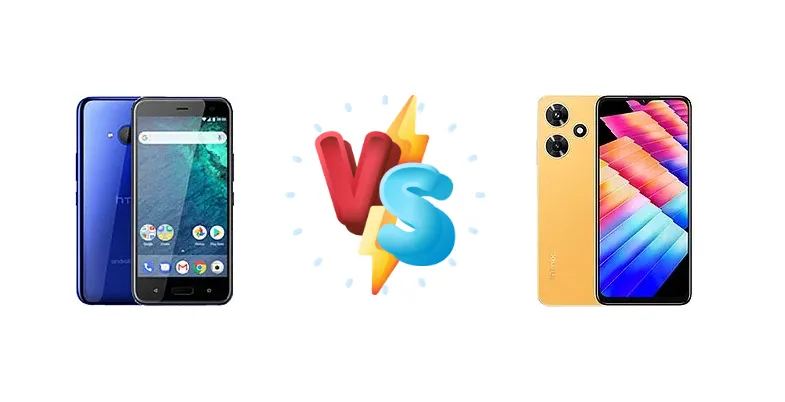
The HTC U11 Life, though an older model, remains relevant due to its solid build and endurance. The Infinix Hot 30i represents a newer generation of budget-focused smartphones. This comparison dissects their key differences, helping you determine which device delivers the best experience given their respective price points and target audiences.
🏆 Quick Verdict
For users prioritizing long-term battery life and a proven track record, the HTC U11 Life is the better choice, boasting a 73-hour endurance rating. However, the Infinix Hot 30i offers faster charging and a more modern chipset architecture, making it appealing for those who value quicker top-ups and potentially improved efficiency.
| Network |
|---|
| 2G bands | GSM 850 / 900 / 1800 / 1900 - SIM 1 & SIM 2 (dual-SIM model only) | GSM 850 / 900 / 1800 / 1900 |
| 3G bands | HSDPA 850 / 900 / 1700(AWS) / 1900 / 2100 | HSDPA 850 / 900 / 1700(AWS) / 1900 / 2100 |
| 4G bands | 1, 2, 3, 4, 5, 7, 12, 13, 17, 20, 28, 66 | 1, 2, 3, 4, 5, 7, 8, 20, 28, 38, 40, 41 |
| Speed | HSPA 42.2/5.76 Mbps, LTE (3CA) Cat11 600/75 Mbps | HSPA, LTE |
| Technology | GSM / HSPA / LTE | GSM / HSPA / LTE |
| Launch |
|---|
| Announced | 2017, November. Released 2017, December | 2023, March 31 |
| Status | Discontinued | Available. Released 2023, March 31 |
| Body |
|---|
| Build | Glass front (Gorilla Glass 3), plastic back, plastic frame | Glass front, plastic frame, plastic back |
| Dimensions | 149.1 x 72.9 x 8.1 mm (5.87 x 2.87 x 0.32 in) | 164 x 75.8 x 8.4 mm (6.46 x 2.98 x 0.33 in) |
| SIM | · Nano-SIM· Nano-SIM + Nano-SIM | Nano-SIM + Nano-SIM |
| Weight | 142 g (5.01 oz) | 191 g (6.74 oz) |
| | IP67 dust/water resistant (up to 1m for 30 mins) | - |
| Display |
|---|
| Protection | Corning Gorilla Glass 3 | - |
| Resolution | 1080 x 1920 pixels, 16:9 ratio (~424 ppi density) | 720 x 1612 pixels, 20:9 ratio (~269 ppi density) |
| Size | 5.2 inches, 74.5 cm2 (~68.6% screen-to-body ratio) | 6.56 inches, 103.4 cm2 (~83.2% screen-to-body ratio) |
| Type | Super LCD | IPS LCD, 90Hz, 500 nits (peak) |
| Platform |
|---|
| CPU | Octa-core 2.2 GHz Cortex-A53 | Octa-core (2x1.6 GHz Cortex-A75 & 6x1.6 GHz Cortex-A55) |
| Chipset | Qualcomm SDM630 Snapdragon 630 (14 nm) | Unisoc T606 (12 nm) |
| GPU | Adreno 508 | Mali-G57 MP1 |
| OS | Android 8.0 (Oreo), upgradable to Android 9.0 (Pie), Android One | Android 12, XOS 10.6 |
| Memory |
|---|
| Card slot | microSDXC (dedicated slot) - single-SIM modelmicroSDXC (uses shared SIM slot) - dual-SIM model | microSDXC (dedicated slot) |
| Internal | 32GB 3GB RAM, 64GB 4GB RAM | 64GB 4GB RAM, 128GB 4GB RAM, 128GB 8GB RAM |
| | - | UFS 2.2 |
| Main Camera |
|---|
| Dual | - | 13 MP, f/1.9, (wide), AF
0.08 MP, (depth) |
| Features | LED flash, HDR, panorama | Dual-LED flash, HDR, panorama |
| Single | 16 MP, f/2.0, PDAF | 13 MP, f/1.9, (wide), 1/3.07", AF
Auxiliary lens |
| Video | 4K@30fps, 1080p@30fps | 1080p@30fps |
| Selfie camera |
|---|
| Features | HDR, panorama | Dual-LED flash |
| Single | 16 MP, f/2.0, 27mm (wide), 1/3.06", 1.0µm | 8 MP, f/2.0, (wide), 1/3.94" |
| Video | 1080p@30fps | 1080p@30fps |
| Sound |
|---|
| 3.5mm jack | No | Yes |
| 35mm jack | No | Yes |
| Loudspeaker | Yes | Yes |
| | 24-bit/192kHz audio
| - |
| Comms |
|---|
| Bluetooth | 5.0, A2DP, LE | Yes |
| NFC | Yes | Yes (Hot 30i NFC only) |
| Positioning | GPS, GLONASS, BDS | GPS |
| Radio | No | FM radio |
| USB | USB Type-C 2.0 | USB Type-C 2.0, OTG |
| WLAN | Wi-Fi 802.11 a/b/g/n/ac, dual-band, Wi-Fi Direct | Wi-Fi 802.11 a/b/g/n/ac, dual-band |
| Features |
|---|
| Sensors | Fingerprint (front-mounted), accelerometer, gyro, proximity, compass | Fingerprint (side-mounted), accelerometer, proximity, compass |
| Battery |
|---|
| Charging | - | 18W wired |
| Stand-by | Up to 670 h (3G) | - |
| Talk time | Up to 17 h (3G) | - |
| Type | Li-Ion 2600 mAh, non-removable | 5000 mAh |
| Misc |
|---|
| Colors | Brilliant Black, Sapphire Blue, Ice White | Mirror Black, Glacier Blue, Diamond White, Marigold |
| Models | U11 life | X669, X669D |
| Price | About 210 EUR | - |
| Tests |
|---|
| Battery life | Endurance rating 73h | - |
| Camera |
Photo / Video | - |
| Display |
Contrast ratio: 1529:1 (nominal), 3.108 (sunlight) | - |
| Loudspeaker |
Voice 70dB / Noise 75dB / Ring 88dB | - |
| Performance |
GeekBench: 4140 (v4.4)
GFXBench: 5.3fps (ES 3.1 onscreen) | - |
HTC U11 Life
- Exceptional 73-hour battery endurance
- Superior sunlight display contrast (3.108:1)
- Proven reliability and build quality (HTC brand)
- Older chipset (Snapdragon 630)
- Slower charging speeds (spec not provided, likely slower than 18W)
- Potentially limited software support
Infinix Hot 30i
- More modern chipset architecture (Unisoc T606)
- Faster 18W wired charging
- Potentially better power efficiency (12nm process)
- Missing battery endurance rating
- Display specifications are unknown
- Unisoc chipset may have limited software optimization
Display Comparison
The HTC U11 Life’s display boasts a contrast ratio of 1529:1 (nominal) and a significantly higher 3.108:1 in sunlight, suggesting superior outdoor visibility compared to the Infinix Hot 30i, for which display specs are unavailable. This higher sunlight contrast is crucial for users frequently exposed to bright conditions. While the U11 Life’s panel technology isn’t specified, the contrast ratios indicate a quality IPS panel. The Hot 30i’s display details are missing, making a direct comparison difficult, but given its price point, it likely utilizes a standard IPS LCD.
Camera Comparison
Both devices are listed as having photo/video capabilities, but detailed camera specifications are absent. Given the U11 Life’s age, its camera likely features a standard sensor and image processing for its time. The Infinix Hot 30i, being a newer device, *may* benefit from improved image processing algorithms, but without sensor size or aperture information, it’s impossible to assess its photographic capabilities accurately. The lack of detail makes a meaningful comparison impossible; both phones likely offer adequate, but not exceptional, camera performance for their respective price brackets.
Performance
The HTC U11 Life is powered by the Qualcomm Snapdragon 630 (14nm), an octa-core processor clocked at 2.2 GHz using Cortex-A53 cores. The Infinix Hot 30i utilizes the Unisoc T606 (12nm) with a hybrid core configuration – two Cortex-A75 cores at 1.6 GHz and six Cortex-A55 cores, also at 1.6 GHz. The Unisoc T606’s 12nm process should theoretically offer better power efficiency than the Snapdragon 630’s 14nm node. However, the Cortex-A75 cores in the Hot 30i provide a performance boost over the U11 Life’s all-A53 configuration, potentially leading to snappier app loading and smoother multitasking. The architectural difference suggests the Hot 30i may handle more demanding tasks slightly better, despite the older Snapdragon’s higher clock speed.
Battery Life
The HTC U11 Life shines with an impressive endurance rating of 73 hours, indicating exceptional battery life. The Infinix Hot 30i, while lacking an endurance rating, compensates with 18W wired charging. This faster charging speed allows for quicker top-ups, a significant advantage for users who frequently need to recharge their devices. The U11 Life’s longevity is ideal for travelers or those who dislike frequent charging, while the Hot 30i prioritizes convenience with its faster charging capabilities.
Buying Guide
Buy the HTC U11 Life if you need exceptional battery endurance and a phone that can reliably last through a full day (and then some) of moderate use. Buy the Infinix Hot 30i if you prefer a more recent chipset with potential for better software support and faster charging, even if it means slightly less overall battery life.
Frequently Asked Questions
❓ Does the Unisoc T606 in the Infinix Hot 30i struggle with graphically intensive games?
While the Unisoc T606 is a capable chipset, it's not designed for high-end gaming. Expect to play most games at medium settings, and potentially experience frame drops in demanding titles. The Snapdragon 630 in the U11 Life offers similar gaming performance, so neither phone is a gaming powerhouse.
❓ How does the 18W charging on the Infinix Hot 30i translate to real-world charging times?
18W charging on the Infinix Hot 30i should allow for a full charge in approximately 2-3 hours, depending on the battery capacity (which is not specified). This is significantly faster than the HTC U11 Life, which likely charges at a slower rate, though exact times are unavailable.
❓ Is the lack of detailed camera specs on both phones a major concern?
Yes, it is. Both phones likely offer adequate camera performance for casual use, but without knowing sensor sizes, apertures, or image processing capabilities, it's impossible to assess their true photographic potential. Expect average results in most lighting conditions.