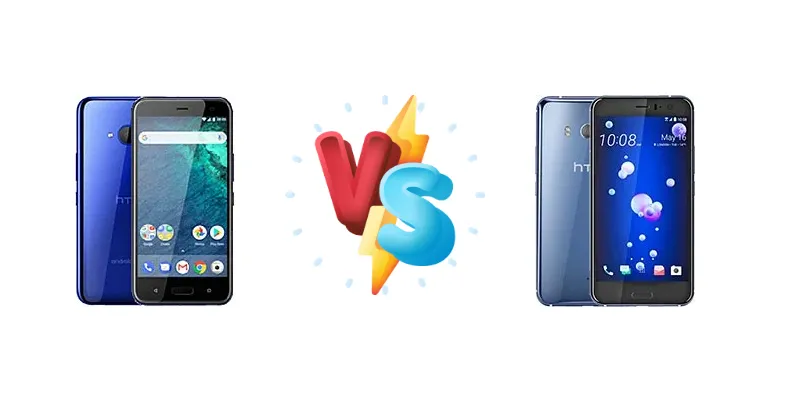
In 2017, HTC offered a compelling two-pronged approach with the U11 and U11 Life. The U11 represented HTC’s flagship ambition, packing a top-tier Snapdragon 835. The U11 Life, however, aimed for a more accessible price point with the Snapdragon 630. This comparison dissects the key differences, helping you determine if the premium price of the U11 is justified or if the U11 Life offers a smarter balance of features and cost.
🏆 Quick Verdict
For most users, the HTC U11 is the superior choice. While both phones share an identical 73-hour endurance rating, the U11’s Snapdragon 835 delivers significantly faster performance and a smoother user experience, justifying its higher initial cost. The U11 Life remains a viable option for budget-conscious users prioritizing efficiency.
| Network |
|---|
| 2G bands | GSM 850 / 900 / 1800 / 1900 - SIM 1 & SIM 2 (dual-SIM model only) | GSM 850 / 900 / 1800 / 1900 - SIM 1 & SIM 2 (dual-SIM model only) |
| 3G bands | HSDPA 850 / 900 / 1700(AWS) / 1900 / 2100 | HSDPA 850 / 900 / 1900 / 2100 |
| 4G bands | 1, 2, 3, 4, 5, 7, 12, 13, 17, 20, 28, 66 | 1, 3, 4, 5, 7, 8, 12, 17, 20, 28, 32, 38, 39, 40, 41 |
| Speed | HSPA 42.2/5.76 Mbps, LTE (3CA) Cat11 600/75 Mbps | HSPA 42.2/5.76 Mbps, LTE (4CA) Cat16 1024/75 Mbps |
| Technology | GSM / HSPA / LTE | GSM / HSPA / LTE |
| Launch |
|---|
| Announced | 2017, November. Released 2017, December | 2017, May 16. Released 2017, June 10 |
| Status | Discontinued | Discontinued |
| Body |
|---|
| Build | Glass front (Gorilla Glass 3), plastic back, plastic frame | Glass front (Gorilla Glass 5), glass back, aluminum frame |
| Dimensions | 149.1 x 72.9 x 8.1 mm (5.87 x 2.87 x 0.32 in) | 153.9 x 75.9 x 7.9 mm (6.06 x 2.99 x 0.31 in) |
| SIM | · Nano-SIM· Nano-SIM + Nano-SIM | · Nano-SIM· Nano-SIM + Nano-SIM |
| Weight | 142 g (5.01 oz) | 169 g (5.96 oz) |
| | IP67 dust/water resistant (up to 1m for 30 mins) | IP67 dust/water resistant (up to 1m for 30 mins) |
| Display |
|---|
| Protection | Corning Gorilla Glass 3 | Corning Gorilla Glass 5 |
| Resolution | 1080 x 1920 pixels, 16:9 ratio (~424 ppi density) | 1440 x 2560 pixels, 16:9 ratio (~534 ppi density) |
| Size | 5.2 inches, 74.5 cm2 (~68.6% screen-to-body ratio) | 5.5 inches, 83.4 cm2 (~71.4% screen-to-body ratio) |
| Type | Super LCD | Super LCD5 |
| Platform |
|---|
| CPU | Octa-core 2.2 GHz Cortex-A53 | Octa-core (4x2.45 GHz Kryo & 4x1.9 GHz Kryo) |
| Chipset | Qualcomm SDM630 Snapdragon 630 (14 nm) | Qualcomm MSM8998 Snapdragon 835 (10 nm) |
| GPU | Adreno 508 | Adreno 540 |
| OS | Android 8.0 (Oreo), upgradable to Android 9.0 (Pie), Android One | Android 7.1 (Nougat), upgradable to Android 9.0 (Pie), Sense UI |
| Memory |
|---|
| Card slot | microSDXC (dedicated slot) - single-SIM modelmicroSDXC (uses shared SIM slot) - dual-SIM model | microSDXC (uses shared SIM slot) - dual SIM model only |
| Internal | 32GB 3GB RAM, 64GB 4GB RAM | 64GB 4GB RAM, 128GB 6GB RAM |
| Main Camera |
|---|
| Features | LED flash, HDR, panorama | Dual-LED dual-tone flash, HDR, panorama |
| Single | 16 MP, f/2.0, PDAF | 12 MP, f/1.7, 1/2.55", 1.4µm, dual pixel PDAF, 5-axis OIS |
| Video | 4K@30fps, 1080p@30fps | 4K@30fps, 1080p@30/60/120fps, HDR, 24-bit/192kHz stereo sound rec. |
| Selfie camera |
|---|
| Features | HDR, panorama | - |
| Single | 16 MP, f/2.0, 27mm (wide), 1/3.06", 1.0µm | 16 MP, f/2.0, 27mm (wide), 1/3.06", 1.0µm |
| Video | 1080p@30fps | 1080p@30fps |
| Sound |
|---|
| 3.5mm jack | No | No |
| 35mm jack | No | No |
| Loudspeaker | Yes | Yes, with stereo speakers |
| | 24-bit/192kHz audio
| 24-bit/192kHz audio
|
| Comms |
|---|
| Bluetooth | 5.0, A2DP, LE | 4.2, A2DP, LE (5.0 after SW update) |
| NFC | Yes | Yes |
| Positioning | GPS, GLONASS, BDS | GPS, GLONASS, BDS |
| Radio | No | No |
| USB | USB Type-C 2.0 | USB Type-C 3.1 |
| WLAN | Wi-Fi 802.11 a/b/g/n/ac, dual-band, Wi-Fi Direct | Wi-Fi 802.11 a/b/g/n/ac, dual-band, Wi-Fi Direct, DLNA |
| Features |
|---|
| Sensors | Fingerprint (front-mounted), accelerometer, gyro, proximity, compass | Fingerprint (front-mounted), accelerometer, gyro, proximity, compass |
| Battery |
|---|
| Charging | - | 18W wired, QC3 |
| Stand-by | Up to 670 h (3G) | Up to 336 h (3G) |
| Talk time | Up to 17 h (3G) | Up to 24 h 30 min (3G) |
| Type | Li-Ion 2600 mAh, non-removable | Li-Ion 3000 mAh, non-removable |
| Misc |
|---|
| Colors | Brilliant Black, Sapphire Blue, Ice White | Amazing Silver, Sapphire Blue, Brilliant Black, Ice White, Solar Red |
| Models | U11 life | U11, HTV33, 2PZC100, 2PZC5, 601HT |
| Price | About 210 EUR | About 300 EUR |
| Tests |
|---|
| Audio quality | - |
Noise -94.1 / Crosstalk -94.5 |
| Battery life | Endurance rating 73h |
Endurance rating 73h
|
| Camera |
Photo / Video |
Photo / Video |
| Display |
Contrast ratio: 1529:1 (nominal), 3.108 (sunlight) | - |
| Loudspeaker |
Voice 70dB / Noise 75dB / Ring 88dB |
Voice 68dB / Noise 73dB / Ring 79dB
|
| Performance |
GeekBench: 4140 (v4.4)
GFXBench: 5.3fps (ES 3.1 onscreen) |
GeekBench: 6393 (v4.4)
GFXBench: 13fps (ES 3.1 onscreen) |
HTC U11 Life
- Significantly faster performance with Snapdragon 835
- Faster charging with 18W Quick Charge 3.0
- Potentially superior camera system due to flagship hardware
- Higher initial cost
- Potentially more heat generation under heavy load
HTC U11
- More affordable price point
- Good battery endurance (73h)
- Efficient Snapdragon 630 processor for everyday tasks
- Slower performance compared to the U11
- Lacks Quick Charge 3.0 for slower charging speeds
Display Comparison
Both the U11 and U11 Life share similar display characteristics, with the U11 Life boasting a contrast ratio of 1529:1 (nominal) and 3.108 (sunlight). While specific nit brightness isn't provided, the U11 Life’s high sunlight contrast suggests good outdoor visibility. However, the U11, being the flagship, likely benefits from slightly better color calibration and potentially a more robust display assembly, though this isn't explicitly stated in the provided data. The lack of information on panel technology (e.g., AMOLED vs. IPS) prevents a deeper analysis of color accuracy and viewing angles.
Camera Comparison
Both devices are listed as having Photo/Video capabilities, but detailed camera specifications are absent. Given the U11’s flagship status, it likely features a more advanced camera system with a larger sensor, wider aperture, and potentially optical image stabilization (OIS) – features not confirmed for the U11 Life. The Snapdragon 835 also includes a more powerful image signal processor (ISP), enabling faster image processing and potentially better low-light performance on the U11. Without sensor size or aperture data, a definitive camera comparison is impossible, but the U11’s hardware advantage suggests superior image quality.
Performance
The core difference lies in the chipset: the HTC U11 features the Qualcomm MSM8998 Snapdragon 835 (10nm), while the U11 Life utilizes the Qualcomm SDM630 Snapdragon 630 (14nm). The 835, built on a smaller 10nm process, offers significantly higher performance and improved thermal efficiency compared to the 630’s 14nm node. The U11’s octa-core CPU (4x2.45 GHz Kryo & 4x1.9 GHz Kryo) dwarfs the U11 Life’s octa-core 2.2 GHz Cortex-A53 CPU. This translates to faster app loading times, smoother multitasking, and a more responsive overall experience on the U11, particularly for graphically intensive tasks like gaming. The U11 also benefits from the 835’s superior GPU.
Battery Life
Interestingly, both the HTC U11 and U11 Life achieve the same endurance rating of 73 hours. This suggests that despite the more power-hungry Snapdragon 835 in the U11, efficient power management and potentially a larger battery capacity (not specified) offset the difference. However, the U11 gains a significant advantage with 18W wired charging and Quick Charge 3.0 support, allowing for much faster charging times compared to the U11 Life, which lacks these features. This means less downtime and quicker top-ups for the U11.
Buying Guide
Buy the HTC U11 Life if you prioritize long-term battery life and a lower upfront cost, and your primary use cases involve everyday tasks like browsing, social media, and light photography. You’re willing to trade raw processing power for affordability. Buy the HTC U11 if you demand the fastest possible performance for gaming, demanding applications, and quick multitasking, and you value the benefits of Qualcomm Quick Charge 3.0 for faster charging speeds.
Frequently Asked Questions
❓ Does the Snapdragon 630 in the U11 Life struggle with demanding games like PUBG or Asphalt 9?
The Snapdragon 630 is capable of running these games, but you'll likely need to lower graphics settings to achieve a smooth frame rate. The U11 Life won't deliver the same consistently high performance as the U11 with its Snapdragon 835, especially during extended gaming sessions.
❓ Given both phones have the same endurance rating, does that mean battery life is identical in real-world use?
While the endurance rating is the same, the U11’s faster charging capabilities significantly reduce downtime. The U11 Life will take considerably longer to fully recharge, impacting overall usability if you’re a heavy user. The 835 also has more efficient power management, potentially extending light usage scenarios.
❓ Is the camera on the U11 Life sufficient for casual photography and social media sharing?
Yes, the U11 Life’s camera is adequate for everyday photography and social media. However, it likely lacks the dynamic range and low-light performance of the U11’s more advanced camera system. Expect good results in well-lit conditions, but potential issues in challenging lighting scenarios.