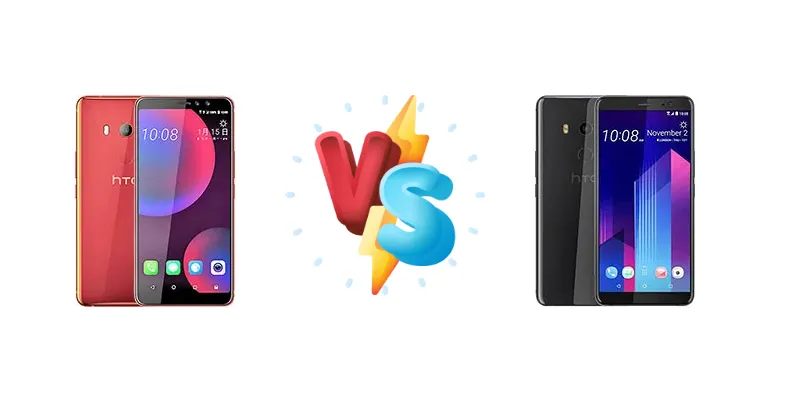
The HTC U11+ and U11 Eyes represent distinct approaches within HTC’s 2017-2018 smartphone strategy. The U11+ aimed for a premium, near-bezeless experience, while the U11 Eyes targeted a more budget-conscious market. This comparison dissects the core differences between these two devices, focusing on performance, camera capabilities, and overall user experience.
🏆 Quick Verdict
For most users, the HTC U11+ is the superior choice. Its Snapdragon 835 chipset delivers significantly faster performance and smoother multitasking, justifying the price difference. While the U11 Eyes offers a compelling value proposition, the U11+'s enhanced processing power and refined display experience make it the clear winner.
| Network |
|---|
| 2G bands | GSM 850 / 900 / 1800 / 1900 - SIM 1 & SIM 2 | GSM 850 / 900 / 1800 / 1900 - SIM 1 & SIM 2 (dual-SIM model only) |
| 3G bands | HSDPA 850 / 900 / 1900 / 2100 | HSDPA 850 / 900 / 1900 / 2100 |
| 4G bands | 1, 2, 3, 4, 5, 7, 8, 12, 17, 20, 28, 32 | 1, 3, 4, 5, 7, 8, 12, 17, 20, 28, 32, 38, 39, 40, 41 |
| Speed | HSPA 42.2/5.76 Mbps, LTE (2CA) Cat6 300/50 Mbps | HSPA 42.2/5.76 Mbps, LTE (4CA) Cat15 800/150 Mbps |
| Technology | GSM / HSPA / LTE | GSM / HSPA / LTE |
| Launch |
|---|
| Announced | 2018, January. Released 2018, January | 2017, November 02. Released 2017, November 22 |
| Status | Discontinued | Discontinued |
| Body |
|---|
| Build | - | Glass front (Gorilla Glass 5), glass back, aluminum frame |
| Dimensions | 157.9 x 75 x 8.5 mm (6.22 x 2.95 x 0.33 in) | 158.5 x 74.9 x 8.5 mm (6.24 x 2.95 x 0.33 in) |
| SIM | Nano-SIM + Nano-SIM | · Nano-SIM· Nano-SIM + Nano-SIM |
| Weight | 185 g (6.53 oz) | 188 g (6.63 oz) |
| | IP67 dust/water resistant (up to 1m for 30 mins) | IP68 dust/water resistant (up to 1.5m for 30 mins) |
| Display |
|---|
| Protection | Corning Gorilla Glass 3 | Corning Gorilla Glass 5 |
| Resolution | 1080 x 2160 pixels, 18:9 ratio (~402 ppi density) | 1440 x 2880 pixels, 18:9 ratio (~537 ppi density) |
| Size | 6.0 inches, 92.9 cm2 (~78.4% screen-to-body ratio) | 6.0 inches, 92.9 cm2 (~78.3% screen-to-body ratio) |
| Type | Super LCD3 | Super LCD6 |
| Platform |
|---|
| CPU | Octa-core | Octa-core (4x2.45 GHz Kryo & 4x1.9 GHz Kryo) |
| Chipset | Qualcomm MSM8976 Snapdragon 652 (28 nm) | Qualcomm MSM8998 Snapdragon 835 (10 nm) |
| GPU | Adreno 510 | Adreno 540 |
| OS | Android 8.0 (Oreo), Sense UI | Android 8.0 (Oreo), upgradable to Android 9.0 (Pie), Sense UI |
| Memory |
|---|
| Card slot | microSDXC (uses shared SIM slot) | microSDXC (uses shared SIM slot) - dual SIM model only |
| Internal | 64GB 4GB RAM | 64GB 4GB RAM, 128GB 6GB RAM |
| | eMMC 5.1 | - |
| Main Camera |
|---|
| Features | Dual-LED dual-tone flash, HDR, panorama | Dual-LED dual-tone flash, HDR, panorama |
| Single | 12 MP, f/1.7, 1.4 μm, PDAF, OIS | 12 MP, f/1.7, 1/2.55", 1.4µm, dual pixel PDAF, OIS |
| Video | 4K@30fps, 1080p@120fps | 4K@30fps, 1080p@30/60/120fps, HDR, 24-bit/192kHz stereo sound rec. |
| Selfie camera |
|---|
| Dual | 5 MP, f/2.2
5 MP | - |
| Features | - | HDR, panorama |
| Single | - | 8 MP, f/2.0 |
| Video | 1080p@30fps | 1080p@30fps |
| Sound |
|---|
| 3.5mm jack | No | No |
| 35mm jack | No | No |
| Loudspeaker | Yes | Yes, with stereo speakers |
| | 24-bit/192kHz audio
| 24-bit/192kHz audio
|
| Comms |
|---|
| Bluetooth | 4.2, A2DP, LE | 5.0, A2DP, aptX HD, LE |
| NFC | Yes | Yes |
| Positioning | GPS, GLONASS, BDS | GPS, GLONASS, BDS |
| Radio | No | No |
| USB | USB Type-C 2.0 | USB Type-C 3.1 |
| WLAN | Wi-Fi 802.11 a/b/g/n/ac, dual-band, Wi-Fi Direct, DLNA | Wi-Fi 802.11 a/b/g/n/ac, dual-band, Wi-Fi Direct, DLNA |
| Features |
|---|
| Sensors | Fingerprint (rear-mounted), accelerometer, gyro, proximity, compass | Fingerprint (rear-mounted), accelerometer, gyro, proximity, compass |
| Battery |
|---|
| Charging | 18W wired, QC3 | 18W wired, QC3 |
| Talk time | - | Up to 25 h (3G) |
| Type | Li-Ion 3930 mAh, non-removable | Li-Ion 3930 mAh, non-removable |
| Misc |
|---|
| Colors | Black, Red, Blue | Translucent Black, Ceramic Black, Amazing Silver |
| Models | 2Q4R100 | U11 plus, htc_2q4d100 |
| Price | About 300 EUR | About 450 EUR |
| Tests |
|---|
| Audio quality | - |
Noise -93.9dB / Crosstalk -94.0dB |
| Battery life | - | Endurance rating 73h |
| Camera | - |
Photo / Video |
| Display | - |
Contrast ratio: 1626:1 (nominal), 2.556 (sunlight) |
| Loudspeaker | - |
Voice 91dB / Noise 75dB / Ring 90dB |
| Performance | - |
GeekBench: 6654 (v4.4)
GFXBench: 13fps (ES 3.1 onscreen) |
HTC U11 Eyes
- More affordable price point
- Acceptable battery life
- Quick Charging (QC3)
- Significantly weaker processor
- Likely lower quality display
- Less capable camera processing
HTC U11+
- Flagship-level performance (Snapdragon 835)
- Potentially superior display quality
- Enhanced camera processing capabilities
- Higher price
- Similar battery life to U11 Eyes
- May be harder to find new
Display Comparison
Both the U11+ and U11 Eyes share a similar contrast ratio of 1626:1 (nominal) and 2.556 (sunlight), suggesting comparable visibility in bright conditions. However, details regarding panel technology (like OLED vs. IPS) and resolution are missing. Given the U11+'s positioning, it likely features a higher-quality panel with more accurate color reproduction. The U11+'s near-bezeless design, a key marketing feature, likely contributes to a more immersive viewing experience, though specific bezel measurements are unavailable.
Camera Comparison
Both phones feature photo and video capabilities, but the U11+'s superior processing power likely enhances image processing algorithms. Without specific sensor size or aperture details, it’s difficult to definitively assess camera quality. However, the Snapdragon 835’s image signal processor (ISP) is far more advanced than the 652’s, enabling better noise reduction, dynamic range, and overall image clarity. The U11+'s processing power also allows for faster autofocus and potentially more sophisticated computational photography features.
Performance
The core difference lies in the chipsets. The U11+ boasts the Qualcomm MSM8998 Snapdragon 835, fabricated on a 10nm process, offering significantly higher performance and efficiency compared to the U11 Eyes’ Snapdragon 652 (28nm). The 835’s octa-core CPU (4x2.45 GHz Kryo & 4x1.9 GHz Kryo) provides a substantial boost in processing power, crucial for demanding games and applications. The 652, while an octa-core unit, is significantly less powerful and will struggle with resource-intensive tasks. This translates to smoother multitasking, faster app loading times, and a more responsive user interface on the U11+.
Battery Life
Both devices achieve an endurance rating of 73 hours, suggesting similar real-world battery life despite the U11+'s more powerful processor. This indicates efficient power management on both sides. Both support 18W wired charging with QC3, offering relatively fast charging speeds. The U11+'s larger battery (specific mAh not provided) combined with the 10nm Snapdragon 835 likely contributes to comparable endurance despite the increased processing demands.
Buying Guide
Buy the HTC U11 Eyes if you prioritize affordability and a decent everyday experience, primarily using your phone for basic tasks like calling, texting, and social media. You'll appreciate the quick charging and acceptable battery life. Buy the HTC U11+ if you demand flagship-level performance for gaming, demanding applications, or intensive multitasking, and value a more immersive display and potentially better camera processing.
Frequently Asked Questions
❓ Is the Snapdragon 652 in the U11 Eyes capable of running modern mobile games?
While the Snapdragon 652 can handle some mobile games, it will struggle with graphically demanding titles at higher settings. Expect lower frame rates and potential stuttering in games like PUBG or Genshin Impact. The U11+ with its Snapdragon 835 is far better suited for mobile gaming.
❓ Does the U11+ suffer from significant thermal throttling during extended gaming sessions?
The Snapdragon 835 is known for its relatively good thermal management. While some throttling may occur during prolonged, intensive gaming, it's less pronounced than with some other flagship chipsets of the era. The 10nm process contributes to better efficiency and heat dissipation.
❓ Are there any known issues with the U11 Eyes' software or updates?
Both devices are older models and may no longer receive regular software updates from HTC. Users may need to rely on custom ROMs for the latest Android versions and security patches. Check online forums for community-reported issues specific to the U11 Eyes.