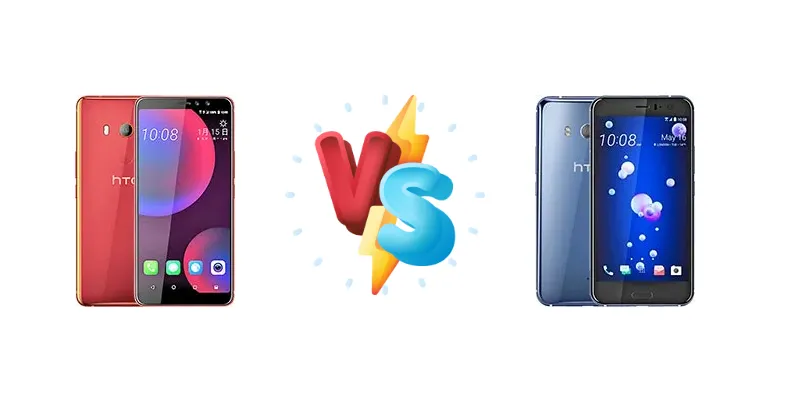
The HTC U11 and U11 Eyes represent distinct approaches to the flagship smartphone experience. The U11, released to critical acclaim, boasted a top-tier Snapdragon 835. The U11 Eyes, arriving later, aimed for a more accessible price point by utilizing the Snapdragon 652. This comparison dissects the core differences between these two devices, focusing on performance, camera capabilities, and overall value.
🏆 Quick Verdict
For most users, the HTC U11 remains the superior choice. While the U11 Eyes offers a similar design and Quick Charge 3.0 support, the Snapdragon 835 in the U11 delivers significantly faster performance and a smoother user experience, justifying its higher price for those prioritizing speed and responsiveness.
| Network |
|---|
| 2G bands | GSM 850 / 900 / 1800 / 1900 - SIM 1 & SIM 2 | GSM 850 / 900 / 1800 / 1900 - SIM 1 & SIM 2 (dual-SIM model only) |
| 3G bands | HSDPA 850 / 900 / 1900 / 2100 | HSDPA 850 / 900 / 1900 / 2100 |
| 4G bands | 1, 2, 3, 4, 5, 7, 8, 12, 17, 20, 28, 32 | 1, 3, 4, 5, 7, 8, 12, 17, 20, 28, 32, 38, 39, 40, 41 |
| Speed | HSPA 42.2/5.76 Mbps, LTE (2CA) Cat6 300/50 Mbps | HSPA 42.2/5.76 Mbps, LTE (4CA) Cat16 1024/75 Mbps |
| Technology | GSM / HSPA / LTE | GSM / HSPA / LTE |
| Launch |
|---|
| Announced | 2018, January. Released 2018, January | 2017, May 16. Released 2017, June 10 |
| Status | Discontinued | Discontinued |
| Body |
|---|
| Build | - | Glass front (Gorilla Glass 5), glass back, aluminum frame |
| Dimensions | 157.9 x 75 x 8.5 mm (6.22 x 2.95 x 0.33 in) | 153.9 x 75.9 x 7.9 mm (6.06 x 2.99 x 0.31 in) |
| SIM | Nano-SIM + Nano-SIM | · Nano-SIM· Nano-SIM + Nano-SIM |
| Weight | 185 g (6.53 oz) | 169 g (5.96 oz) |
| | IP67 dust/water resistant (up to 1m for 30 mins) | IP67 dust/water resistant (up to 1m for 30 mins) |
| Display |
|---|
| Protection | Corning Gorilla Glass 3 | Corning Gorilla Glass 5 |
| Resolution | 1080 x 2160 pixels, 18:9 ratio (~402 ppi density) | 1440 x 2560 pixels, 16:9 ratio (~534 ppi density) |
| Size | 6.0 inches, 92.9 cm2 (~78.4% screen-to-body ratio) | 5.5 inches, 83.4 cm2 (~71.4% screen-to-body ratio) |
| Type | Super LCD3 | Super LCD5 |
| Platform |
|---|
| CPU | Octa-core | Octa-core (4x2.45 GHz Kryo & 4x1.9 GHz Kryo) |
| Chipset | Qualcomm MSM8976 Snapdragon 652 (28 nm) | Qualcomm MSM8998 Snapdragon 835 (10 nm) |
| GPU | Adreno 510 | Adreno 540 |
| OS | Android 8.0 (Oreo), Sense UI | Android 7.1 (Nougat), upgradable to Android 9.0 (Pie), Sense UI |
| Memory |
|---|
| Card slot | microSDXC (uses shared SIM slot) | microSDXC (uses shared SIM slot) - dual SIM model only |
| Internal | 64GB 4GB RAM | 64GB 4GB RAM, 128GB 6GB RAM |
| | eMMC 5.1 | - |
| Main Camera |
|---|
| Features | Dual-LED dual-tone flash, HDR, panorama | Dual-LED dual-tone flash, HDR, panorama |
| Single | 12 MP, f/1.7, 1.4 μm, PDAF, OIS | 12 MP, f/1.7, 1/2.55", 1.4µm, dual pixel PDAF, 5-axis OIS |
| Video | 4K@30fps, 1080p@120fps | 4K@30fps, 1080p@30/60/120fps, HDR, 24-bit/192kHz stereo sound rec. |
| Selfie camera |
|---|
| Dual | 5 MP, f/2.2
5 MP | - |
| Single | - | 16 MP, f/2.0, 27mm (wide), 1/3.06", 1.0µm |
| Video | 1080p@30fps | 1080p@30fps |
| Sound |
|---|
| 3.5mm jack | No | No |
| 35mm jack | No | No |
| Loudspeaker | Yes | Yes, with stereo speakers |
| | 24-bit/192kHz audio
| 24-bit/192kHz audio
|
| Comms |
|---|
| Bluetooth | 4.2, A2DP, LE | 4.2, A2DP, LE (5.0 after SW update) |
| NFC | Yes | Yes |
| Positioning | GPS, GLONASS, BDS | GPS, GLONASS, BDS |
| Radio | No | No |
| USB | USB Type-C 2.0 | USB Type-C 3.1 |
| WLAN | Wi-Fi 802.11 a/b/g/n/ac, dual-band, Wi-Fi Direct, DLNA | Wi-Fi 802.11 a/b/g/n/ac, dual-band, Wi-Fi Direct, DLNA |
| Features |
|---|
| Sensors | Fingerprint (rear-mounted), accelerometer, gyro, proximity, compass | Fingerprint (front-mounted), accelerometer, gyro, proximity, compass |
| Battery |
|---|
| Charging | 18W wired, QC3 | 18W wired, QC3 |
| Stand-by | - | Up to 336 h (3G) |
| Talk time | - | Up to 24 h 30 min (3G) |
| Type | Li-Ion 3930 mAh, non-removable | Li-Ion 3000 mAh, non-removable |
| Misc |
|---|
| Colors | Black, Red, Blue | Amazing Silver, Sapphire Blue, Brilliant Black, Ice White, Solar Red |
| Models | 2Q4R100 | U11, HTV33, 2PZC100, 2PZC5, 601HT |
| Price | About 300 EUR | About 300 EUR |
| Tests |
|---|
| Audio quality | - |
Noise -94.1 / Crosstalk -94.5 |
| Battery life | - |
Endurance rating 73h
|
| Camera | - |
Photo / Video |
| Loudspeaker | - |
Voice 68dB / Noise 73dB / Ring 79dB
|
| Performance | - |
GeekBench: 6393 (v4.4)
GFXBench: 13fps (ES 3.1 onscreen) |
HTC U11 Eyes
- Significantly faster processor (Snapdragon 835)
- Superior GPU performance for gaming
- Better thermal management, reducing throttling
- Higher price point
- May be harder to find new
HTC U11
- More affordable price
- Similar battery life to the U11
- Quick Charge 3.0 support
- Noticeably slower processor (Snapdragon 652)
- Limited gaming performance
- Potential for slowdowns with demanding apps
Display Comparison
Both devices share a similar form factor, but detailed display specs are unavailable. However, given HTC's history, we can assume both utilize high-quality IPS LCD panels. The key difference lies in the processing power driving them. The U11's Snapdragon 835 will render UI elements and games more smoothly, even if the panels themselves are comparable in resolution and color accuracy. The absence of detailed display data highlights the U11's advantage in overall system responsiveness.
Camera Comparison
Both phones are advertised as having capable photo and video recording capabilities. However, the U11’s superior processing power likely enhances its image processing pipeline, resulting in faster capture times and potentially better low-light performance. Without specific sensor details, it’s difficult to make a definitive judgment, but the 835’s image signal processor (ISP) is a significant advantage. The U11 Eyes’ Snapdragon 652 will have a less powerful ISP, potentially leading to slower processing and less refined image quality.
Performance
The core differentiator is the chipset: the HTC U11 features the Qualcomm MSM8998 Snapdragon 835 (10nm), while the U11 Eyes utilizes the MSM8976 Snapdragon 652 (28nm). This is a substantial gap. The 835, built on a 10nm process, offers significantly higher CPU and GPU performance, alongside improved power efficiency. The U11’s octa-core CPU (4x2.45 GHz Kryo & 4x1.9 GHz Kryo) will handle multitasking and demanding applications with ease, while the 652 in the U11 Eyes will likely exhibit noticeable slowdowns under heavy load. The 10nm node of the 835 also translates to better thermal management, reducing the likelihood of performance throttling during extended gaming sessions.
Battery Life
Both the HTC U11 and U11 Eyes boast an endurance rating of 73 hours, suggesting similar battery life despite the chipset differences. This is likely due to the Snapdragon 652’s lower power consumption offsetting its lower capacity. Both devices support 18W wired charging with Quick Charge 3.0, meaning 0-100% charge times will be comparable. The U11’s more efficient chipset, however, may allow it to maintain that battery life for longer under sustained use.
Buying Guide
Buy the HTC U11 Eyes if you prioritize affordability and a sleek design over raw processing power, and your smartphone usage primarily revolves around everyday tasks like browsing, social media, and light photography. Buy the HTC U11 if you demand the best possible performance for gaming, demanding applications, and future-proofing, and are willing to invest in a more capable chipset.
Frequently Asked Questions
❓ Will the HTC U11 Eyes struggle with graphically intensive games like PUBG or Genshin Impact?
Yes, the Snapdragon 652 in the U11 Eyes is not designed for demanding games. While you may be able to run them at lower settings, expect noticeable frame drops and potential lag, especially during intense action sequences. The U11’s Snapdragon 835 provides a far smoother gaming experience.
❓ Does the difference in chipsets affect the speed of software updates on the U11 Eyes?
Potentially. The more powerful processor in the U11 can handle software updates and installations more quickly. While the difference may not be dramatic, the U11 Eyes could experience slightly longer update times due to its less capable chipset.
❓ Is the camera on the U11 Eyes significantly worse than the U11 in real-world shooting scenarios?
While both phones can take good photos, the U11 likely has an edge in challenging conditions like low light. The Snapdragon 835’s image signal processor (ISP) allows for faster processing and better noise reduction, resulting in clearer and more detailed images. The U11 Eyes will still be capable, but may struggle in comparison.