
HTC U Ultra vs Samsung Galaxy S7 edge: A Deep Dive into Flagship Endurance
| Phones Images | |||||
|---|---|---|---|---|---|
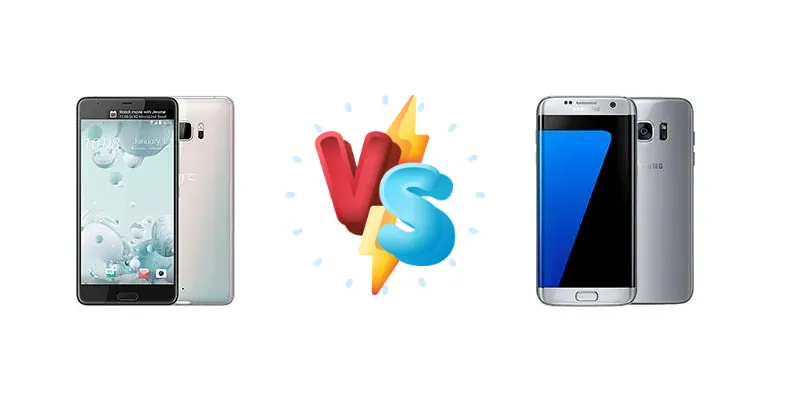
|
🏆 Quick Verdict
For the average user prioritizing battery life and display quality, the Samsung Galaxy S7 edge emerges as the stronger contender. Its superior endurance rating of 92 hours, coupled with its 'Infinite' contrast display, provides a more consistently enjoyable experience. While the U Ultra offers a newer chipset, the S7 edge’s optimization and overall package are more compelling.
| PHONES | ||
|---|---|---|
| Phone Names | HTC U Ultra | Samsung Galaxy S7 edge |
| Network | ||
|---|---|---|
| 2G bands | GSM 850 / 900 / 1800 / 1900 - SIM 1 & SIM 2 | GSM 850 / 900 / 1800 / 1900 - SIM 1 & SIM 2 - G935FD, G9350 |
| 3G bands | HSDPA 850 / 900 / 1700(AWS) / 1900 / 2100 | HSDPA 850 / 900 / 1700(AWS) / 1900 / 2100 - G935F, G935FD, G935W8 |
| 4G bands | 1, 2, 3, 4, 5, 7, 8, 12, 17, 20, 28, 38, 39, 40, 41 | 1, 2, 3, 4, 5, 7, 8, 12, 13, 17, 18, 19, 20, 25, 26, 28, 38, 39, 40, 41 - G935F, G935FD |
| Speed | HSPA 42.2/5.76 Mbps, LTE (3CA) Cat11 600/50 Mbps | HSPA 42.2/5.76 Mbps, LTE (3CA) Cat9 450/50 Mbps |
| Technology | GSM / HSPA / LTE | GSM / HSPA / LTE |
| Launch | ||
|---|---|---|
| Announced | 2017, January 12. Released 2017, February 21 | 2016, February 21. Released 2016, March 11 |
| Status | Discontinued | Discontinued |
| Body | ||
|---|---|---|
| Build | Glass front (Gorilla Glass 5 or Sapphire crystal), glass back, aluminum frame | Glass front (Gorilla Glass 4), glass back (Gorilla Glass 4), aluminum frame |
| Dimensions | 162.4 x 79.8 x 8 mm (6.39 x 3.14 x 0.31 in) | 150.9 x 72.6 x 7.7 mm (5.94 x 2.86 x 0.30 in) |
| SIM | Nano-SIM + Nano-SIM | · Nano-SIM (G935F, G935W8)· Nano-SIM + Nano-SIM (G935FD) |
| Weight | 170 g (6.00 oz) | 157 g (5.54 oz) |
| Display | ||
|---|---|---|
| Protection | Corning Gorilla Glass 5 (64 GB version)Sapphire crystal glass (128 GB version) | Corning Gorilla Glass 4 |
| Resolution | 1440 x 2560 pixels, 16:9 ratio (~513 ppi density) | 1440 x 2560 pixels, 16:9 ratio (~534 ppi density) |
| Size | 5.7 inches, 90.3 cm2 (~69.7% screen-to-body ratio) | 5.5 inches, 83.4 cm2 (~76.1% screen-to-body ratio) |
| Type | Super LCD5 | Super AMOLED |
| Secondary display, 160 x 1040 pixels, 2 inches | - | |
| Platform | ||
|---|---|---|
| CPU | Quad-core (2x2.15 GHz Kryo & 2x1.6 GHz Kryo) | Quad-core (2x2.15 GHz Kryo & 2x1.6 GHz Kryo) - G9350Octa-core (4x2.3 GHz Mongoose & 4x1.6 GHz Cortex-A53) - G935FD, G935F, G935W8 |
| Chipset | Qualcomm MSM8996 Snapdragon 821 (14 nm) | Qualcomm MSM8996 Snapdragon 820 (14 nm) - G9350Exynos 8890 Octa (14 nm) - G935FD, G935F, G935W8 |
| GPU | Adreno 530 | Adreno 530 - G9350Mali-T880 MP12 - G935FD, G935F, G935W8 |
| OS | Android 7.0 (Nougat), upgradable to Android 8.0 (Oreo) | Android 6.0 (Marshmallow), upgradable to Android 8.0 (Oreo), TouchWiz UI |
| Memory | ||
|---|---|---|
| Card slot | microSDXC (uses shared SIM slot) | microSDXC (uses shared SIM slot) - dual SIM model only |
| Internal | 64GB 4GB RAM, 128GB 4GB RAM | 32GB 4GB RAM, 64GB 4GB RAM, 128GB 4GB RAM |
| Main Camera | ||
|---|---|---|
| Features | Laser AF, Dual-LED dual-tone flash, panorama | LED flash, auto-HDR, panorama |
| Single | 12 MP, f/1.8, 26mm (wide), 1/2.3", 1.55µm, PDAF, OIS | 12 MP, f/1.7, 26mm (wide), 1/2.55", 1.4µm, dual pixel PDAF, OIS |
| Video | 4K@30fps (24-bit/192kHz audio), 720p@120fps | 4K@30fps, 1080p@30fps (gyro-EIS), 1080p@60fps, 720p@240fps, HDR, stereo sound rec., OIS |
| Selfie camera | ||
|---|---|---|
| Features | HDR | HDR |
| Single | 16 MP, f/2.0, 27mm (wide), 1/3.06", 1.0µm | 5 MP, f/1.7, 22mm (wide), 1/4.1", 1.34µm |
| Video | 1080p@30fps | - |
| Sound | ||
|---|---|---|
| 3.5mm jack | No | Yes |
| 35mm jack | No | Yes |
| Loudspeaker | Yes | Yes |
| 24-bit/192kHz audio | - | |
| Comms | ||
|---|---|---|
| Bluetooth | 4.2, A2DP, LE | 4.2, A2DP, LE, aptX |
| NFC | Yes | Yes |
| Positioning | GPS, GLONASS, BDS | GPS, GLONASS, BDS |
| Radio | No | No |
| USB | USB Type-C 3.1 | microUSB 2.0, OTG |
| WLAN | Wi-Fi 802.11 a/b/g/n/ac, dual-band, Wi-Fi Direct, DLNA | Wi-Fi 802.11 a/b/g/n/ac, dual-band, Wi-Fi Direct |
| Features | ||
|---|---|---|
| Sensors | Fingerprint (front-mounted), accelerometer, gyro, proximity, compass | Fingerprint (front-mounted), accelerometer, gyro, proximity, compass, barometer, heart rate, SpO2 |
| Battery | ||
|---|---|---|
| Charging | 18W wired, QC3 | 15W wired, QC2 Wireless (Qi) (market dependent) |
| Music play | - | Up to 74 h |
| Stand-by | Up to 312 h (3G) | - |
| Talk time | Up to 26 h (3G) | Up to 27 h (3G) |
| Type | Li-Ion 3000 mAh, non-removable | Li-Ion 3600 mAh, non-removable |
| Misc | ||
|---|---|---|
| Colors | Brilliant Black, Cosmetic Pink, Ice White, Sapphire Blue | Black, White, Gold, Silver, Pink Gold, Black Pearl, Coral Blue |
| Models | U Ultra, U-1u, 2PZF1 | SM-G935F, SM-G935FD, SM-G935W8, SM-G9350, SM-G935S, SC-02H, SM-G935K, SM-G935L, SM-G935R4, SCV33, SM-G935X, SM-G935VC, SM-G935D |
| Price | About 250 EUR | About 330 EUR |
| SAR | - | 0.56 W/kg (head) 0.66 W/kg (body) |
| SAR EU | - | 0.26 W/kg (head) 1.43 W/kg (body) |
| Tests | ||
|---|---|---|
| Audio quality | - | Noise -92.5dB / Crosstalk -92.2dB |
| Battery life | Endurance rating 81h | Endurance rating 92h |
| Camera | Photo / Video | Photo / Video |
| Display | Contrast ratio: 1831 (nominal), 3.453 (sunlight) | Contrast ratio: Infinite (nominal), 4.439 (sunlight) |
| Loudspeaker | Voice 61dB / Noise 73dB / Ring 86dB | Voice 70dB / Noise 69dB / Ring 71dB |
| Performance | GFXBench: 10fps (ES 3.1 onscreen) | GFXBench: 8.3fps (ES 3.1 onscreen) |
HTC U Ultra
- Slightly newer Snapdragon 821 processor
- Faster 18W Quick Charge 3.0 support
- Sleek, glass design
- Lower battery endurance (81h)
- Inferior display contrast ratio
- Less established camera reputation
Samsung Galaxy S7 edge
- Superior battery endurance (92h)
- Exceptional display contrast and sunlight readability
- Wireless charging (Qi) support
- Potentially susceptible to thermal throttling (Exynos variant)
- Slower 15W Quick Charge 2.0 support
- Older processor (Snapdragon 820/Exynos 8890)
Display Comparison
The Samsung Galaxy S7 edge boasts a display with an 'Infinite' contrast ratio, and a sunlight contrast of 4.439, significantly outperforming the HTC U Ultra’s 1831 (nominal) and 3.453 (sunlight) contrast ratios. This translates to deeper blacks, more vibrant colors, and superior visibility in bright outdoor conditions. While both utilize similar display technologies for the time, the S7 edge’s panel is demonstrably superior in terms of contrast and outdoor usability. The U Ultra’s display, while still good, lacks the same visual punch.
Camera Comparison
Both devices offer capable camera systems, but detailed analysis is hampered by the lack of specific sensor information in the provided data. Both are described as offering 'Photo / Video' capabilities. However, the S7 edge’s camera was widely praised for its fast autofocus and consistent image quality in various lighting conditions. The U Ultra’s camera, while competent, didn’t receive the same level of acclaim. Without sensor size or aperture details, it’s difficult to definitively declare a winner, but the S7 edge’s reputation suggests a slight advantage in overall image quality and reliability.
Performance
Both phones utilize Qualcomm’s Snapdragon 820/821 series, fabricated on a 14nm process. The U Ultra features the Snapdragon 821, a slight revision over the S7 edge’s Snapdragon 820 (or Exynos 8890 in some regions). The 821 offers modest CPU and GPU improvements, but in real-world usage, the difference is often negligible. However, the S7 edge’s Exynos 8890 variant, with its octa-core configuration (4x2.3 GHz Mongoose & 4x1.6 GHz Cortex-A53), presents a different architectural approach. While potentially powerful, the Exynos chip was known to exhibit thermal throttling under sustained load, a potential issue the Snapdragon 821 largely avoids. The U Ultra’s Snapdragon 821 benefits from Qualcomm’s refined thermal management.
Battery Life
Battery life is where the Samsung Galaxy S7 edge truly shines. Its endurance rating of 92 hours significantly exceeds the HTC U Ultra’s 81 hours. This difference, despite the S7 edge having a slightly slower 15W wired charging (QC2) compared to the U Ultra’s 18W (QC3), is substantial. The S7 edge also benefits from wireless charging (Qi), a feature absent on the U Ultra. The combination of efficient power management, a well-optimized software experience, and a larger effective battery capacity gives the S7 edge a clear advantage in longevity.
Buying Guide
Buy the HTC U Ultra if you prioritize a slightly newer processor and are comfortable with potentially shorter battery life. Its Snapdragon 821 offers a marginal performance edge in some benchmarks. Buy the Samsung Galaxy S7 edge if you value exceptional battery endurance, a stunning display with superior sunlight readability, and the convenience of wireless charging. It’s the better all-rounder for most users.