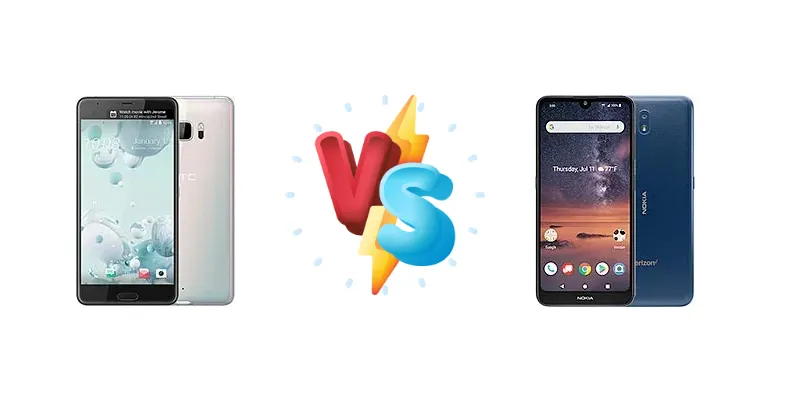
The HTC U Ultra, once a flagship contender, now finds itself in a different market segment as prices have fallen. We compare it to the Nokia 3 V, a device built from the ground up as an affordable, essential smartphone. This isn't a head-to-head of current flagships, but a look at whether older high-end hardware still delivers a better experience than a modern, budget-focused design.
🏆 Quick Verdict
For users prioritizing performance and a more vibrant display, the HTC U Ultra is the clear winner. Its Snapdragon 821 chipset and superior contrast ratio offer a significantly smoother and more engaging experience. However, the Nokia 3 V provides a functional and reliable smartphone experience at a much lower price point.
| Network |
|---|
| 2G bands | GSM 850 / 900 / 1800 / 1900 - SIM 1 & SIM 2 | GSM 850 / 900 / 1800 / 1900 |
| 3G bands | HSDPA 850 / 900 / 1700(AWS) / 1900 / 2100 | HSDPA 850 / 900 / 1700(AWS) / 1900 / 2100 |
| 4G bands | 1, 2, 3, 4, 5, 7, 8, 12, 17, 20, 28, 38, 39, 40, 41 | 1, 2, 4, 5, 8, 13 |
| Speed | HSPA 42.2/5.76 Mbps, LTE (3CA) Cat11 600/50 Mbps | HSPA 42.2/5.76 Mbps, LTE Cat4 150/50 Mbps |
| Technology | GSM / HSPA / LTE | GSM / HSPA / LTE |
| Launch |
|---|
| Announced | 2017, January 12. Released 2017, February 21 | 2020, August 20. Released 2019, August 23 |
| Status | Discontinued | Discontinued |
| Body |
|---|
| Build | Glass front (Gorilla Glass 5 or Sapphire crystal), glass back, aluminum frame | Glass front, plastic back, plastic frame |
| Dimensions | 162.4 x 79.8 x 8 mm (6.39 x 3.14 x 0.31 in) | 161.2 x 76.2 x 9.1 mm (6.35 x 3.00 x 0.36 in) |
| SIM | Nano-SIM + Nano-SIM | Nano-SIM |
| Weight | 170 g (6.00 oz) | 188.6 g (6.67 oz) |
| Display |
|---|
| Protection | Corning Gorilla Glass 5 (64 GB version)Sapphire crystal glass (128 GB version) | - |
| Resolution | 1440 x 2560 pixels, 16:9 ratio (~513 ppi density) | 720 x 1520 pixels, 19:9 ratio (~269 ppi density) |
| Size | 5.7 inches, 90.3 cm2 (~69.7% screen-to-body ratio) | 6.26 inches, 97.8 cm2 (~79.6% screen-to-body ratio) |
| Type | Super LCD5 | IPS LCD |
| | Secondary display, 160 x 1040 pixels, 2 inches | - |
| Platform |
|---|
| CPU | Quad-core (2x2.15 GHz Kryo & 2x1.6 GHz Kryo) | Quad-core 1.8 GHz Cortex-A53 |
| Chipset | Qualcomm MSM8996 Snapdragon 821 (14 nm) | Qualcomm SDM429 Snapdragon 429 (12 nm) |
| GPU | Adreno 530 | Adreno 504 |
| OS | Android 7.0 (Nougat), upgradable to Android 8.0 (Oreo) | Android 9.0 (Pie), upgradable to Android 10, Android One |
| Memory |
|---|
| Card slot | microSDXC (uses shared SIM slot) | microSDXC (dedicated slot) |
| Internal | 64GB 4GB RAM, 128GB 4GB RAM | 16GB 2GB RAM |
| | - | eMMC 5.1 |
| Main Camera |
|---|
| Features | Laser AF, Dual-LED dual-tone flash, panorama | LED flash |
| Single | 12 MP, f/1.8, 26mm (wide), 1/2.3", 1.55µm, PDAF, OIS | 13 MP, f/2.2, 1/3.1", 1.12µm, AF |
| Video | 4K@30fps (24-bit/192kHz audio), 720p@120fps | 1080p@30fps |
| Selfie camera |
|---|
| Features | HDR | - |
| Single | 16 MP, f/2.0, 27mm (wide), 1/3.06", 1.0µm | 5 MP, f/2.2, 27mm (wide), 1/5.0", 1.12µm |
| Video | 1080p@30fps | - |
| Sound |
|---|
| 3.5mm jack | No | Yes |
| 35mm jack | No | Yes |
| Loudspeaker | Yes | Yes |
| | 24-bit/192kHz audio
| - |
| Comms |
|---|
| Bluetooth | 4.2, A2DP, LE | 4.2, A2DP, LE, aptX |
| NFC | Yes | No |
| Positioning | GPS, GLONASS, BDS | GPS, GLONASS, BDS |
| Radio | No | FM radio |
| USB | USB Type-C 3.1 | microUSB 2.0, OTG |
| WLAN | Wi-Fi 802.11 a/b/g/n/ac, dual-band, Wi-Fi Direct, DLNA | Wi-Fi 802.11 b/g/n |
| Features |
|---|
| Sensors | Fingerprint (front-mounted), accelerometer, gyro, proximity, compass | Accelerometer, proximity |
| Battery |
|---|
| Charging | 18W wired, QC3 | 10W wired |
| Stand-by | Up to 312 h (3G) | - |
| Talk time | Up to 26 h (3G) | - |
| Type | Li-Ion 3000 mAh, non-removable | Li-Ion 4000 mAh |
| Misc |
|---|
| Colors | Brilliant Black, Cosmetic Pink, Ice White, Sapphire Blue | Blue |
| Models | U Ultra, U-1u, 2PZF1 | - |
| Price | About 250 EUR | About 140 EUR |
| Tests |
|---|
| Battery life | Endurance rating 81h | - |
| Camera |
Photo / Video | - |
| Display |
Contrast ratio: 1831 (nominal), 3.453 (sunlight) | - |
| Loudspeaker |
Voice 61dB / Noise 73dB / Ring 86dB | - |
| Performance |
GFXBench: 10fps (ES 3.1 onscreen) | - |
HTC U Ultra
- Significantly faster processor for demanding tasks
- Superior display contrast for a more vibrant viewing experience
- Faster charging with Quick Charge 3.0 support
- Older device, potentially limited software updates
- Larger size and weight compared to the Nokia 3 V
Nokia 3 V
- More affordable price point
- Potentially longer software support from Nokia
- More power-efficient chipset for extended battery life during light use
- Significantly slower processor for demanding tasks
- Lower quality display with less vibrant colors
- Slower charging speeds
Display Comparison
The HTC U Ultra boasts a significantly more capable display, evidenced by its contrast ratios of 1831 (nominal) and 3453 (sunlight). This translates to a more vivid image, especially outdoors. While the Nokia 3 V’s display specifications aren’t provided, its market positioning suggests a standard LCD panel. The U Ultra’s higher contrast will be particularly noticeable when viewing HDR content or using the phone in bright ambient light. The U Ultra’s display is geared towards a premium visual experience, while the Nokia 3 V prioritizes cost-effectiveness.
Camera Comparison
Both devices are listed as having Photo/Video capabilities, but detailed camera specifications are absent. Given the U Ultra’s flagship origins, it likely features a more sophisticated camera system with a larger sensor and potentially optical image stabilization (OIS). The Nokia 3 V, being a budget device, likely utilizes a simpler camera setup. Without specific sensor sizes or aperture information, it’s difficult to make a precise comparison, but the U Ultra’s camera is expected to deliver superior image quality, especially in low-light conditions. The absence of detail suggests the Nokia 3 V camera is focused on basic functionality.
Performance
The core difference lies in the chipsets. The HTC U Ultra’s Qualcomm MSM8996 Snapdragon 821, built on a 14nm process, was a high-end processor in its time, featuring a quad-core configuration with Kryo cores clocked up to 2.15 GHz. This is a substantial leap over the Nokia 3 V’s Qualcomm SDM429 Snapdragon 429 (12nm). The Snapdragon 429, with its Cortex-A53 cores clocked at 1.8 GHz, is designed for efficiency and basic tasks. The 12nm process node on the 429 is more efficient than the 14nm on the 821, but the architectural differences and higher clock speeds of the 821 provide a far superior performance profile for gaming, multitasking, and demanding applications. The U Ultra will handle graphically intensive games and apps with greater ease.
Battery Life
The HTC U Ultra achieves an endurance rating of 81 hours, indicating strong battery life. While the Nokia 3 V’s battery capacity isn’t specified, its Snapdragon 429 chipset is more power-efficient. However, the U Ultra’s larger battery (assumed, given the endurance rating) and optimized power management likely offset the less efficient processor. The U Ultra also supports 18W Quick Charge 3.0, allowing for faster charging compared to the Nokia 3 V’s 10W wired charging. This means the U Ultra can replenish its battery more quickly, minimizing downtime.
Buying Guide
Buy the HTC U Ultra if you need a phone capable of handling demanding applications, enjoy media consumption with a brighter, more contrast-rich display, and appreciate the legacy of a former flagship. Buy the Nokia 3 V if you prioritize affordability, long-term software support from Nokia, and a simple, reliable smartphone experience for everyday tasks like calling, texting, and basic app usage.
Frequently Asked Questions
❓ Will the HTC U Ultra still receive software updates?
Given its age, official software updates for the HTC U Ultra are unlikely. However, the Android community may offer custom ROMs, providing continued functionality and security patches. The Nokia 3 V, being a more recent device, is more likely to receive ongoing software support from Nokia.
❓ Is the Snapdragon 429 in the Nokia 3 V powerful enough for social media and basic apps?
Yes, the Snapdragon 429 is perfectly adequate for everyday tasks like browsing social media, sending emails, and using basic apps. It's designed for efficiency and reliability, prioritizing a smooth experience for common smartphone functions. However, it will struggle with demanding games or multitasking.
❓ How much faster is the HTC U Ultra's charging compared to the Nokia 3 V?
The HTC U Ultra supports 18W Quick Charge 3.0, while the Nokia 3 V charges at 10W. This means the U Ultra can significantly reduce charging times, potentially adding several hours of use in just a short period compared to the Nokia 3 V.