
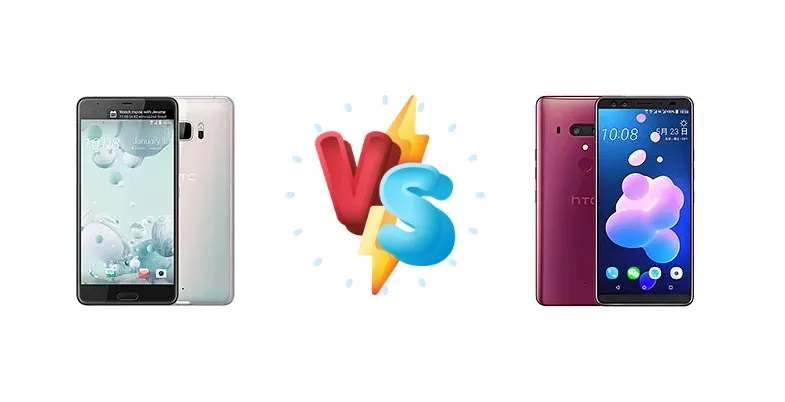
HTC U Ultra vs. HTC U12+: Which Flagship Reigns Supreme?
| Phones Images | |||||
|---|---|---|---|---|---|
|
🏆 Quick Verdict
For most users, the HTC U12+ is the superior choice. While it sacrifices some battery endurance, the significantly faster Snapdragon 845 chipset delivers a noticeably smoother and more responsive experience, making it better suited for demanding tasks and future-proofing. The U Ultra remains viable for battery-focused users.
| PHONES | ||
|---|---|---|
| Phone Names | HTC U Ultra | HTC U12+ |
| Network | ||
|---|---|---|
| 2G bands | GSM 850 / 900 / 1800 / 1900 - SIM 1 & SIM 2 | GSM 850 / 900 / 1800 / 1900 - SIM 1 & SIM 2 (dual-SIM model only) |
| 3G bands | HSDPA 850 / 900 / 1700(AWS) / 1900 / 2100 | HSDPA 850 / 900 / 1700(AWS) / 1900 / 2100 |
| 4G bands | 1, 2, 3, 4, 5, 7, 8, 12, 17, 20, 28, 38, 39, 40, 41 | 1, 2, 3, 4, 5, 7, 8, 12, 13, 17, 20, 28, 32, 38, 39, 49, 41, 66 |
| Speed | HSPA 42.2/5.76 Mbps, LTE (3CA) Cat11 600/50 Mbps | HSPA 42.2/5.76 Mbps, LTE-A (5CA) Cat18 1200/150 Mbps |
| Technology | GSM / HSPA / LTE | GSM / HSPA / LTE |
| Launch | ||
|---|---|---|
| Announced | 2017, January 12. Released 2017, February 21 | 2018, May 23 |
| Status | Discontinued | Available. Released 2018, June 29 |
| Body | ||
|---|---|---|
| Build | Glass front (Gorilla Glass 5 or Sapphire crystal), glass back, aluminum frame | Glass front (Gorilla Glass 3), glass back, aluminum frame |
| Dimensions | 162.4 x 79.8 x 8 mm (6.39 x 3.14 x 0.31 in) | 156.6 x 73.9 x 8.7 mm (6.17 x 2.91 x 0.34 in) |
| SIM | Nano-SIM + Nano-SIM | Single SIM (Nano-SIM) or Hybrid Dual SIM (Nano-SIM, dual stand-by) |
| Weight | 170 g (6.00 oz) | 188 g (6.63 oz) |
| - | IP68 dust/water resistant (up to 1.5m for 30 mins) Pressure-sensitive buttons | |
| Display | ||
|---|---|---|
| Protection | Corning Gorilla Glass 5 (64 GB version)Sapphire crystal glass (128 GB version) | Corning Gorilla Glass 3 |
| Resolution | 1440 x 2560 pixels, 16:9 ratio (~513 ppi density) | 1440 x 2880 pixels, 18:9 ratio (~537 ppi density) |
| Size | 5.7 inches, 90.3 cm2 (~69.7% screen-to-body ratio) | 6.0 inches, 92.9 cm2 (~80.3% screen-to-body ratio) |
| Type | Super LCD5 | Super LCD6, HDR10 |
| Secondary display, 160 x 1040 pixels, 2 inches | - | |
| Platform | ||
|---|---|---|
| CPU | Quad-core (2x2.15 GHz Kryo & 2x1.6 GHz Kryo) | Octa-core (4x2.8 GHz Kryo 385 Gold & 4x1.7 GHz Kryo 385 Silver) |
| Chipset | Qualcomm MSM8996 Snapdragon 821 (14 nm) | Qualcomm SDM845 Snapdragon 845 (10 nm) |
| GPU | Adreno 530 | Adreno 630 |
| OS | Android 7.0 (Nougat), upgradable to Android 8.0 (Oreo) | Android 8.0 (Oreo), upgradable to Android 9.0 (Pie), Sense UI |
| Memory | ||
|---|---|---|
| Card slot | microSDXC (uses shared SIM slot) | microSDXC (uses shared SIM slot) |
| Internal | 64GB 4GB RAM, 128GB 4GB RAM | 64GB 6GB RAM, 128GB 6GB RAM |
| Main Camera | ||
|---|---|---|
| Dual | - | 12 MP, f/1.8, 1/2.55", 1.4µm, dual pixel PDAF, Laser AF, OIS 16 MP (12 MP effective), f/2.6, 1/3.1", 1.0µm, 2x optical zoom, AF |
| Features | Laser AF, Dual-LED dual-tone flash, panorama | Dual-LED dual-tone flash, HDR |
| Single | 12 MP, f/1.8, 26mm (wide), 1/2.3", 1.55µm, PDAF, OIS | - |
| Video | 4K@30fps (24-bit/192kHz audio), 720p@120fps | 4K@60fps, 1080p@60/240fps, 1080p@30fps (gyro-EIS), HDR, 24-bit/96kHz stereo sound rec. |
| Selfie camera | ||
|---|---|---|
| Dual | - | 8 MP, f/2.0, 1/4", 1.12µm 8 MP, f/2.0, 1/4", 1.12µm |
| Features | HDR | HDR, panorama |
| Single | 16 MP, f/2.0, 27mm (wide), 1/3.06", 1.0µm | - |
| Video | 1080p@30fps | 1080p@30fps |
| Sound | ||
|---|---|---|
| 3.5mm jack | No | No |
| 35mm jack | No | - |
| Loudspeaker | Yes | Yes, with stereo speakers |
| 24-bit/192kHz audio | 32-bit/384kHz audio | |
| Comms | ||
|---|---|---|
| Bluetooth | 4.2, A2DP, LE | 5.0, A2DP, aptX HD, LE |
| NFC | Yes | Yes |
| Positioning | GPS, GLONASS, BDS | GPS, GLONASS, GALILEO, BDS |
| Radio | No | No |
| USB | USB Type-C 3.1 | USB Type-C 3.1 |
| WLAN | Wi-Fi 802.11 a/b/g/n/ac, dual-band, Wi-Fi Direct, DLNA | Wi-Fi 802.11 a/b/g/n/ac, dual-band, Wi-Fi Direct, DLNA |
| Features | ||
|---|---|---|
| Sensors | Fingerprint (front-mounted), accelerometer, gyro, proximity, compass | Fingerprint (rear-mounted), accelerometer, gyro, proximity, compass |
| Battery | ||
|---|---|---|
| Charging | 18W wired, QC3 | 18W wired, QC3, 50% in 35 min (advertised) |
| Stand-by | Up to 312 h (3G) | - |
| Talk time | Up to 26 h (3G) | Up to 24 h (3G) |
| Type | Li-Ion 3000 mAh, non-removable | Li-Ion 3500 mAh, non-removable |
| Misc | ||
|---|---|---|
| Colors | Brilliant Black, Cosmetic Pink, Ice White, Sapphire Blue | Translucent Blue, Ceramic Black, Flame Red |
| Models | U Ultra, U-1u, 2PZF1 | U12, 2Q55100 |
| Price | About 250 EUR | About 450 EUR |
| Tests | ||
|---|---|---|
| Audio quality | - | Noise -93.7dB / Crosstalk -52.7dB |
| Battery life | Endurance rating 81h | Endurance rating 64h |
| Camera | Photo / Video | Photo / Video |
| Display | Contrast ratio: 1831 (nominal), 3.453 (sunlight) | Contrast ratio: 1818:1 (nominal), 3.085 (sunlight) |
| Loudspeaker | Voice 61dB / Noise 73dB / Ring 86dB | Voice 77dB / Noise 73dB / Ring 99dB |
| Performance | GFXBench: 10fps (ES 3.1 onscreen) | AnTuTu: 263696 (v7) GeekBench: 9001 (v4.4) GFXBench: 20fps (ES 3.1 onscreen) |
HTC U Ultra
- Exceptional battery life (81h endurance)
- Slightly higher nominal display contrast
- Unique secondary display functionality
- Older Snapdragon 821 processor
- Less powerful GPU for gaming
- Potentially slower camera performance
HTC U12+
- Significantly faster Snapdragon 845 processor
- Improved GPU performance for gaming
- Faster charging capabilities (50% in 35 min)
- More immersive, nearly bezel-less display
- Lower battery endurance (64h)
- Slightly lower nominal display contrast
- Potentially higher price (depending on current market)
Display Comparison
Both the U Ultra and U12+ feature displays with excellent contrast ratios, with the U Ultra achieving 1831:1 (nominal) and 3.453 (sunlight) compared to the U12+'s 1818:1 and 3.085 (sunlight). While the U Ultra boasts slightly higher contrast in nominal conditions, the difference is unlikely to be perceptible to most users. Both phones lack high refresh rate panels, a common feature in modern flagships. The U12+’s design incorporates a nearly bezel-less display, offering a more immersive viewing experience, though the U Ultra’s secondary display offered a unique, if niche, functionality.
Camera Comparison
Both devices are listed as having Photo/Video capabilities, but detailed sensor information is missing. However, given the U12+'s positioning as a flagship, it likely features a more advanced camera system with a larger sensor and improved image processing. The U12+ benefits from the Snapdragon 845’s enhanced image signal processor (ISP), enabling faster image capture and improved low-light performance. The U Ultra, while capable, would likely struggle to match the U12+'s image quality in challenging conditions. The absence of detailed camera specs prevents a more granular comparison.
Performance
The performance gap between the U Ultra and U12+ is substantial. The U Ultra’s Snapdragon 821, built on a 14nm process, features a quad-core CPU. The U12+, however, utilizes the Snapdragon 845, fabricated on a more efficient 10nm process, and boasts an octa-core CPU. This translates to a significant performance uplift in the U12+, particularly in demanding applications and games. The 845’s Kryo 385 cores, with peak speeds of 2.8 GHz, offer a considerable advantage over the 821’s 2.15 GHz Kryo cores. While both phones likely feature similar RAM configurations, the 845’s improved memory controller contributes to faster overall system responsiveness.
Battery Life
The HTC U Ultra holds a clear advantage in endurance, boasting an 81-hour rating. The U12+, despite featuring Quick Charge 3.0 and an advertised 50% charge in 35 minutes, has a lower endurance rating of 64 hours. This suggests that the more powerful Snapdragon 845 consumes more power, offsetting any gains from the more efficient 10nm process. Users prioritizing all-day battery life will likely prefer the U Ultra, while those willing to trade some endurance for performance may opt for the U12+.
Buying Guide
Buy the HTC U Ultra if you prioritize exceptional battery life and are comfortable with a slightly older processor. It’s ideal for users who primarily browse, communicate, and consume media. Buy the HTC U12+ if you demand the best possible performance for gaming, multitasking, and camera-intensive applications. It’s the better option for power users and those who want a phone that will remain responsive for years to come.