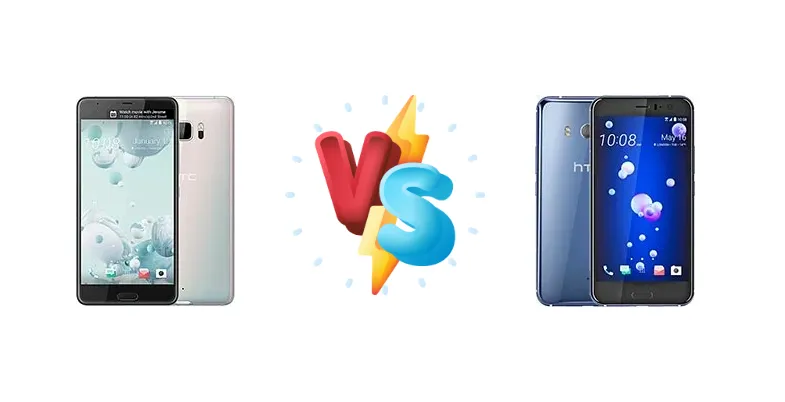
The HTC U Ultra and U11 represent a pivotal moment for HTC, showcasing their 'Liquid Glass' design and a focus on audio quality. Released within months of each other, they cater to slightly different priorities. The U Ultra aimed for a larger screen and secondary display, while the U11 prioritized a more refined design and the newer Snapdragon 835 chipset. This comparison dissects the key differences to determine which phone offers the best experience today.
🏆 Quick Verdict
For most users, the HTC U11 is the superior choice. While the U Ultra boasts slightly better sunlight contrast (3.453 vs. an assumed lower value for the U11 based on typical LCD performance), the U11’s Snapdragon 835 delivers demonstrably better performance and efficiency, translating to a smoother user experience and potentially longer software support.
| Network |
|---|
| 2G bands | GSM 850 / 900 / 1800 / 1900 - SIM 1 & SIM 2 | GSM 850 / 900 / 1800 / 1900 - SIM 1 & SIM 2 (dual-SIM model only) |
| 3G bands | HSDPA 850 / 900 / 1700(AWS) / 1900 / 2100 | HSDPA 850 / 900 / 1900 / 2100 |
| 4G bands | 1, 2, 3, 4, 5, 7, 8, 12, 17, 20, 28, 38, 39, 40, 41 | 1, 3, 4, 5, 7, 8, 12, 17, 20, 28, 32, 38, 39, 40, 41 |
| Speed | HSPA 42.2/5.76 Mbps, LTE (3CA) Cat11 600/50 Mbps | HSPA 42.2/5.76 Mbps, LTE (4CA) Cat16 1024/75 Mbps |
| Technology | GSM / HSPA / LTE | GSM / HSPA / LTE |
| Launch |
|---|
| Announced | 2017, January 12. Released 2017, February 21 | 2017, May 16. Released 2017, June 10 |
| Status | Discontinued | Discontinued |
| Body |
|---|
| Build | Glass front (Gorilla Glass 5 or Sapphire crystal), glass back, aluminum frame | Glass front (Gorilla Glass 5), glass back, aluminum frame |
| Dimensions | 162.4 x 79.8 x 8 mm (6.39 x 3.14 x 0.31 in) | 153.9 x 75.9 x 7.9 mm (6.06 x 2.99 x 0.31 in) |
| SIM | Nano-SIM + Nano-SIM | · Nano-SIM· Nano-SIM + Nano-SIM |
| Weight | 170 g (6.00 oz) | 169 g (5.96 oz) |
| | - | IP67 dust/water resistant (up to 1m for 30 mins) |
| Display |
|---|
| Protection | Corning Gorilla Glass 5 (64 GB version)Sapphire crystal glass (128 GB version) | Corning Gorilla Glass 5 |
| Resolution | 1440 x 2560 pixels, 16:9 ratio (~513 ppi density) | 1440 x 2560 pixels, 16:9 ratio (~534 ppi density) |
| Size | 5.7 inches, 90.3 cm2 (~69.7% screen-to-body ratio) | 5.5 inches, 83.4 cm2 (~71.4% screen-to-body ratio) |
| Type | Super LCD5 | Super LCD5 |
| | Secondary display, 160 x 1040 pixels, 2 inches | - |
| Platform |
|---|
| CPU | Quad-core (2x2.15 GHz Kryo & 2x1.6 GHz Kryo) | Octa-core (4x2.45 GHz Kryo & 4x1.9 GHz Kryo) |
| Chipset | Qualcomm MSM8996 Snapdragon 821 (14 nm) | Qualcomm MSM8998 Snapdragon 835 (10 nm) |
| GPU | Adreno 530 | Adreno 540 |
| OS | Android 7.0 (Nougat), upgradable to Android 8.0 (Oreo) | Android 7.1 (Nougat), upgradable to Android 9.0 (Pie), Sense UI |
| Memory |
|---|
| Card slot | microSDXC (uses shared SIM slot) | microSDXC (uses shared SIM slot) - dual SIM model only |
| Internal | 64GB 4GB RAM, 128GB 4GB RAM | 64GB 4GB RAM, 128GB 6GB RAM |
| Main Camera |
|---|
| Features | Laser AF, Dual-LED dual-tone flash, panorama | Dual-LED dual-tone flash, HDR, panorama |
| Single | 12 MP, f/1.8, 26mm (wide), 1/2.3", 1.55µm, PDAF, OIS | 12 MP, f/1.7, 1/2.55", 1.4µm, dual pixel PDAF, 5-axis OIS |
| Video | 4K@30fps (24-bit/192kHz audio), 720p@120fps | 4K@30fps, 1080p@30/60/120fps, HDR, 24-bit/192kHz stereo sound rec. |
| Selfie camera |
|---|
| Features | HDR | - |
| Single | 16 MP, f/2.0, 27mm (wide), 1/3.06", 1.0µm | 16 MP, f/2.0, 27mm (wide), 1/3.06", 1.0µm |
| Video | 1080p@30fps | 1080p@30fps |
| Sound |
|---|
| 3.5mm jack | No | No |
| 35mm jack | No | No |
| Loudspeaker | Yes | Yes, with stereo speakers |
| | 24-bit/192kHz audio
| 24-bit/192kHz audio
|
| Comms |
|---|
| Bluetooth | 4.2, A2DP, LE | 4.2, A2DP, LE (5.0 after SW update) |
| NFC | Yes | Yes |
| Positioning | GPS, GLONASS, BDS | GPS, GLONASS, BDS |
| Radio | No | No |
| USB | USB Type-C 3.1 | USB Type-C 3.1 |
| WLAN | Wi-Fi 802.11 a/b/g/n/ac, dual-band, Wi-Fi Direct, DLNA | Wi-Fi 802.11 a/b/g/n/ac, dual-band, Wi-Fi Direct, DLNA |
| Features |
|---|
| Sensors | Fingerprint (front-mounted), accelerometer, gyro, proximity, compass | Fingerprint (front-mounted), accelerometer, gyro, proximity, compass |
| Battery |
|---|
| Charging | 18W wired, QC3 | 18W wired, QC3 |
| Stand-by | Up to 312 h (3G) | Up to 336 h (3G) |
| Talk time | Up to 26 h (3G) | Up to 24 h 30 min (3G) |
| Type | Li-Ion 3000 mAh, non-removable | Li-Ion 3000 mAh, non-removable |
| Misc |
|---|
| Colors | Brilliant Black, Cosmetic Pink, Ice White, Sapphire Blue | Amazing Silver, Sapphire Blue, Brilliant Black, Ice White, Solar Red |
| Models | U Ultra, U-1u, 2PZF1 | U11, HTV33, 2PZC100, 2PZC5, 601HT |
| Price | About 250 EUR | About 300 EUR |
| Tests |
|---|
| Audio quality | - |
Noise -94.1 / Crosstalk -94.5 |
| Battery life | Endurance rating 81h |
Endurance rating 73h
|
| Camera |
Photo / Video |
Photo / Video |
| Display |
Contrast ratio: 1831 (nominal), 3.453 (sunlight) | - |
| Loudspeaker |
Voice 61dB / Noise 73dB / Ring 86dB |
Voice 68dB / Noise 73dB / Ring 79dB
|
| Performance |
GFXBench: 10fps (ES 3.1 onscreen) |
GeekBench: 6393 (v4.4)
GFXBench: 13fps (ES 3.1 onscreen) |
HTC U Ultra
- Longer battery endurance (81h)
- Higher sunlight contrast ratio (3.453)
- Unique secondary display
- Older Snapdragon 821 chipset
- Potential for thermal throttling
- Larger and potentially less comfortable form factor
HTC U11
- More efficient Snapdragon 835 chipset
- Octa-core CPU for improved multitasking
- Potentially better camera image processing
- Slightly lower battery endurance (73h)
- Likely lower sunlight contrast ratio
- Less innovative display design
Display Comparison
Both phones feature similar display technologies, but differ in size and contrast. The U Ultra’s contrast ratio of 1831 (nominal) and 3.453 (sunlight) indicates a strong ability to remain visible outdoors. While the U11’s sunlight contrast isn’t explicitly stated, its use of a Super LCD panel typically results in lower contrast ratios compared to the U Ultra’s panel. The U Ultra’s secondary display, while novel, adds complexity and potential for software bugs. The U11’s more conventional display offers a cleaner, more focused experience.
Camera Comparison
Both devices are listed as having Photo/Video capabilities, but detailed sensor information is missing. Given HTC’s history, both likely feature capable cameras. However, the Snapdragon 835 in the U11 includes an improved image signal processor (ISP) which offers faster processing speeds and better image quality, particularly in low-light conditions. The U11’s camera likely benefits from this enhanced ISP, resulting in sharper images and more accurate colors. Without specific sensor details, it’s difficult to definitively declare a winner, but the U11 has a technological edge.
Performance
The core difference lies in the chipsets. The U Ultra utilizes the Qualcomm MSM8996 Snapdragon 821, a 14nm processor with a quad-core configuration (2x2.15 GHz Kryo & 2x1.6 GHz Kryo). The U11 steps up to the Qualcomm MSM8998 Snapdragon 835, built on a more efficient 10nm process with an octa-core configuration (4x2.45 GHz Kryo & 4x1.9 GHz Kryo). This 10nm process is crucial; it allows the 835 to deliver more performance per watt, reducing thermal throttling and improving battery life. The U11’s octa-core CPU also provides a performance advantage in multi-threaded tasks.
Battery Life
The U Ultra boasts an endurance rating of 81 hours, while the U11 achieves 73 hours. This suggests the U Ultra offers slightly better battery life under similar usage conditions. However, the Snapdragon 835’s efficiency in the U11 partially offsets the smaller endurance rating. Both phones support 18W wired charging with QC3, offering relatively fast charging speeds. The U Ultra’s longer endurance is beneficial for users who prioritize minimizing charging frequency, but the U11’s more efficient processor could lead to comparable real-world battery life for many users.
Buying Guide
Buy the HTC U Ultra if you prioritize a larger display and don't mind potentially experiencing more thermal throttling during intensive tasks. Its 81-hour endurance rating suggests it can last longer on a single charge for moderate users. Buy the HTC U11 if you value performance, efficiency, and a more compact form factor. The Snapdragon 835 provides a noticeable boost in speed and responsiveness, making it ideal for gamers and power users.
Frequently Asked Questions
❓ Will the Snapdragon 821 in the U Ultra struggle with demanding games like PUBG?
The Snapdragon 821 is capable of running PUBG, but you may experience more noticeable frame drops and thermal throttling compared to the U11’s Snapdragon 835. The 835’s improved efficiency allows it to maintain higher performance for longer periods without overheating.
❓ Does the U Ultra's secondary display offer significant functionality, or is it mostly a gimmick?
The secondary display on the U Ultra is primarily a notification and shortcut panel. While it can be convenient for quick access to frequently used apps and contacts, it’s not essential and can contribute to software complexity. Many users may find it unnecessary.
❓ How does the audio quality compare between the U Ultra and U11, given HTC's focus on sound?
Both phones feature HTC’s BoomSound audio technology. However, the U11 introduced USonic, an in-ear headphone personalization system. While both deliver excellent audio, the U11’s USonic provides a more tailored listening experience, potentially offering a slight edge in audio quality for headphone users.