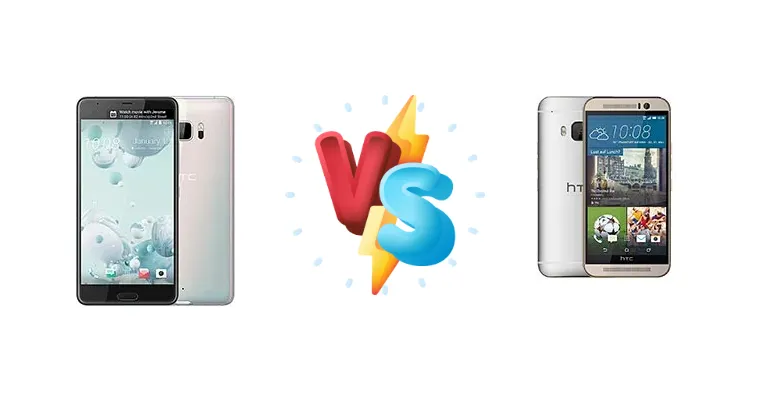
The HTC U Ultra and One M9 represent distinct eras in HTC’s flagship strategy. The One M9, released in 2015, aimed for premium build quality and a refined Metal Unibody design. The U Ultra, arriving in 2017, pivoted towards a more glass-focused aesthetic and leveraged the newer Snapdragon 821. This comparison dissects the core differences between these two devices, focusing on areas where advancements in chipset and display technology truly impact the user experience.
🏆 Quick Verdict
For most users today, the HTC U Ultra is the superior choice. Its Snapdragon 821 offers a noticeable performance boost over the One M9’s Snapdragon 810, and the significantly improved display contrast ratio and battery endurance make it a more enjoyable daily driver. While both support Quick Charge, the U Ultra’s QC3 is a slight advantage.
| Network |
|---|
| 2G bands | GSM 850 / 900 / 1800 / 1900 - SIM 1 & SIM 2 | GSM 850 / 900 / 1800 / 1900 |
| 3G bands | HSDPA 850 / 900 / 1700(AWS) / 1900 / 2100 | HSDPA 850 / 900 / 1900 / 2100 |
| 4G bands | 1, 2, 3, 4, 5, 7, 8, 12, 17, 20, 28, 38, 39, 40, 41 | 1, 3, 5, 7, 8, 20, 28, 38, 40, 41 |
| Speed | HSPA 42.2/5.76 Mbps, LTE (3CA) Cat11 600/50 Mbps | HSPA 42.2/21.1 Mbps, LTE Cat6 300/50 Mbps |
| Technology | GSM / HSPA / LTE | GSM / HSPA / LTE |
| Launch |
|---|
| Announced | 2017, January 12. Released 2017, February 21 | 2015, March 01. Released 2015, March 09 |
| Status | Discontinued | Discontinued |
| Body |
|---|
| Build | Glass front (Gorilla Glass 5 or Sapphire crystal), glass back, aluminum frame | Glass front (Gorilla Glass 3), aluminum back, aluminum frame |
| Dimensions | 162.4 x 79.8 x 8 mm (6.39 x 3.14 x 0.31 in) | 144.6 x 69.7 x 9.6 mm (5.69 x 2.74 x 0.38 in) |
| SIM | Nano-SIM + Nano-SIM | Nano-SIM |
| Weight | 170 g (6.00 oz) | 157 g (5.54 oz) |
| Display |
|---|
| Protection | Corning Gorilla Glass 5 (64 GB version)Sapphire crystal glass (128 GB version) | Corning Gorilla Glass 3 |
| Resolution | 1440 x 2560 pixels, 16:9 ratio (~513 ppi density) | 1080 x 1920 pixels, 16:9 ratio (~441 ppi density) |
| Size | 5.7 inches, 90.3 cm2 (~69.7% screen-to-body ratio) | 5.0 inches, 68.9 cm2 (~68.4% screen-to-body ratio) |
| Type | Super LCD5 | Super LCD3 |
| | Secondary display, 160 x 1040 pixels, 2 inches | - |
| Platform |
|---|
| CPU | Quad-core (2x2.15 GHz Kryo & 2x1.6 GHz Kryo) | Octa-core (4x1.5 GHz Cortex-A53 & 4x2.0 GHz Cortex-A57) |
| Chipset | Qualcomm MSM8996 Snapdragon 821 (14 nm) | Qualcomm MSM8994 Snapdragon 810 (20 nm) |
| GPU | Adreno 530 | Adreno 430 |
| OS | Android 7.0 (Nougat), upgradable to Android 8.0 (Oreo) | Android 5.0 (Lollipop), upgradable to 7.0 (Nougat), Sense UI 7 |
| Memory |
|---|
| Card slot | microSDXC (uses shared SIM slot) | microSDXC (dedicated slot) |
| Internal | 64GB 4GB RAM, 128GB 4GB RAM | 32GB 3GB RAM |
| | - | eMMC 5.0 |
| Main Camera |
|---|
| Features | Laser AF, Dual-LED dual-tone flash, panorama | Dual-LED dual-tone flash, HDR, panorama |
| Single | 12 MP, f/1.8, 26mm (wide), 1/2.3", 1.55µm, PDAF, OIS | 20 MP, f/2.2, 28mm (wide), 1/2.4", 1.2µm, AF |
| Video | 4K@30fps (24-bit/192kHz audio), 720p@120fps | 4K@30fps, 1080p@60fps, 720p@120fps, HDR, stereo sound rec. |
| Selfie camera |
|---|
| Features | HDR | HDR |
| Single | 16 MP, f/2.0, 27mm (wide), 1/3.06", 1.0µm | 4 MP, f/2.0, 27mm (wide), 1/3", 2µm |
| Video | 1080p@30fps | 1080p@30fps |
| Sound |
|---|
| 3.5mm jack | No | Yes |
| 35mm jack | No | Yes |
| Loudspeaker | Yes | Yes, with stereo speakers |
| | 24-bit/192kHz audio
| 24-bit/192kHz audio
|
| Comms |
|---|
| Bluetooth | 4.2, A2DP, LE | 4.1, A2DP, aptX |
| Infrared port | - | Yes |
| NFC | Yes | Yes |
| Positioning | GPS, GLONASS, BDS | GPS, GLONASS |
| Radio | No | Stereo FM radio, RDS |
| USB | USB Type-C 3.1 | microUSB 2.0 (MHL 3.0 TV-out), OTG |
| WLAN | Wi-Fi 802.11 a/b/g/n/ac, dual-band, Wi-Fi Direct, DLNA | Wi-Fi 802.11 a/b/g/n/ac, dual-band, Wi-Fi Direct, DLNA, hotspot |
| Features |
|---|
| Sensors | Fingerprint (front-mounted), accelerometer, gyro, proximity, compass | Accelerometer, gyro, proximity, compass |
| Battery |
|---|
| Charging | 18W wired, QC3 | 18W wired, QC2 |
| Stand-by | Up to 312 h (3G) | Up to 391 h (2G) / Up to 402 h (3G) |
| Talk time | Up to 26 h (3G) | Up to 25 h 20 min (2G) / Up to 21 h 50 min (3G) |
| Type | Li-Ion 3000 mAh, non-removable | Li-Po 2840 mAh, non-removable |
| Misc |
|---|
| Colors | Brilliant Black, Cosmetic Pink, Ice White, Sapphire Blue | Gunmetal Gray, Amber Gold, Silver/Rose gold, Gold/Pink, Pink |
| Models | U Ultra, U-1u, 2PZF1 | One M9, M9u, 0PJA2, HTC6535LVW, M9pw, M9, 0PJA10 |
| Price | About 250 EUR | About 360 EUR |
| Tests |
|---|
| Audio quality | - |
Noise -94.8dB / Crosstalk -93.7dB |
| Battery life | Endurance rating 81h |
Endurance rating 62h
|
| Camera |
Photo / Video |
Photo / Video |
| Display |
Contrast ratio: 1831 (nominal), 3.453 (sunlight) |
Contrast ratio: 1221:1 (nominal), 2.334 (sunlight) |
| Loudspeaker |
Voice 61dB / Noise 73dB / Ring 86dB |
Voice 65dB / Noise 64dB / Ring 76dB
|
| Performance |
GFXBench: 10fps (ES 3.1 onscreen) |
Basemark OS II 2.0: 1365Basemark X: 19848 |
HTC U Ultra
- Superior performance with Snapdragon 821
- Significantly better display contrast ratio
- Longer battery life (81h endurance)
- Likely higher price point (at launch)
- Glass design may be more prone to scratches
HTC One M9
- Classic HTC Metal Unibody design
- More affordable (especially now)
- Quick Charge 2.0 support
- Inferior performance with Snapdragon 810
- Lower display contrast ratio
- Shorter battery life (62h endurance)
Display Comparison
The HTC U Ultra boasts a significantly superior display experience. Its contrast ratio of 1831 (nominal) and 3.453 (sunlight) dramatically outperforms the One M9’s 1221:1 and 2.334 respectively. This translates to deeper blacks, more vivid colors, and improved visibility in bright outdoor conditions. While both utilize similar display technologies for the time, the U Ultra’s higher contrast ratio is a tangible benefit for media consumption and general usability. The improved sunlight readability is particularly crucial for users who spend a lot of time outdoors.
Camera Comparison
Both devices feature capable camera systems, but detailed specifications are limited in the provided data. However, the U Ultra likely benefits from advancements in image processing algorithms and potentially a larger sensor, common improvements between 2015 and 2017 flagship cameras. The focus on 'Photo / Video' capabilities for both suggests a similar emphasis on multimedia capture, but the U Ultra’s more powerful processor would allow for faster image processing and potentially better low-light performance. Without specific sensor size or aperture data, a definitive camera comparison is difficult.
Performance
The shift from the Snapdragon 810 in the One M9 to the Snapdragon 821 in the U Ultra represents a substantial performance upgrade. The 821, built on a 14nm process versus the 810’s 20nm, offers improved efficiency and thermal management. While the One M9’s octa-core configuration (4x1.5 GHz Cortex-A53 & 4x2.0 GHz Cortex-A57) appears more numerous, the U Ultra’s quad-core Kryo setup (2x2.15 GHz & 2x1.6 GHz) delivers superior single-core and multi-core performance. This means faster app loading times, smoother multitasking, and a more responsive user experience, especially for graphically intensive games.
Battery Life
The HTC U Ultra’s endurance rating of 81 hours significantly exceeds the One M9’s 62 hours. This improvement isn’t solely due to battery capacity (not specified in the data), but also the more efficient Snapdragon 821 processor and its 14nm manufacturing process. Both devices support 18W wired charging with Quick Charge technology, but the U Ultra utilizes QC3, offering potentially faster charging speeds and improved efficiency compared to the One M9’s QC2. This translates to less time tethered to a charger and more time using the device.
Buying Guide
Buy the HTC U Ultra if you prioritize performance for demanding apps and games, and value a brighter, more vibrant display with longer battery life. It’s the better option for users who frequently consume media or rely on their phone throughout the day. Buy the HTC One M9 if you are on a very tight budget and appreciate the classic HTC Metal Unibody design, but be prepared for compromises in performance and battery life. It’s suitable for basic smartphone tasks and users who don’t heavily stress their device.
Frequently Asked Questions
❓ Does the Snapdragon 810 in the One M9 suffer from significant thermal throttling under sustained load?
The Snapdragon 810 was known to experience thermal throttling under prolonged heavy use, particularly during gaming. While not a complete deal-breaker, users may notice performance dips during extended gaming sessions or video recording. The U Ultra’s Snapdragon 821, with its 14nm process, is significantly more efficient and less prone to throttling.
❓ Is the difference in display contrast ratio between the U Ultra and One M9 noticeable in everyday use?
Absolutely. The U Ultra’s much higher contrast ratio (1831 vs 1221:1) results in deeper blacks and more vibrant colors. This is particularly noticeable when viewing photos, videos, or playing games. The improved sunlight readability also makes the U Ultra a better choice for outdoor use.
❓ Will I see a significant performance improvement in gaming moving from the One M9 to the U Ultra?
Yes. The Snapdragon 821 in the U Ultra offers a substantial performance boost over the 810 in the One M9. This translates to higher frame rates, smoother gameplay, and faster loading times in demanding mobile games. The U Ultra’s more efficient processor also helps to maintain consistent performance over longer gaming sessions.