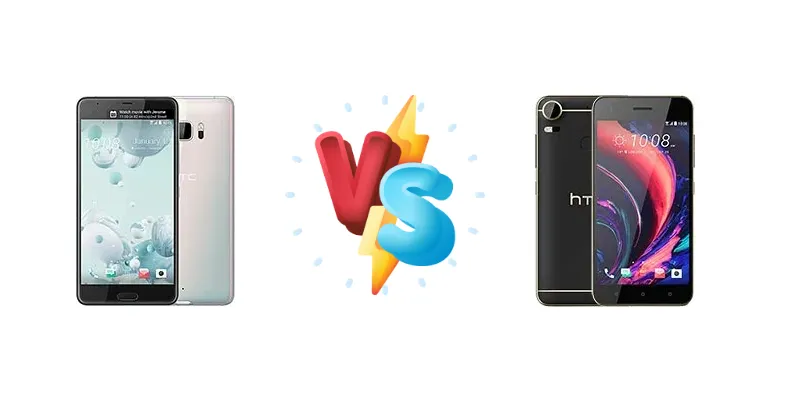
Released in different eras and targeting distinct price points, the HTC U Ultra and Desire 10 Pro represent contrasting approaches to the smartphone market. The U Ultra aimed for a premium experience with flagship internals, while the Desire 10 Pro focused on delivering a solid feature set at a more accessible price. This comparison dissects their key differences to help you determine which device best suits your needs.
🏆 Quick Verdict
For users prioritizing performance and display quality, the HTC U Ultra is the clear winner. Its Snapdragon 821 chipset and superior display contrast ratio offer a significantly smoother and more vibrant experience. However, the Desire 10 Pro remains a viable option for budget-conscious buyers who prioritize battery life and don't demand top-tier processing power.
| Network |
|---|
| 2G bands | GSM 850 / 900 / 1800 / 1900 - SIM 1 & SIM 2 | GSM 850 / 900 / 1800 / 1900 - SIM 1 & SIM 2 |
| 3G bands | HSDPA 850 / 900 / 1700(AWS) / 1900 / 2100 | HSDPA 850 / 900 / 1900 / 2100 |
| 4G bands | 1, 2, 3, 4, 5, 7, 8, 12, 17, 20, 28, 38, 39, 40, 41 | 1, 3, 5, 7, 8, 20, 28, 38, 40 |
| Speed | HSPA 42.2/5.76 Mbps, LTE (3CA) Cat11 600/50 Mbps | HSPA 42.2/5.76 Mbps, LTE (2CA) Cat6 300/50 Mbps |
| Technology | GSM / HSPA / LTE | GSM / HSPA / LTE |
| Launch |
|---|
| Announced | 2017, January 12. Released 2017, February 21 | 2016, September 20. Released 2016, December 20 |
| Status | Discontinued | Discontinued |
| Body |
|---|
| Build | Glass front (Gorilla Glass 5 or Sapphire crystal), glass back, aluminum frame | Glass front (Gorilla Glass), aluminum back, aluminum frame |
| Dimensions | 162.4 x 79.8 x 8 mm (6.39 x 3.14 x 0.31 in) | 156.5 x 76 x 7.9 mm (6.16 x 2.99 x 0.31 in) |
| SIM | Nano-SIM + Nano-SIM | Nano-SIM + Nano-SIM |
| Weight | 170 g (6.00 oz) | 165 g (5.82 oz) |
| Display |
|---|
| Protection | Corning Gorilla Glass 5 (64 GB version)Sapphire crystal glass (128 GB version) | Corning Gorilla Glass (unspecified version) |
| Resolution | 1440 x 2560 pixels, 16:9 ratio (~513 ppi density) | 1080 x 1920 pixels, 16:9 ratio (~400 ppi density) |
| Size | 5.7 inches, 90.3 cm2 (~69.7% screen-to-body ratio) | 5.5 inches, 83.8 cm2 (~70.5% screen-to-body ratio) |
| Type | Super LCD5 | IPS LCD |
| | Secondary display, 160 x 1040 pixels, 2 inches | - |
| Platform |
|---|
| CPU | Quad-core (2x2.15 GHz Kryo & 2x1.6 GHz Kryo) | Octa-core (4x1.8 GHz Cortex-A53 & 4x1.0 GHz Cortex-A53) |
| Chipset | Qualcomm MSM8996 Snapdragon 821 (14 nm) | Mediatek MT6755 Helio P10 (28 nm) |
| GPU | Adreno 530 | Mali-T860MP2 |
| OS | Android 7.0 (Nougat), upgradable to Android 8.0 (Oreo) | Android 6.0 (Marshmallow) |
| Memory |
|---|
| Card slot | microSDXC (uses shared SIM slot) | microSDXC (uses shared SIM slot) |
| Internal | 64GB 4GB RAM, 128GB 4GB RAM | 64GB 4GB RAM |
| | - | eMMC 5.1 |
| Main Camera |
|---|
| Features | Laser AF, Dual-LED dual-tone flash, panorama | Laser AF, Dual-LED dual-tone flash, panorama |
| Single | 12 MP, f/1.8, 26mm (wide), 1/2.3", 1.55µm, PDAF, OIS | 20 MP, f/2.2, 28mm (wide) |
| Video | 4K@30fps (24-bit/192kHz audio), 720p@120fps | 1080p@30fps |
| Selfie camera |
|---|
| Features | HDR | HDR |
| Single | 16 MP, f/2.0, 27mm (wide), 1/3.06", 1.0µm | 13 MP, f/2.2, 28mm (wide), 1/3.1", 1.12µm |
| Video | 1080p@30fps | 1080p@30fps |
| Sound |
|---|
| 3.5mm jack | No | Yes |
| 35mm jack | No | Yes |
| Loudspeaker | Yes | Yes, dual mono speakers |
| | 24-bit/192kHz audio
| - |
| Comms |
|---|
| Bluetooth | 4.2, A2DP, LE | 4.2, A2DP, LE |
| NFC | Yes | Yes |
| Positioning | GPS, GLONASS, BDS | GPS, GLONASS |
| Radio | No | FM radio |
| USB | USB Type-C 3.1 | microUSB 2.0 |
| WLAN | Wi-Fi 802.11 a/b/g/n/ac, dual-band, Wi-Fi Direct, DLNA | Wi-Fi 802.11 a/b/g/n, dual-band, Wi-Fi Direct |
| Features |
|---|
| Sensors | Fingerprint (front-mounted), accelerometer, gyro, proximity, compass | Fingerprint (rear-mounted), accelerometer, gyro, proximity, compass |
| Battery |
|---|
| Charging | 18W wired, QC3 | 10W wired |
| Music play | - | Up to 53 h |
| Stand-by | Up to 312 h (3G) | Up to 480 h (3G) |
| Talk time | Up to 26 h (3G) | Up to 19 h (3G) |
| Type | Li-Ion 3000 mAh, non-removable | Li-Ion 3000 mAh, non-removable |
| Misc |
|---|
| Colors | Brilliant Black, Cosmetic Pink, Ice White, Sapphire Blue | Stone Black, Polar White, Royal Blue, Valentine Lux, Mint Green |
| Models | U Ultra, U-1u, 2PZF1 | Desire 10 pro, D10i |
| Price | About 250 EUR | About 260 EUR |
| Tests |
|---|
| Battery life | Endurance rating 81h | - |
| Camera |
Photo / Video | - |
| Display |
Contrast ratio: 1831 (nominal), 3.453 (sunlight) | - |
| Loudspeaker |
Voice 61dB / Noise 73dB / Ring 86dB | - |
| Performance |
GFXBench: 10fps (ES 3.1 onscreen) | - |
HTC U Ultra
- Significantly faster processor for demanding tasks
- Superior display contrast for better visibility
- Faster charging with Quick Charge 3.0
- Likely higher price point
- Potentially shorter battery life compared to Desire 10 Pro (despite good endurance rating)
HTC Desire 10 Pro
- More affordable price
- Potentially longer battery life due to less demanding hardware
- Octa-core processor offers decent performance for everyday tasks
- Slower processor struggles with demanding applications
- Slower charging speed
- Inferior display quality
Display Comparison
The HTC U Ultra boasts a significantly more refined display experience. While both phones lack detailed display specifications beyond contrast ratios, the U Ultra’s contrast ratio of 1831 (nominal) and 3.453 (sunlight) suggests superior visibility in bright conditions compared to the Desire 10 Pro, which lacks this data. This difference is likely due to the U Ultra’s positioning as a flagship device, benefiting from higher-quality panel technology. The absence of detailed specs on the Desire 10 Pro’s display suggests a more cost-optimized solution.
Camera Comparison
Both phones are listed with 'Photo / Video' capabilities, but lack specific details regarding sensor size, aperture, or features like Optical Image Stabilization (OIS). Given the U Ultra’s flagship status, it likely features a more advanced camera system with a larger sensor and potentially OIS, resulting in better low-light performance and image quality. The Desire 10 Pro, positioned as a mid-range device, likely employs a more basic camera setup. Without further specifications, it’s difficult to provide a detailed comparison, but the U Ultra’s higher price point suggests a superior camera experience.
Performance
The performance gap between these two devices is substantial. The HTC U Ultra’s Qualcomm MSM8996 Snapdragon 821, built on a 14nm process, is a flagship-class chipset featuring a quad-core CPU (2x2.15 GHz Kryo & 2x1.6 GHz Kryo). This contrasts sharply with the Desire 10 Pro’s MediaTek MT6755 Helio P10, fabricated on a larger 28nm node, and utilizing an octa-core configuration (4x1.8 GHz Cortex-A53 & 4x1.0 GHz Cortex-A53). The smaller fabrication process of the Snapdragon 821 translates to better thermal efficiency and higher sustained performance, crucial for demanding applications. The Desire 10 Pro’s Helio P10, while offering more cores, relies on less efficient Cortex-A53 cores and a larger process node, resulting in lower overall performance.
Battery Life
The HTC U Ultra achieves an endurance rating of 81 hours, indicating strong battery life. While the Desire 10 Pro’s battery capacity isn’t specified, its 10W wired charging is significantly slower than the U Ultra’s 18W charging with Quick Charge 3.0 (QC3). This means the U Ultra can be charged more quickly, minimizing downtime. The U Ultra’s endurance rating suggests efficient power management despite its powerful processor, potentially offsetting the Desire 10 Pro’s potentially larger battery capacity.
Buying Guide
Buy the HTC U Ultra if you need a responsive device for demanding tasks like gaming or video editing, and value a high-quality display for media consumption. Buy the HTC Desire 10 Pro if you prefer a longer-lasting battery and a more affordable price point, and primarily use your phone for basic communication, social media, and light web browsing.
Frequently Asked Questions
❓ Is the Snapdragon 821 in the U Ultra still capable of handling modern apps and games?
Despite being a few years old, the Snapdragon 821 remains a capable processor. It can handle most modern apps and games, although you might encounter some limitations with the most graphically demanding titles at maximum settings. Its 14nm process and Kryo cores provide a good balance of performance and efficiency.
❓ Does the Desire 10 Pro's Helio P10 chipset struggle with multitasking?
The Helio P10, with its Cortex-A53 cores, can handle basic multitasking, such as switching between messaging apps and web browsing. However, it may exhibit slowdowns when running multiple resource-intensive applications simultaneously. It's best suited for users who primarily focus on one task at a time.
❓ How does the 28nm process of the Helio P10 affect battery life in the Desire 10 Pro?
The 28nm process is less efficient than the 14nm process used in the Snapdragon 821. This means the Helio P10 consumes more power for the same level of performance, potentially impacting battery life. However, the Desire 10 Pro's less demanding hardware may offset this inefficiency to some extent.