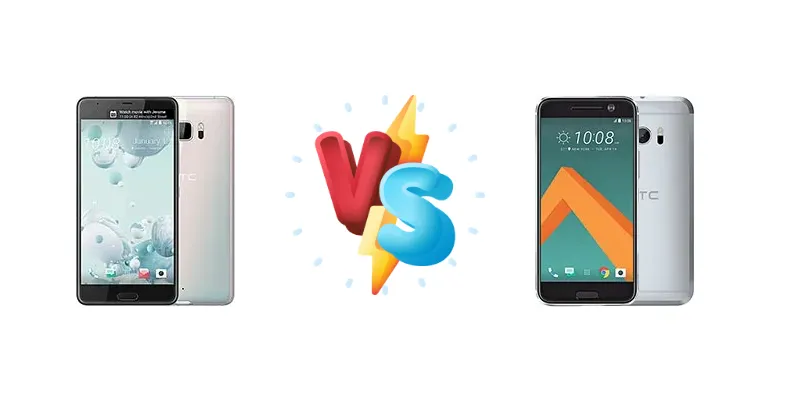
Released within a year of each other, the HTC U Ultra and HTC 10 represent distinct approaches to the flagship smartphone experience. The HTC 10 aimed for a refined, all-around premium experience, while the U Ultra pushed boundaries with its unique design and focus on audio and camera capabilities. This comparison dissects the core differences between these two devices, focusing on performance, battery life, and user experience.
🏆 Quick Verdict
For most users, the HTC U Ultra is the superior choice. Its Snapdragon 821 chipset and significantly improved 81-hour endurance rating offer a noticeable advantage in performance and longevity over the HTC 10’s 66-hour rating. While both share similar charging speeds, the U Ultra’s overall package delivers a more modern and capable experience.
| Network |
|---|
| 2G bands | GSM 850 / 900 / 1800 / 1900 - SIM 1 & SIM 2 | GSM 850 / 900 / 1800 / 1900 |
| 3G bands | HSDPA 850 / 900 / 1700(AWS) / 1900 / 2100 | HSDPA 850 / 900 / 1900 / 2100 |
| 4G bands | 1, 2, 3, 4, 5, 7, 8, 12, 17, 20, 28, 38, 39, 40, 41 | 1, 3, 5, 7, 8, 20, 28, 38, 40, 41 |
| Speed | HSPA 42.2/5.76 Mbps, LTE (3CA) Cat11 600/50 Mbps | HSPA, LTE (3CA) Cat9 450/50 Mbps |
| Technology | GSM / HSPA / LTE | GSM / HSPA / LTE |
| Launch |
|---|
| Announced | 2017, January 12. Released 2017, February 21 | 2016, April 12. Released 2016, April 12 |
| Status | Discontinued | Discontinued |
| Body |
|---|
| Build | Glass front (Gorilla Glass 5 or Sapphire crystal), glass back, aluminum frame | Glass front (Gorilla Glass 3), aluminum back, aluminum frame |
| Dimensions | 162.4 x 79.8 x 8 mm (6.39 x 3.14 x 0.31 in) | 145.9 x 71.9 x 9 mm (5.74 x 2.83 x 0.35 in) |
| SIM | Nano-SIM + Nano-SIM | Nano-SIM |
| Weight | 170 g (6.00 oz) | 161 g (5.68 oz) |
| Display |
|---|
| Protection | Corning Gorilla Glass 5 (64 GB version)Sapphire crystal glass (128 GB version) | Corning Gorilla Glass 3 |
| Resolution | 1440 x 2560 pixels, 16:9 ratio (~513 ppi density) | 1440 x 2560 pixels, 16:9 ratio (~565 ppi density) |
| Size | 5.7 inches, 90.3 cm2 (~69.7% screen-to-body ratio) | 5.2 inches, 74.5 cm2 (~71.1% screen-to-body ratio) |
| Type | Super LCD5 | Super LCD5 |
| | Secondary display, 160 x 1040 pixels, 2 inches | - |
| Platform |
|---|
| CPU | Quad-core (2x2.15 GHz Kryo & 2x1.6 GHz Kryo) | Quad-core (2x2.15 GHz Kryo & 2x1.6 GHz Kryo) |
| Chipset | Qualcomm MSM8996 Snapdragon 821 (14 nm) | Qualcomm MSM8996 Snapdragon 820 (14 nm) |
| GPU | Adreno 530 | Adreno 530 |
| OS | Android 7.0 (Nougat), upgradable to Android 8.0 (Oreo) | Android 6.0.1 (Marshmallow), upgradable to Android 8.0 (Oreo), Sense UI |
| Memory |
|---|
| Card slot | microSDXC (uses shared SIM slot) | microSDXC (dedicated slot) |
| Internal | 64GB 4GB RAM, 128GB 4GB RAM | 32GB 4GB RAM, 64GB 4GB RAM |
| Main Camera |
|---|
| Features | Laser AF, Dual-LED dual-tone flash, panorama | Laser AF, Dual-LED dual-tone flash, HDR, panorama |
| Single | 12 MP, f/1.8, 26mm (wide), 1/2.3", 1.55µm, PDAF, OIS | 12 MP, f/1.8, 26mm (wide), 1/2.3", 1.55µm, OIS |
| Video | 4K@30fps (24-bit/192kHz audio), 720p@120fps | 4K@30fps, 720p@120fps, HDR, stereo sound rec. |
| Selfie camera |
|---|
| Features | HDR | HDR |
| Single | 16 MP, f/2.0, 27mm (wide), 1/3.06", 1.0µm | 5 MP, f/1.8, 23mm (wide), 1/4.1", 1.34µm, OIS, AF |
| Video | 1080p@30fps | 1080p@30fps |
| Sound |
|---|
| 3.5mm jack | No | Yes |
| 35mm jack | No | Yes |
| Loudspeaker | Yes | Yes, with stereo speakers |
| | 24-bit/192kHz audio
| 24-bit/192kHz audio
|
| Comms |
|---|
| Bluetooth | 4.2, A2DP, LE | 4.2, A2DP, aptX |
| NFC | Yes | Yes |
| Positioning | GPS, GLONASS, BDS | GPS, GLONASS/ BDS (region dependent) |
| Radio | No | No |
| USB | USB Type-C 3.1 | USB Type-C 3.1 |
| WLAN | Wi-Fi 802.11 a/b/g/n/ac, dual-band, Wi-Fi Direct, DLNA | Wi-Fi 802.11 a/b/g/n/ac, dual-band, Wi-Fi Direct, DLNA |
| Features |
|---|
| Sensors | Fingerprint (front-mounted), accelerometer, gyro, proximity, compass | Fingerprint (front-mounted), accelerometer, gyro, proximity, compass |
| Battery |
|---|
| Charging | 18W wired, QC3 | 18W wired, QC3, 50% in 30 min |
| Stand-by | Up to 312 h (3G) | Up to 456 h (3G) |
| Talk time | Up to 26 h (3G) | Up to 27 h (3G) |
| Type | Li-Ion 3000 mAh, non-removable | Li-Ion 3000 mAh, non-removable |
| Misc |
|---|
| Colors | Brilliant Black, Cosmetic Pink, Ice White, Sapphire Blue | Carbon Gray, Topaz Gold, Glacier Silver, Camellia Red |
| Models | U Ultra, U-1u, 2PZF1 | 10, M10h, HTC6545LVW, HTV32, 2PS64, 2PS6200 |
| Price | About 250 EUR | About 300 EUR |
| SAR | - | 0.47 W/kg (head) 0.64 W/kg (body) |
| Tests |
|---|
| Audio quality | - |
Noise -90.4dB / Crosstalk -87.3dB |
| Battery life | Endurance rating 81h |
Endurance rating 66h
|
| Camera |
Photo / Video |
Photo / Video |
| Display |
Contrast ratio: 1831 (nominal), 3.453 (sunlight) | - |
| Loudspeaker |
Voice 61dB / Noise 73dB / Ring 86dB |
Voice 65dB / Noise 62dB / Ring 63dB
|
| Performance |
GFXBench: 10fps (ES 3.1 onscreen) |
Basemark OS II 2.0: 1839Basemark X: 28882 |
HTC U Ultra
- Superior battery life (81h endurance)
- Slightly faster processor (Snapdragon 821)
- Higher display contrast ratio for better visibility
- Potentially higher price point
- Design may be polarizing
HTC 10
- Balanced flagship experience
- Fast charging (50% in 30 min)
- Potentially more affordable
- Shorter battery life (66h endurance)
- Less powerful processor (Snapdragon 820)
Display Comparison
Both devices share a similar display philosophy, prioritizing color accuracy and viewing angles. However, the U Ultra boasts a superior contrast ratio, achieving 1831:1 nominally and a remarkable 3453:1 in direct sunlight. This translates to a more vibrant and readable display, especially outdoors. While specific panel technology details are unavailable, the higher contrast ratio suggests a more advanced panel implementation in the U Ultra, offering a more visually immersive experience.
Camera Comparison
Both phones feature capable photo and video recording capabilities, but detailed camera specifications are limited in the provided data. The absence of sensor size or aperture information makes a direct comparison difficult. However, given HTC’s marketing focus on the U Ultra’s camera, it’s reasonable to assume improvements in image processing algorithms and potentially a larger sensor were implemented. The U Ultra likely delivers better low-light performance and more detailed images, though both phones are expected to produce high-quality results in optimal conditions.
Performance
The core difference in performance lies within the chipsets. The HTC U Ultra utilizes the Qualcomm MSM8996 Snapdragon 821, a refined version of the Snapdragon 820 found in the HTC 10. While both chipsets feature a quad-core Kryo configuration (2x2.15 GHz & 2x1.6 GHz), the 821 offers incremental improvements in CPU and GPU performance, resulting in smoother multitasking and slightly faster gaming frame rates. The 14nm manufacturing process is identical on both, so thermal differences are likely minimal, but the U Ultra will handle sustained loads marginally better.
Battery Life
Battery life is a key differentiator. The HTC U Ultra’s endurance rating of 81 hours significantly surpasses the HTC 10’s 66 hours. This 23% increase in endurance suggests a combination of optimized power management and potentially a slightly larger battery capacity (though not specified). Both devices support 18W wired charging with Quick Charge 3.0, achieving 50% charge in 30 minutes on the HTC 10. The U Ultra’s longer endurance, however, reduces the reliance on frequent charging, making it ideal for users who prioritize all-day battery life.
Buying Guide
Buy the HTC U Ultra if you prioritize extended battery life, slightly faster processing for demanding tasks, and are willing to accept a potentially higher price point. Buy the HTC 10 if you value a more balanced and potentially more affordable flagship experience, and don't heavily rely on maximizing battery endurance or pushing the absolute limits of mobile performance.
Frequently Asked Questions
❓ Does the Snapdragon 821 in the U Ultra offer a noticeable performance boost over the 820 in the HTC 10 for everyday tasks?
While both chipsets are capable, the Snapdragon 821 in the U Ultra provides a subtle but noticeable improvement in responsiveness and multitasking. For demanding applications like gaming or video editing, the difference will be more pronounced, resulting in smoother frame rates and faster processing times.
❓ Given the difference in battery endurance, how much longer can I realistically expect the HTC U Ultra to last on a single charge compared to the HTC 10?
The 81-hour endurance rating of the U Ultra versus the 66-hour rating of the HTC 10 suggests you could realistically expect an extra half-day to a full day of usage depending on your usage patterns. Heavy users will benefit the most from the U Ultra’s improved battery life.
❓ Is the camera on the HTC U Ultra significantly better than the HTC 10, and should that be a deciding factor?
While concrete camera specs are limited, HTC marketed the U Ultra with a focus on camera improvements. It's reasonable to expect better low-light performance and more detailed images from the U Ultra, making it a worthwhile consideration if photography is a priority. However, both phones are capable of taking excellent photos in good lighting conditions.