
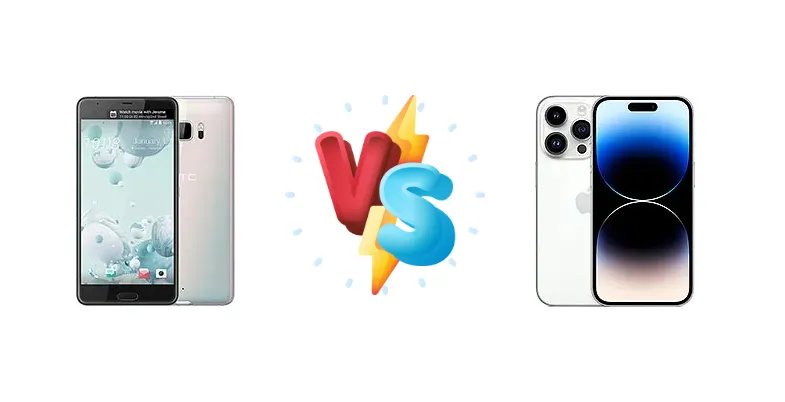
HTC U Ultra vs. Apple iPhone 14 Pro: A Generational Leap in Smartphone Technology
| Phones Images | |||||
|---|---|---|---|---|---|
|
🏆 Quick Verdict
For the vast majority of users, the Apple iPhone 14 Pro is the clear winner. Its significantly more powerful A16 Bionic chip, superior display technology, and modern features justify the price premium. However, the U Ultra remains a viable option for budget-conscious users prioritizing battery endurance and a unique design.
| PHONES | ||
|---|---|---|
| Phone Names | HTC U Ultra | Apple iPhone 14 Pro |
| Network | ||
|---|---|---|
| 2G bands | GSM 850 / 900 / 1800 / 1900 - SIM 1 & SIM 2 | GSM 850 / 900 / 1800 / 1900 |
| 3G bands | HSDPA 850 / 900 / 1700(AWS) / 1900 / 2100 | HSDPA 850 / 900 / 1700(AWS) / 1900 / 2100 |
| 4G bands | 1, 2, 3, 4, 5, 7, 8, 12, 17, 20, 28, 38, 39, 40, 41 | 1, 2, 3, 4, 5, 7, 8, 12, 13, 17, 18, 19, 20, 25, 26, 28, 30, 32, 34, 38, 39, 40, 41, 42, 46, 48, 66 - A2890, A2892 |
| 5G bands | - | 1, 2, 3, 5, 7, 8, 12, 20, 25, 26, 28, 30, 38, 40, 41, 48, 66, 70, 77, 78, 79 SA/NSA/Sub6 - A2890, A2892 |
| Speed | HSPA 42.2/5.76 Mbps, LTE (3CA) Cat11 600/50 Mbps | HSPA, LTE, 5G, EV-DO Rev.A 3.1 Mbps |
| Technology | GSM / HSPA / LTE | GSM / CDMA / HSPA / EVDO / LTE / 5G |
| - | 1, 2, 3, 5, 7, 8, 12, 20, 25, 26, 28, 30, 38, 40, 41, 48, 66, 70, 77, 78, 79 SA/NSA/Sub6 - A2891 | |
| Launch | ||
|---|---|---|
| Announced | 2017, January 12. Released 2017, February 21 | 2022, September 07 |
| Status | Discontinued | Available. Released 2022, September 16 |
| Body | ||
|---|---|---|
| Build | Glass front (Gorilla Glass 5 or Sapphire crystal), glass back, aluminum frame | Glass front, glass back, stainless steel frame |
| Dimensions | 162.4 x 79.8 x 8 mm (6.39 x 3.14 x 0.31 in) | 147.5 x 71.5 x 7.9 mm (5.81 x 2.81 x 0.31 in) |
| SIM | Nano-SIM + Nano-SIM | · Nano-SIM + eSIM + eSIM (max 2 at a time; International)· eSIM + eSIM (8 or more, max 2 at a time; USA)· Nano-SIM + Nano-SIM (China) |
| Weight | 170 g (6.00 oz) | 206 g (7.27 oz) |
| - | IP68 dust/water resistant (up to 6m for 30 min) Apple Pay (Visa, MasterCard, AMEX certified) | |
| Display | ||
|---|---|---|
| Protection | Corning Gorilla Glass 5 (64 GB version)Sapphire crystal glass (128 GB version) | Ceramic Shield glass |
| Resolution | 1440 x 2560 pixels, 16:9 ratio (~513 ppi density) | 1179 x 2556 pixels, 19.5:9 ratio (~460 ppi density) |
| Size | 5.7 inches, 90.3 cm2 (~69.7% screen-to-body ratio) | 6.1 inches, 91.7 cm2 (~87.0% screen-to-body ratio) |
| Type | Super LCD5 | LTPO Super Retina XDR OLED, 120Hz, HDR10, Dolby Vision, 1000 nits (typ), 2000 nits (HBM) |
| Secondary display, 160 x 1040 pixels, 2 inches | Always-On display | |
| Platform | ||
|---|---|---|
| CPU | Quad-core (2x2.15 GHz Kryo & 2x1.6 GHz Kryo) | Hexa-core (2x3.46 GHz Everest + 4x2.02 GHz Sawtooth) |
| Chipset | Qualcomm MSM8996 Snapdragon 821 (14 nm) | Apple A16 Bionic (4 nm) |
| GPU | Adreno 530 | Apple GPU (5-core graphics) |
| OS | Android 7.0 (Nougat), upgradable to Android 8.0 (Oreo) | iOS 16, upgradable to iOS 26.1 |
| Memory | ||
|---|---|---|
| Card slot | microSDXC (uses shared SIM slot) | No |
| Internal | 64GB 4GB RAM, 128GB 4GB RAM | 128GB 6GB RAM, 256GB 6GB RAM, 512GB 6GB RAM, 1TB 6GB RAM |
| - | NVMe | |
| Main Camera | ||
|---|---|---|
| Features | Laser AF, Dual-LED dual-tone flash, panorama | Dual-LED dual-tone flash, HDR (photo/panorama) |
| Single | 12 MP, f/1.8, 26mm (wide), 1/2.3", 1.55µm, PDAF, OIS | 12 MP, f/1.9, 23mm (wide), 1/3.6", PDAF, OIS (unconfirmed) SL 3D, (depth/biometrics sensor) |
| Triple | - | 48 MP, f/1.8, 24mm (wide), 1/1.28", 1.22µm, dual pixel PDAF, sensor-shift OIS 12 MP, f/2.8, 77mm (telephoto), 1/3.5", 1.0µm, PDAF, OIS, 3x optical zoom 12 MP, f/2.2, 13mm, 120˚ (ultrawide), 1/2.55", 1.4µm, dual pixel PDAF TOF 3D LiDAR scanner (depth) |
| Video | 4K@30fps (24-bit/192kHz audio), 720p@120fps | 4K@24/25/30/60fps, 1080p@25/30/60/120/240fps, 10-bit HDR, Dolby Vision HDR (up to 60fps), ProRes, stereo sound rec. |
| Selfie camera | ||
|---|---|---|
| Features | HDR | HDR |
| Single | 16 MP, f/2.0, 27mm (wide), 1/3.06", 1.0µm | 12 MP, f/1.9, 23mm (wide), 1/3.6", 1.0µm, PDAF, OIS SL 3D, (depth/biometrics sensor) |
| Video | 1080p@30fps | 4K@24/25/30/60fps, 1080p@25/30/60/120fps, gyro-EIS |
| Sound | ||
|---|---|---|
| 3.5mm jack | No | No |
| 35mm jack | No | No |
| Loudspeaker | Yes | Yes, with stereo speakers |
| 24-bit/192kHz audio | - | |
| Comms | ||
|---|---|---|
| Bluetooth | 4.2, A2DP, LE | 5.3, A2DP, LE |
| NFC | Yes | Yes |
| Positioning | GPS, GLONASS, BDS | GPS (L1+L5), GLONASS, GALILEO, BDS, QZSS |
| Radio | No | No |
| USB | USB Type-C 3.1 | Lightning, USB 2.0 |
| WLAN | Wi-Fi 802.11 a/b/g/n/ac, dual-band, Wi-Fi Direct, DLNA | Wi-Fi 802.11 a/b/g/n/ac/6, dual-band, hotspot |
| Features | ||
|---|---|---|
| Sensors | Fingerprint (front-mounted), accelerometer, gyro, proximity, compass | Face ID, accelerometer, gyro, proximity, compass, barometer |
| - | Ultra Wideband (UWB) support Emergency SOS via satellite (SMS sending/receiving) | |
| Battery | ||
|---|---|---|
| Charging | 18W wired, QC3 | Wired, PD2.0, 50% in 30 min 15W wireless (MagSafe) 15W wireless (Qi2) - requires iOS 17.2 update |
| Stand-by | Up to 312 h (3G) | - |
| Talk time | Up to 26 h (3G) | - |
| Type | Li-Ion 3000 mAh, non-removable | Li-Ion 3200 mAh (12.38 Wh) |
| Misc | ||
|---|---|---|
| Colors | Brilliant Black, Cosmetic Pink, Ice White, Sapphire Blue | Space Black, Silver, Gold, Deep Purple |
| Models | U Ultra, U-1u, 2PZF1 | A2890, A2650, A2889, A2892, iphone15,2 |
| Price | About 250 EUR | $ 395.67 / C$ 693.35 / £ 403.99 / € 492.99 |
| SAR | - | 1.15 W/kg (head) 1.15 W/kg (body) |
| SAR EU | - | 0.98 W/kg (head) 0.98 W/kg (body) |
| Tests | ||
|---|---|---|
| Battery life | Endurance rating 81h | Endurance rating 86h |
| Camera | Photo / Video | Photo / Video |
| Display | Contrast ratio: 1831 (nominal), 3.453 (sunlight) | Contrast ratio: Infinite (nominal) |
| Loudspeaker | Voice 61dB / Noise 73dB / Ring 86dB | -26.2 LUFS (Good) |
| Performance | GFXBench: 10fps (ES 3.1 onscreen) | AnTuTu: 968412 (v9) GeekBench: 5346 (v5.1) GFXBench: 60fps (ES 3.1 onscreen) |
HTC U Ultra
- Excellent battery endurance for its age
- Unique glass design
- Significantly lower price point
- Outdated processor and software
- Inferior display technology
- Less capable camera system
Apple iPhone 14 Pro
- Blazing-fast performance with the A16 Bionic
- Stunning Super Retina XDR display
- Advanced camera system with excellent image quality
- Higher price tag
- Less battery endurance than the U Ultra
- Requires Apple ecosystem investment
Display Comparison
The iPhone 14 Pro’s display is a substantial upgrade. While the HTC U Ultra boasts a respectable contrast ratio of 1831 (nominal) and 3453 in sunlight, the iPhone 14 Pro achieves a peak brightness of 1791 nits, offering superior visibility outdoors. More importantly, the iPhone 14 Pro’s ‘Infinite’ contrast ratio, enabled by OLED technology, delivers richer blacks and more vibrant colors. The U Ultra’s LCD, while adequate, lacks the dynamic range and color accuracy of the iPhone’s Super Retina XDR display. The iPhone 14 Pro also benefits from ProMotion, an adaptive refresh rate technology, which the U Ultra lacks.
Camera Comparison
Both phones offer photo and video capabilities, but the iPhone 14 Pro’s camera system is far more advanced. While specific sensor sizes aren’t provided for the U Ultra, it’s safe to assume they are smaller than the iPhone 14 Pro’s main sensor. The iPhone 14 Pro benefits from advanced image processing algorithms, improved low-light performance, and features like Cinematic mode for video recording. The U Ultra’s camera, while capable in good lighting conditions, will struggle in challenging environments. The iPhone 14 Pro’s computational photography capabilities are a generation ahead.
Performance
The performance gap is immense. The HTC U Ultra’s Qualcomm Snapdragon 821, a 14nm chip, is dwarfed by the iPhone 14 Pro’s 4nm Apple A16 Bionic. The A16’s hexa-core architecture (2x3.46 GHz Everest + 4x2.02 GHz Sawtooth) delivers significantly faster processing speeds and improved power efficiency. The U Ultra’s quad-core Kryo CPU simply cannot compete. This translates to noticeably slower app launch times, less responsive multitasking, and a less enjoyable gaming experience on the U Ultra. The A16 Bionic’s integrated GPU also provides a substantial advantage in graphics-intensive tasks.
Battery Life
Interestingly, the endurance ratings are surprisingly close: 81 hours for the U Ultra and 86 hours for the iPhone 14 Pro. This suggests that the U Ultra’s older, less efficient chipset is offset by a potentially larger battery capacity (though specific mAh isn’t provided). However, the iPhone 14 Pro offers significantly faster charging with 18W wired charging (QC3 on the U Ultra) and the convenience of 15W wireless charging via MagSafe and Qi2 (requiring iOS 17.2). The U Ultra’s 18W charging is slower, and it lacks wireless charging capabilities.
Buying Guide
Buy the HTC U Ultra if you need a long-lasting battery and are comfortable with an older Android experience, prioritizing value over cutting-edge features. It’s ideal for users who primarily use their phone for calls, texts, and basic apps. Buy the Apple iPhone 14 Pro if you demand the best possible performance, a stunning display, a versatile camera system, and seamless integration within the Apple ecosystem. This is the phone for power users, content creators, and those who want a device that will remain relevant for years to come.