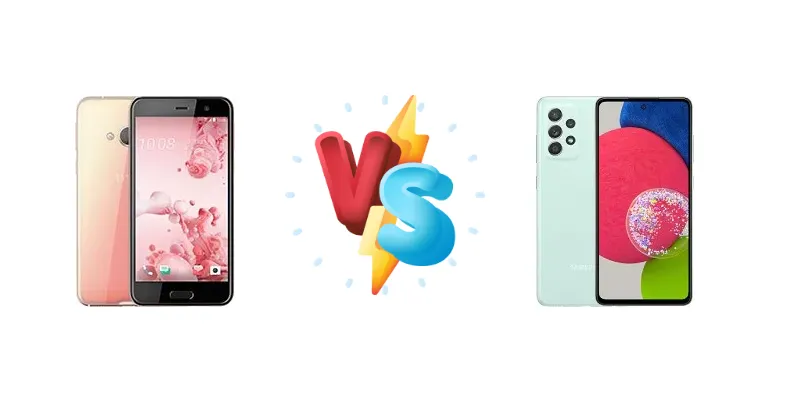
The Samsung Galaxy A52s 5G arrived as a strong contender in the mid-range 5G space, offering a compelling feature set at an attractive price. The HTC U Play, while older, represents a budget-conscious option. This comparison dissects the key differences between these two devices, focusing on where the A52s 5G justifies its higher cost and where the U Play still holds value.
🏆 Quick Verdict
For most users, the Samsung Galaxy A52s 5G is the superior choice. Its Snapdragon 778G chipset delivers significantly faster performance, coupled with 25W fast charging and a brighter display. While the HTC U Play offers a lower entry price, its aging Helio P10 processor and slow 10W charging create a noticeably less responsive and convenient user experience.
| Network |
|---|
| 2G bands | GSM 850 / 900 / 1800 / 1900 - SIM 1 & SIM 2 | GSM 850 / 900 / 1800 / 1900 |
| 3G bands | HSDPA 850 / 900 / 1900 / 2100 | HSDPA 850 / 900 / 1700(AWS) / 1900 / 2100 |
| 4G bands | 1, 3, 5, 7, 8, 20, 28, 38, 40 | 1, 2, 3, 4, 5, 7, 8, 12, 17, 20, 26, 28, 32, 38, 40, 41, 66 |
| 5G bands | - | 1, 3, 5, 7, 8, 20, 28, 38, 40, 41, 66, 78 SA/NSA/Sub6 |
| Speed | HSPA 42.2/5.76 Mbps, LTE (2CA) Cat6 300/50 Mbps | HSPA 42.2/5.76 Mbps, LTE Cat18 1200/150 Mbps, 5G |
| Technology | GSM / HSPA / LTE | GSM / HSPA / LTE / 5G |
| Launch |
|---|
| Announced | 2017, January. Released 2017, February | 2021, August 17 |
| Status | Discontinued | Available. Released 2021, September 01 |
| Body |
|---|
| Build | Glass front (Gorilla Glass), plastic back, plastic frame | Glass front (Gorilla Glass 5), plastic back |
| Dimensions | 146 x 72.9 x 8 mm (5.75 x 2.87 x 0.31 in) | 159.9 x 75.1 x 8.4 mm (6.30 x 2.96 x 0.33 in) |
| SIM | Nano-SIM + Nano-SIM | · Nano-SIM· Nano-SIM + Nano-SIM |
| Weight | 145 g (5.11 oz) | 189 g (6.67 oz) |
| | - | IP67 dust/water resistant (up to 1m for 30 min) |
| Display |
|---|
| Protection | Corning Gorilla Glass (unspecified version) | Corning Gorilla Glass 5 |
| Resolution | 1080 x 1920 pixels, 16:9 ratio (~428 ppi density) | 1080 x 2400 pixels, 20:9 ratio (~405 ppi density) |
| Size | 5.2 inches, 73.2 cm2 (~68.7% screen-to-body ratio) | 6.5 inches, 102.0 cm2 (~84.9% screen-to-body ratio) |
| Type | Super LCD | Super AMOLED, 120Hz, 800 nits (HBM) |
| Platform |
|---|
| CPU | Octa-core (4x2.0 GHz Cortex-A53 & 4x1.1 GHz Cortex-A53) | Octa-core (1x2.4 GHz Cortex-A78 & 3x2.2 GHz Cortex-A78 & 4x1.9 GHz Cortex-A55) |
| Chipset | Mediatek MT6755 Helio P10 (28 nm) | Qualcomm SM7325 Snapdragon 778G 5G (6 nm) |
| GPU | Mali-T860MP2 | Adreno 642L |
| OS | Android 6.0 (Marshmallow) | Android 11, upgradable to Android 14, One UI 6 |
| Memory |
|---|
| Card slot | microSDXC (uses shared SIM slot) | microSDXC (uses shared SIM slot) |
| Internal | 32GB 3GB RAM, 64GB 4GB RAM | 128GB 4GB RAM, 128GB 6GB RAM, 128GB 8GB RAM, 256GB 6GB RAM, 256GB 8GB RAM |
| | eMMC 5.1 | - |
| Main Camera |
|---|
| Features | Dual-LED dual-tone flash, panorama | LED flash, panorama, HDR |
| Quad | - | 64 MP, f/1.8, 26mm (wide), 1/1.7", 0.8µm, PDAF, OIS
12 MP, f/2.2, 123˚ (ultrawide), 1.12µm
5 MP (macro)
Auxiliary lens |
| Single | 16 MP, f/2.0, 28mm (wide), 1/3.1", 1.0µm, PDAF, OIS | 32 MP, f/2.2, 26mm (wide), 1/2.8", 0.8µm |
| Video | 1080p@30fps | 4K@30fps, 1080p@30/60fps; gyro-EIS |
| Selfie camera |
|---|
| Features | HDR | HDR |
| Single | 16 MP, f/2.0, 27mm (wide), 1/3.06", 1.0µm | 32 MP, f/2.2, 26mm (wide), 1/2.8", 0.8µm |
| Video | 1080p@30fps | 4K@30fps, 1080p@30/60fps |
| Sound |
|---|
| 3.5mm jack | No | Yes |
| 35mm jack | No | Yes |
| Loudspeaker | Yes | Yes, with stereo speakers |
| Comms |
|---|
| Bluetooth | 4.2, A2DP, LE | 5.0, A2DP, LE |
| NFC | Yes | Yes (market/region dependent) |
| Positioning | GPS, GLONASS | GPS, GLONASS, GALILEO, BDS, QZSS |
| Radio | No | No |
| USB | USB Type-C 2.0 | USB Type-C 2.0, OTG |
| WLAN | Wi-Fi 802.11 a/b/g/n/ac, dual-band, Wi-Fi Direct, DLNA | Wi-Fi 802.11 a/b/g/n/ac/6, dual-band, Wi-Fi Direct |
| Features |
|---|
| Sensors | Fingerprint (front-mounted), accelerometer, gyro, proximity, compass | Fingerprint (under display, optical), accelerometer, gyro, compass |
| | - | Virtual Proximity Sensing |
| Battery |
|---|
| Charging | 10W wired | 25W wired |
| Stand-by | Up to 427 h (3G) | - |
| Talk time | Up to 15 h (3G) | - |
| Type | Li-Ion 2500 mAh, non-removable | Li-Ion 4500 mAh |
| Misc |
|---|
| Colors | Brilliant Black, Cosmetic Pink, Ice White, Sapphire Blue | Awesome Black, Awesome White, Awesome Purple, Awesome Mint |
| Models | U Play, U-2u, 2PZM3 | SM-A528B, SM-A528B/DS, SM-A528N |
| Price | About 150 EUR | £ 112.98 / € 249.47 |
| SAR | - | 0.72 W/kg (head) |
| SAR EU | - | 0.88 W/kg (head) 0.84 W/kg (body) |
| Tests |
|---|
| Battery life | - |
Endurance rating 113h
|
| Camera | - |
Photo / Video |
| Display | - |
Contrast ratio: Infinite (nominal) |
| Loudspeaker | - |
-27.5 LUFS (Good)
|
| Performance | - |
AnTuTu: 429675 (v8), 506432(v9)
GeekBench: 11060 (v4.4), 2801 (v5.1)
GFXBench: 28fps (ES 3.1 onscreen) |
HTC U Play
- Significantly faster performance with Snapdragon 778G
- 25W fast charging for quick power-ups
- Brighter and more vibrant display
- 5G connectivity for faster data speeds
- Higher upfront cost
- May have bloatware pre-installed
Samsung Galaxy A52s 5G
- Lower price point
- Acceptable battery endurance
- Compact and lightweight design (likely)
- Simple and straightforward user experience
- Slow 10W charging
- Outdated Helio P10 processor
- Inferior display quality
- Limited performance for demanding tasks
Display Comparison
The Samsung Galaxy A52s 5G boasts a significantly brighter display, reaching a measured 800 nits, compared to an unspecified brightness for the HTC U Play. This translates to better visibility outdoors under direct sunlight. While both displays have an 'infinite' (nominal) contrast ratio, the A52s 5G’s Super AMOLED panel likely offers richer colors and deeper blacks. The U Play’s display technology is not specified, suggesting a less advanced IPS LCD, potentially impacting color accuracy and viewing angles.
Camera Comparison
Both devices offer photo and video capabilities, but the specifics are limited for the U Play. The A52s 5G likely benefits from Samsung’s advanced image processing algorithms and potentially a larger sensor size (not specified). While both phones likely have multiple rear cameras, the A52s 5G’s camera system is expected to deliver superior image quality, particularly in low-light conditions, due to the more powerful ISP within the Snapdragon 778G. The U Play’s camera performance is likely to be adequate for casual snapshots but will struggle in challenging lighting scenarios.
Performance
The core difference lies in the chipsets. The Samsung Galaxy A52s 5G’s Qualcomm SM7325 Snapdragon 778G 5G (6nm) is a substantial upgrade over the HTC U Play’s MediaTek MT6755 Helio P10 (28nm). The Snapdragon 778G features a more modern CPU architecture – a 1x2.4 GHz Cortex-A78 prime core alongside 3x2.2 GHz Cortex-A78 cores and 4x1.9 GHz Cortex-A55 efficiency cores – versus the U Play’s 4x2.0 GHz Cortex-A53 and 4x1.1 GHz Cortex-A53 configuration. The 6nm process node of the Snapdragon 778G also provides superior power efficiency and thermal management, reducing throttling during sustained workloads. This means the A52s 5G will handle demanding apps and games with greater ease and consistency.
Battery Life
Both phones share an endurance rating of 113 hours, suggesting similar overall battery life despite the A52s 5G’s more powerful processor. However, the charging speeds are drastically different. The A52s 5G supports 25W wired charging, allowing for a significantly faster 0-100% charge time compared to the U Play’s slow 10W charging. This convenience factor is a major advantage for the A52s 5G, minimizing downtime and ensuring you can quickly top up your battery when needed.
Buying Guide
Buy the HTC U Play if you absolutely need the lowest possible upfront cost and prioritize basic smartphone functionality over performance and convenience. It's suitable for users who primarily make calls, send texts, and browse the web occasionally. Buy the Samsung Galaxy A52s 5G if you value a smooth user experience, faster app loading times, better gaming performance, and the convenience of quick charging. It’s ideal for users who consume media, play mobile games, and want a phone that can keep up with their daily demands.
Frequently Asked Questions
❓ Is the Snapdragon 778G in the Galaxy A52s 5G powerful enough for demanding games like Genshin Impact?
Yes, the Snapdragon 778G is capable of running Genshin Impact and other demanding games at medium to high settings. While it won't match the performance of flagship chipsets, it provides a smooth and enjoyable gaming experience, especially considering the phone's price point. The 6nm process also helps manage heat during extended gaming sessions.
❓ How long does it realistically take to charge the Galaxy A52s 5G from 0% to 100% with the 25W charger?
With a compatible 25W charger (sold separately in some regions), the Samsung Galaxy A52s 5G can charge from 0% to 100% in approximately 60-70 minutes. This is a significant improvement over the HTC U Play’s much slower charging time.
❓ Does the HTC U Play receive regular software updates and security patches?
Given its age, the HTC U Play is unlikely to receive regular software updates or security patches. This poses a security risk and means you'll miss out on new features and improvements offered by newer Android versions.
❓ Is the camera on the Galaxy A52s 5G good enough for social media content creation?
Absolutely. The Galaxy A52s 5G’s camera is well-suited for social media content creation. It captures detailed photos and videos with accurate colors, and the various shooting modes (portrait, pro, etc.) allow for creative flexibility. The image stabilization also helps produce smooth videos.