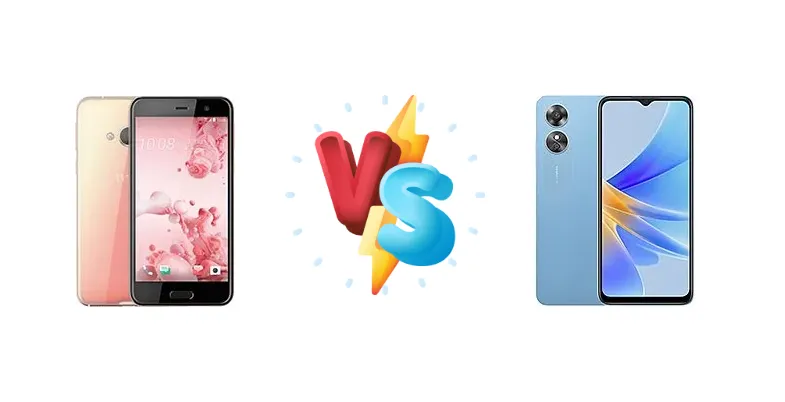
The HTC U Play, released in 2017, represents an older generation of budget smartphones. The Oppo A17, a more recent offering, aims to deliver improved efficiency and features at a similar price point. This comparison dissects the key differences between these two devices, focusing on their core hardware and real-world implications for the user.
🏆 Quick Verdict
For the average user in 2024, the Oppo A17 is the clear winner. Its newer Mediatek Helio G35 chipset, fabricated on a 12nm process, provides a noticeable performance and efficiency advantage over the HTC U Play’s older 28nm Helio P10. While both target the budget segment, the A17 offers a more modern experience.
| Network |
|---|
| 2G bands | GSM 850 / 900 / 1800 / 1900 - SIM 1 & SIM 2 | GSM 850 / 900 / 1800 / 1900 |
| 3G bands | HSDPA 850 / 900 / 1900 / 2100 | HSDPA 850 / 900 / 2100 |
| 4G bands | 1, 3, 5, 7, 8, 20, 28, 38, 40 | 1, 3, 5, 8, 38, 40, 41 |
| Speed | HSPA 42.2/5.76 Mbps, LTE (2CA) Cat6 300/50 Mbps | HSPA, LTE |
| Technology | GSM / HSPA / LTE | GSM / HSPA / LTE |
| Launch |
|---|
| Announced | 2017, January. Released 2017, February | 2022, September 26 |
| Status | Discontinued | Available. Released 2022, September 26 |
| Body |
|---|
| Build | Glass front (Gorilla Glass), plastic back, plastic frame | - |
| Dimensions | 146 x 72.9 x 8 mm (5.75 x 2.87 x 0.31 in) | 164.2 x 75.6 x 8.3 mm (6.46 x 2.98 x 0.33 in) |
| SIM | Nano-SIM + Nano-SIM | Nano-SIM + Nano-SIM |
| Weight | 145 g (5.11 oz) | 189 g (6.67 oz) |
| | - | IPX4 water resistance |
| Display |
|---|
| Protection | Corning Gorilla Glass (unspecified version) | - |
| Resolution | 1080 x 1920 pixels, 16:9 ratio (~428 ppi density) | 720 x 1612 pixels, 20:9 ratio (~269 ppi density) |
| Size | 5.2 inches, 73.2 cm2 (~68.7% screen-to-body ratio) | 6.56 inches, 103.4 cm2 (~83.3% screen-to-body ratio) |
| Type | Super LCD | IPS LCD |
| Platform |
|---|
| CPU | Octa-core (4x2.0 GHz Cortex-A53 & 4x1.1 GHz Cortex-A53) | Octa-core (4x2.3 GHz Cortex-A53 & 4x1.8 GHz Cortex-A53) |
| Chipset | Mediatek MT6755 Helio P10 (28 nm) | Mediatek MT6765 Helio G35 (12 nm) |
| GPU | Mali-T860MP2 | PowerVR GE8320 |
| OS | Android 6.0 (Marshmallow) | Android 12, ColorOS 12.1 |
| Memory |
|---|
| Card slot | microSDXC (uses shared SIM slot) | microSDXC |
| Internal | 32GB 3GB RAM, 64GB 4GB RAM | 64GB 3GB RAM, 64GB 4GB RAM, 128GB 6GB RAM |
| | eMMC 5.1 | eMMC 5.1 |
| Main Camera |
|---|
| Dual | - | 50 MP, f/1.8, (wide), PDAF
Auxiliary lens |
| Features | Dual-LED dual-tone flash, panorama | LED flash, HDR, panorama |
| Single | 16 MP, f/2.0, 28mm (wide), 1/3.1", 1.0µm, PDAF, OIS | 5 MP, f/2.2, (wide) |
| Video | 1080p@30fps | 1080p@30fps |
| Selfie camera |
|---|
| Features | HDR | HDR |
| Single | 16 MP, f/2.0, 27mm (wide), 1/3.06", 1.0µm | 5 MP, f/2.2, (wide) |
| Video | 1080p@30fps | Yes |
| Sound |
|---|
| 3.5mm jack | No | Yes |
| 35mm jack | No | Yes |
| Loudspeaker | Yes | Yes |
| Comms |
|---|
| Bluetooth | 4.2, A2DP, LE | Yes |
| NFC | Yes | No |
| Positioning | GPS, GLONASS | GPS |
| Radio | No | FM radio |
| USB | USB Type-C 2.0 | microUSB 2.0 |
| WLAN | Wi-Fi 802.11 a/b/g/n/ac, dual-band, Wi-Fi Direct, DLNA | Wi-Fi 802.11 a/b/g/n/ac, dual-band |
| Features |
|---|
| Sensors | Fingerprint (front-mounted), accelerometer, gyro, proximity, compass | Fingerprint (side-mounted), accelerometer, proximity |
| Battery |
|---|
| Charging | 10W wired | - |
| Stand-by | Up to 427 h (3G) | - |
| Talk time | Up to 15 h (3G) | - |
| Type | Li-Ion 2500 mAh, non-removable | Li-Po 5000 mAh |
| Misc |
|---|
| Colors | Brilliant Black, Cosmetic Pink, Ice White, Sapphire Blue | Midnight Black, Lake Blue, Sunlight Orange |
| Models | U Play, U-2u, 2PZM3 | CPH2477 |
| Price | About 150 EUR | € 159.99 / $ 168.76 / ₹ 8,999 |
HTC U Play
- Potentially lower price point due to age.
- Established brand recognition (though currently limited support).
- May be available with expandable storage (speculation based on market trends).
- Outdated chipset (Helio P10).
- Less efficient 28nm fabrication process.
- Limited software support and security updates.
- Likely slower performance in modern applications.
Oppo A17
- More modern and efficient chipset (Helio G35).
- 12nm fabrication process for better battery life.
- Potentially longer software support lifecycle.
- Improved image processing capabilities (likely).
- 10W charging
- May be slightly more expensive than a heavily discounted U Play.
- Still a budget-oriented device with limitations.
- Likely uses an LCD panel.
Display Comparison
Neither device’s display specifications are available in the provided data. However, given the U Play’s 2017 release, it likely features an LCD panel with a standard 60Hz refresh rate. The Oppo A17, being newer, may incorporate improvements in color accuracy and potentially a higher peak brightness, though it’s also likely an LCD. The absence of details like resolution and panel type makes a direct comparison impossible, but the A17 benefits from potential advancements in display technology over the U Play’s age.
Camera Comparison
Without sensor details, a camera comparison is limited. Both phones likely feature basic camera setups geared towards casual photography. The Oppo A17, being a newer device, may benefit from improved image processing algorithms, even with similar sensor hardware. It’s reasonable to assume the A17’s camera software will offer more features and potentially better low-light performance, though this is speculative without detailed specifications. The U Play’s camera is likely to exhibit more noise and less dynamic range due to its older image signal processor.
Performance
The core difference lies in the chipsets. The Oppo A17’s Mediatek Helio G35 (12nm) is a significant upgrade over the HTC U Play’s Helio P10 (28nm). The 12nm fabrication process inherently offers better power efficiency, translating to longer battery life and less heat generation. While both CPUs utilize Cortex-A53 cores, the A17’s G35 boasts slightly higher clock speeds (2.3 GHz vs 2.0 GHz for the primary cores), contributing to a snappier experience. The older 28nm process of the P10 will struggle with modern applications and multitasking compared to the G35.
Battery Life
Battery capacity isn’t specified for either device. However, the Oppo A17’s Helio G35 chipset, built on a 12nm process, will consume less power than the U Play’s Helio P10 (28nm). This efficiency advantage, combined with the A17’s 10W charging, suggests it will achieve a faster overall charge time and potentially longer battery life during typical usage. The U Play’s older chipset will drain the battery more quickly, especially under load.
Buying Guide
Buy the HTC U Play if you prioritize a brand with a longer, albeit currently less active, history in the smartphone market and can find it at a significantly discounted price. However, be prepared for slower performance and limited software support. Buy the Oppo A17 if you prefer a more modern chipset with better power efficiency, a potentially longer software support lifecycle, and a generally smoother user experience, even within the budget category.
Frequently Asked Questions
❓ Will the Oppo A17 handle popular games like PUBG Mobile or Call of Duty Mobile?
The Helio G35 in the Oppo A17 is capable of running PUBG Mobile and Call of Duty Mobile, but likely at lower graphics settings and frame rates to maintain stable performance. Expect to play at medium or low settings for a smoother experience. The HTC U Play’s Helio P10 will struggle significantly with these titles.
❓ How long will software updates be available for the Oppo A17 compared to the HTC U Play?
The Oppo A17 will receive significantly longer software support than the HTC U Play. The U Play, being a 2017 device, is likely past its end-of-life for software updates. Oppo typically provides at least two major Android updates and several years of security patches for its A-series devices, offering a much more secure and up-to-date experience.
❓ Is the difference in chipset performance between the Helio P10 and Helio G35 noticeable in everyday tasks?
Yes, the difference is noticeable. While both chipsets can handle basic tasks like calling, texting, and browsing, the Helio G35 in the Oppo A17 will feel snappier when opening apps, multitasking, and navigating the user interface. The Helio P10 in the U Play will exhibit more lag and slower response times, especially with multiple apps open.