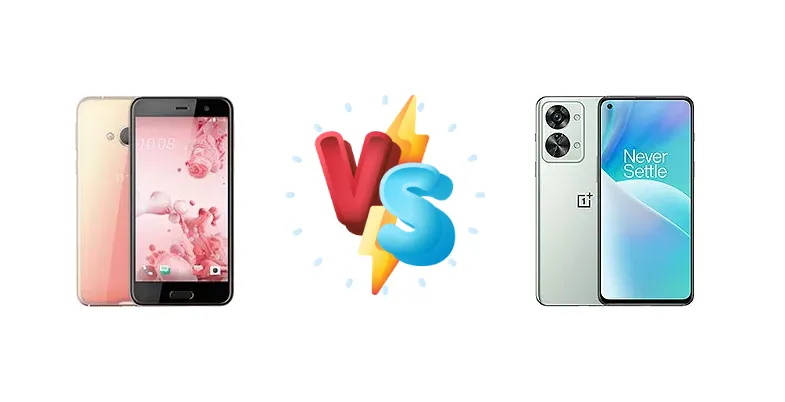
The HTC U Play, released in 2017, represents a bygone era of smartphone design and performance. Now, facing off against the 2022 OnePlus Nord 2T, we examine whether the older device still holds value, or if the Nord 2T’s modern chipset and charging capabilities justify its higher price point. This comparison isn't about crowning a 'winner' outright, but understanding where each phone excels and who benefits most.
🏆 Quick Verdict
For the vast majority of users, the OnePlus Nord 2T is the superior choice. Its Mediatek Dimensity 1300 chipset delivers significantly faster performance, coupled with blazing-fast 80W charging. While the U Play may suffice for basic tasks, the Nord 2T offers a dramatically improved user experience.
| Network |
|---|
| 2G bands | GSM 850 / 900 / 1800 / 1900 - SIM 1 & SIM 2 | GSM 850 / 900 / 1800 / 1900 |
| 3G bands | HSDPA 850 / 900 / 1900 / 2100 | HSDPA 800 / 850 / 900 / 1700(AWS) / 1800 / 1900 / 2100 |
| 4G bands | 1, 3, 5, 7, 8, 20, 28, 38, 40 | 1, 2, 3, 4, 5, 7, 8, 12, 17, 18, 19, 20, 26, 28, 32, 34, 38, 39, 40, 41, 66 |
| 5G bands | - | 1, 3, 7, 8, 20, 28, 38, 41, 78 SA/NSA |
| Speed | HSPA 42.2/5.76 Mbps, LTE (2CA) Cat6 300/50 Mbps | HSPA 42.2/5.76 Mbps, LTE Cat18 1200/150 Mbps, 5G |
| Technology | GSM / HSPA / LTE | GSM / HSPA / LTE / 5G |
| Launch |
|---|
| Announced | 2017, January. Released 2017, February | 2022, May 19 |
| Status | Discontinued | Available. Released 2022, May 21 |
| Body |
|---|
| Build | Glass front (Gorilla Glass), plastic back, plastic frame | Glass front (Gorilla Glass 5), plastic frame |
| Dimensions | 146 x 72.9 x 8 mm (5.75 x 2.87 x 0.31 in) | 159.1 x 73.2 x 8.2 mm (6.26 x 2.88 x 0.32 in) |
| SIM | Nano-SIM + Nano-SIM | Nano-SIM + Nano-SIM |
| Weight | 145 g (5.11 oz) | 190 g (6.70 oz) |
| Display |
|---|
| Protection | Corning Gorilla Glass (unspecified version) | Corning Gorilla Glass 5 |
| Resolution | 1080 x 1920 pixels, 16:9 ratio (~428 ppi density) | 1080 x 2400 pixels, 20:9 ratio (~409 ppi density) |
| Size | 5.2 inches, 73.2 cm2 (~68.7% screen-to-body ratio) | 6.43 inches, 99.8 cm2 (~85.7% screen-to-body ratio) |
| Type | Super LCD | AMOLED, 90Hz, HDR10+ |
| Platform |
|---|
| CPU | Octa-core (4x2.0 GHz Cortex-A53 & 4x1.1 GHz Cortex-A53) | Octa-core (1x3.0 GHz Cortex-A78 & 3x2.6 GHz Cortex-A78 & 4x2.0 GHz Cortex-A55) |
| Chipset | Mediatek MT6755 Helio P10 (28 nm) | Mediatek Dimensity 1300 (6 nm) |
| GPU | Mali-T860MP2 | Mali-G77 MC9 |
| OS | Android 6.0 (Marshmallow) | Android 12, upgradable to Android 14, OxygenOS 14 |
| Memory |
|---|
| Card slot | microSDXC (uses shared SIM slot) | No |
| Internal | 32GB 3GB RAM, 64GB 4GB RAM | 128GB 8GB RAM, 256GB 12GB RAM |
| | eMMC 5.1 | UFS 3.1 |
| Main Camera |
|---|
| Features | Dual-LED dual-tone flash, panorama | Dual-LED flash, HDR, panorama |
| Single | 16 MP, f/2.0, 28mm (wide), 1/3.1", 1.0µm, PDAF, OIS | 32 MP, f/2.4, (wide), 1/2.8", 0.8µm |
| Triple | - | 50 MP, f/1.9, 24mm (wide), 1/1.56", 1.0µm, PDAF, OIS
8 MP, f/2.2, 120˚ (ultrawide)
Auxiliary lens |
| Video | 1080p@30fps | 4K@30fps, 1080p@30/60/120/480fps, gyro-EIS |
| Selfie camera |
|---|
| Features | HDR | Auto HDR |
| Single | 16 MP, f/2.0, 27mm (wide), 1/3.06", 1.0µm | 32 MP, f/2.4, (wide), 1/2.8", 0.8µm |
| Video | 1080p@30fps | 1080p@30fps, gyro-EIS |
| Sound |
|---|
| 3.5mm jack | No | No |
| 35mm jack | No | No |
| Loudspeaker | Yes | Yes, with stereo speakers |
| Comms |
|---|
| Bluetooth | 4.2, A2DP, LE | 5.2, A2DP, LE, aptX HD |
| NFC | Yes | Yes |
| Positioning | GPS, GLONASS | GPS, GLONASS, GALILEO, BDS, NavIC |
| Radio | No | No |
| USB | USB Type-C 2.0 | USB Type-C 2.0, OTG |
| WLAN | Wi-Fi 802.11 a/b/g/n/ac, dual-band, Wi-Fi Direct, DLNA | Wi-Fi 802.11 a/b/g/n/ac/6, dual-band, Wi-Fi Direct |
| Features |
|---|
| Sensors | Fingerprint (front-mounted), accelerometer, gyro, proximity, compass | Fingerprint (under display, optical), accelerometer, gyro, proximity, compass |
| Battery |
|---|
| Charging | 10W wired | 80W wired, PD |
| Stand-by | Up to 427 h (3G) | - |
| Talk time | Up to 15 h (3G) | - |
| Type | Li-Ion 2500 mAh, non-removable | Li-Po 4500 mAh |
| Misc |
|---|
| Colors | Brilliant Black, Cosmetic Pink, Ice White, Sapphire Blue | Gray Shadow, Jade Fog |
| Models | U Play, U-2u, 2PZM3 | CPH2399, CPH2401 |
| Price | About 150 EUR | € 144.39 / $ 169.99 / ₹ 31,490 |
| Tests |
|---|
| Battery life | - |
Endurance rating 100h
|
| Camera | - |
Photo / Video |
| Display | - |
Contrast ratio: Infinite (nominal) |
| Loudspeaker | - |
-25.6 LUFS (Very good)
|
| Performance | - |
AnTuTu: 490545 (v8) | 604467 (v9)
GeekBench: 2790 (v5.1)
GFXBench: 40fps (ES 3.1 onscreen) |
HTC U Play
- Extremely affordable
- Compact size (likely)
- Simple, straightforward interface (potentially)
- Outdated chipset
- Slow charging
- Limited software support
- Poor performance with modern apps
OnePlus Nord 2T
- Fast 80W charging
- Powerful Dimensity 1300 chipset
- Modern software experience
- Bright and vibrant display
- Better camera performance
- Higher price
- Larger size (potentially)
- May require more frequent charging with heavy use
Display Comparison
The OnePlus Nord 2T boasts a significantly brighter display, reaching a measured 636 nits, compared to the HTC U Play’s unspecified brightness. This translates to better visibility outdoors. While both phones offer a 'Photo/Video' capable display, the Nord 2T’s contrast ratio is listed as 'Infinite (nominal)', suggesting a superior OLED panel, likely offering deeper blacks and more vibrant colors than the U Play’s likely LCD. The U Play’s display technology is a significant point of compromise given its age.
Camera Comparison
Both phones are listed as having 'Photo / Video' capabilities, but the specifics are lacking for the U Play. The Nord 2T benefits from a more modern image signal processor (ISP) within the Dimensity 1300, enabling better image processing and potentially superior low-light performance. Without sensor size or aperture information for the U Play, it’s difficult to make a direct comparison, but the Nord 2T’s newer technology gives it a clear advantage. The U Play’s camera is likely to produce noticeably less detailed and dynamic images.
Performance
The performance gap between these devices is substantial. The HTC U Play’s Mediatek MT6755 Helio P10, built on a 28nm process, features an octa-core CPU with a split architecture – four Cortex-A53 cores at 2.0 GHz and four at 1.1 GHz. This contrasts sharply with the OnePlus Nord 2T’s Mediatek Dimensity 1300, fabricated on a more efficient 6nm process. The Dimensity 1300’s CPU configuration – 1x3.0 GHz Cortex-A78, 3x2.6 GHz Cortex-A78, and 4x2.0 GHz Cortex-A55 – provides a significant uplift in both single-core and multi-core performance. The newer architecture and smaller process node mean the Nord 2T will handle demanding apps and multitasking with ease, while the U Play will struggle.
Battery Life
Both devices share an endurance rating of 100h, but this metric doesn’t tell the whole story. The Nord 2T’s 80W wired charging with Power Delivery (PD) is a game-changer, allowing for a full charge in a fraction of the time compared to the U Play’s slow 10W charging. While the U Play might last a full day on a single charge with light use, the Nord 2T’s faster charging mitigates any potential battery life concerns, offering the convenience of quickly topping up when needed. The efficiency gains from the 6nm Dimensity 1300 also contribute to better battery life under load.
Buying Guide
Buy the HTC U Play if you prioritize extreme budget constraints and only need a phone for very basic communication – calls, texts, and light web browsing. Its age means limited software support and a sluggish experience with modern apps. Buy the OnePlus Nord 2T if you value performance, fast charging, and a more modern software experience. It’s ideal for users who multitask, game occasionally, or simply want a phone that feels responsive and future-proof.
Frequently Asked Questions
❓ Is the HTC U Play still usable for basic tasks like calling and texting in 2024?
Yes, the HTC U Play can still handle basic communication tasks like calls and texts. However, expect a sluggish experience with anything more demanding, such as web browsing or social media. App compatibility may also become an issue as older apps are discontinued.
❓ How much faster is the OnePlus Nord 2T's charging compared to the HTC U Play?
The Nord 2T's 80W charging is exponentially faster. A full charge takes around 30-40 minutes, while the U Play's 10W charging can take several hours. This difference is crucial for users who need to quickly top up their phone throughout the day.
❓ Will the OnePlus Nord 2T run the latest Android updates?
The OnePlus Nord 2T launched with Android 12 and has received updates to Android 13. While future updates are not guaranteed, OnePlus generally provides a reasonable level of software support for its devices, offering a significantly longer support lifespan than the HTC U Play.
❓ Is the performance difference between the Helio P10 and Dimensity 1300 noticeable in everyday use?
Absolutely. The Dimensity 1300 is a vastly more powerful chipset. You'll notice a difference in app loading times, multitasking, and overall responsiveness. The U Play will struggle with demanding apps, while the Nord 2T will handle them with ease.