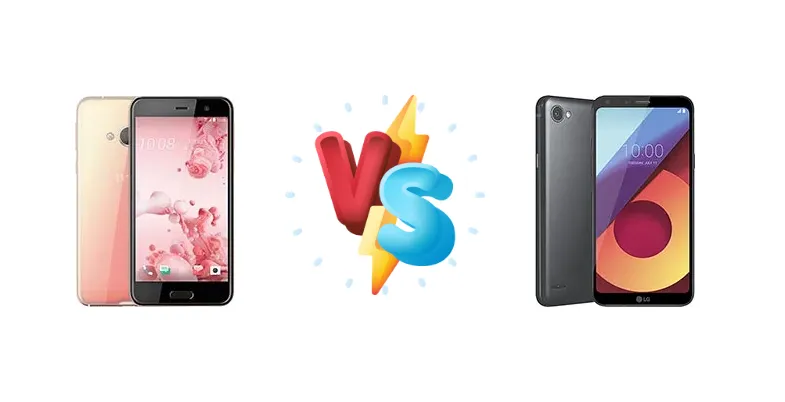
The HTC U Play and LG Q6 represent a bygone era of affordable Android smartphones, now available at extremely competitive prices. Both devices aimed to deliver a functional smartphone experience without breaking the bank, but they took different approaches to achieving this goal. This comparison dissects their key specifications to determine which offers the better value proposition in today's market.
🏆 Quick Verdict
For the average user prioritizing sustained performance and a slightly more responsive experience, the HTC U Play edges out the LG Q6. While both offer similar battery endurance, the U Play’s Mediatek Helio P10 chipset provides a modest CPU performance advantage, making it better suited for multitasking and light gaming.
| Network |
|---|
| 2G bands | GSM 850 / 900 / 1800 / 1900 - SIM 1 & SIM 2 | GSM 850 / 900 / 1800 / 1900 - SIM 1 & SIM 2 (dual-SIM model only) |
| 3G bands | HSDPA 850 / 900 / 1900 / 2100 | HSDPA 850 / 900 / 1900 / 2100 |
| 4G bands | 1, 3, 5, 7, 8, 20, 28, 38, 40 | 1, 3, 4, 5, 7, 8, 12, 17, 20, 28, 38 |
| Speed | HSPA 42.2/5.76 Mbps, LTE (2CA) Cat6 300/50 Mbps | HSPA 42.2/5.76 Mbps, LTE (2CA) Cat7 300/100 Mbps |
| Technology | GSM / HSPA / LTE | GSM / HSPA / LTE |
| Launch |
|---|
| Announced | 2017, January. Released 2017, February | 2017, July. Released 2017, August |
| Status | Discontinued | Discontinued |
| Body |
|---|
| Build | Glass front (Gorilla Glass), plastic back, plastic frame | Glass front (Gorilla Glass 3), plastic back, aluminum frame |
| Dimensions | 146 x 72.9 x 8 mm (5.75 x 2.87 x 0.31 in) | 142.5 x 69.3 x 8.1 mm (5.61 x 2.73 x 0.32 in) |
| SIM | Nano-SIM + Nano-SIM | · Nano-SIM· Nano-SIM + Nano-SIM |
| Weight | 145 g (5.11 oz) | 149 g (5.26 oz) |
| | - | MIL-STD-810G compliant*
*does not guarantee ruggedness or use in extreme conditions |
| Display |
|---|
| Protection | Corning Gorilla Glass (unspecified version) | Corning Gorilla Glass 3 |
| Resolution | 1080 x 1920 pixels, 16:9 ratio (~428 ppi density) | 1080 x 2160 pixels, 18:9 ratio (~442 ppi density) |
| Size | 5.2 inches, 73.2 cm2 (~68.7% screen-to-body ratio) | 5.5 inches, 77.0 cm2 (~78.0% screen-to-body ratio) |
| Type | Super LCD | IPS LCD |
| Platform |
|---|
| CPU | Octa-core (4x2.0 GHz Cortex-A53 & 4x1.1 GHz Cortex-A53) | Octa-core 1.4 GHz Cortex-A53 |
| Chipset | Mediatek MT6755 Helio P10 (28 nm) | Qualcomm MSM8940 Snapdragon 435 (28 nm) |
| GPU | Mali-T860MP2 | Adreno 505 |
| OS | Android 6.0 (Marshmallow) | Android 7.1.1 (Nougat), upgradable to Android 8.0 (Oreo), LG UI 5.0 |
| Memory |
|---|
| Card slot | microSDXC (uses shared SIM slot) | microSDXC (dedicated slot) |
| Internal | 32GB 3GB RAM, 64GB 4GB RAM | 16GB 2GB RAM, 32GB 3GB RAM, 64GB 4GB RAM |
| | eMMC 5.1 | eMMC 5.1 |
| Main Camera |
|---|
| Features | Dual-LED dual-tone flash, panorama | LED flash, panorama |
| Single | 16 MP, f/2.0, 28mm (wide), 1/3.1", 1.0µm, PDAF, OIS | 13 MP, f/2.2, 1/3.1", 1.12µm, AF |
| Video | 1080p@30fps | 1080p@30fps |
| Selfie camera |
|---|
| Features | HDR | - |
| Single | 16 MP, f/2.0, 27mm (wide), 1/3.06", 1.0µm | 5 MP, f/2.2, 1/5.0", 1.12µm |
| Video | 1080p@30fps | - |
| Sound |
|---|
| 3.5mm jack | No | Yes |
| 35mm jack | No | Yes |
| Loudspeaker | Yes | Yes |
| Comms |
|---|
| Bluetooth | 4.2, A2DP, LE | 4.2, A2DP, LE |
| NFC | Yes | Yes (market dependent) |
| Positioning | GPS, GLONASS | GPS, GLONASS |
| Radio | No | Stereo FM radio with RDS |
| USB | USB Type-C 2.0 | microUSB 2.0, OTG |
| WLAN | Wi-Fi 802.11 a/b/g/n/ac, dual-band, Wi-Fi Direct, DLNA | Wi-Fi 802.11 b/g/n, Wi-Fi Direct |
| Features |
|---|
| Browser | - | HTML, Adobe Flash |
| Sensors | Fingerprint (front-mounted), accelerometer, gyro, proximity, compass | Accelerometer, gyro, proximity, compass |
| Battery |
|---|
| Charging | 10W wired | - |
| Stand-by | Up to 427 h (3G) | Up to 372 h |
| Talk time | Up to 15 h (3G) | Up to 6 h |
| Type | Li-Ion 2500 mAh, non-removable | Li-Po 3000 mAh, non-removable |
| Misc |
|---|
| Colors | Brilliant Black, Cosmetic Pink, Ice White, Sapphire Blue | Astro Black, Ice Platinum, Mystic White, Terra Gold |
| Models | U Play, U-2u, 2PZM3 | M700, M703, LGM-X600L, LGM-X600K, LGM-X600S, US700 |
| Price | About 150 EUR | About 110 EUR |
| SAR | - | 1.14 W/kg (head) |
| Tests |
|---|
| Audio quality | - |
Noise -85.0dB / Crosstalk -92.9dB |
| Battery life | - |
Endurance rating 69h
|
| Camera | - |
Photo / Video |
| Display | - |
Contrast ratio: 1771:1 (nominal), 2.987 (sunlight) |
| Loudspeaker | - |
Voice 67dB / Noise 69dB / Ring 76dB
|
| Performance | - |
GeekBench: 2244 (v4.4)
GFXBench: 2fps (ES 3.1 onscreen) |
HTC U Play
- Slightly faster CPU performance due to Helio P10
- Potentially better multitasking capabilities
- More responsive user interface
- Unknown battery capacity
- Slower 10W charging
- Limited camera details
LG Q6
- Excellent 69-hour endurance rating
- Better display contrast for outdoor visibility
- Qualcomm ISP potentially offers better image processing
- Slower CPU performance compared to Helio P10
- Less responsive user interface
- Limited camera details
Display Comparison
Both the HTC U Play and LG Q6 lack detailed display specifications beyond the LG Q6’s reported contrast ratio of 1771:1 (nominal) and 2.987 (sunlight). This suggests the LG Q6 offers better visibility in direct sunlight. Given both phones target the budget segment, it’s safe to assume they utilize IPS LCD panels. The absence of information regarding resolution or pixel density suggests both likely feature 720p displays, adequate for their screen sizes but not exceptional. The LG Q6’s contrast ratio is a key differentiator, indicating potentially better color reproduction and depth.
Camera Comparison
Both devices are listed as having 'Photo / Video' capabilities, but lack specific details regarding sensor size, aperture, or features like Optical Image Stabilization (OIS). Given their price point, it’s reasonable to expect 8-13MP primary cameras with limited low-light performance. The absence of details makes a direct comparison impossible; however, Qualcomm’s image signal processor (ISP) in the Snapdragon 435 generally offers slightly better image processing than Mediatek’s equivalent in the Helio P10, potentially resulting in more accurate colors and reduced noise. The lack of OIS on either device means image stabilization will rely solely on software algorithms.
Performance
The core difference lies in the chipsets: the HTC U Play utilizes the Mediatek MT6755 Helio P10, an octa-core processor with a split core configuration (4x2.0 GHz Cortex-A53 & 4x1.1 GHz Cortex-A53), while the LG Q6 employs the Qualcomm MSM8940 Snapdragon 435, an octa-core 1.4 GHz Cortex-A53. The Helio P10’s higher clock speeds on its primary cores provide a performance edge in CPU-intensive tasks. However, both chipsets are built on a 28nm process, meaning thermal efficiency is comparable. The Snapdragon 435 benefits from Qualcomm’s optimized software and potentially better GPU performance, but the U Play’s CPU advantage is likely more noticeable in everyday use.
Battery Life
The LG Q6 boasts an endurance rating of 69 hours, a significant metric indicating its battery life under typical usage conditions. The HTC U Play’s battery capacity is unknown, but its 10W wired charging suggests slower charging speeds compared to potentially faster charging options available on some LG Q6 variants. While the U Play’s chipset might consume slightly more power, the difference is unlikely to be substantial. The LG Q6’s endurance rating is the key advantage here, promising all-day battery life for most users.
Buying Guide
Buy the HTC U Play if you need a phone capable of handling a bit more multitasking and appreciate a slightly faster user interface. It’s ideal for users who occasionally play casual games or switch between several apps. Buy the LG Q6 if battery life is your absolute top priority and you primarily use your phone for basic communication and media consumption. Its endurance rating suggests it will last a full day even with moderate use, and its display offers good contrast.
Frequently Asked Questions
❓ Is the Mediatek Helio P10 in the HTC U Play capable of running modern apps smoothly?
While the Helio P10 is an older chipset, it can handle most everyday apps and light multitasking without significant issues. However, demanding games or resource-intensive applications may experience lag or slowdowns. It's best suited for basic smartphone usage.
❓ How does the LG Q6's battery life hold up with heavy usage, like streaming video or using GPS?
The LG Q6's 69-hour endurance rating is based on moderate usage. Heavy usage, such as prolonged video streaming or GPS navigation, will significantly reduce battery life. However, it should still provide a reasonable amount of screen-on time, likely around 4-6 hours of continuous use.
❓ Are software updates still available for either the HTC U Play or the LG Q6?
Given the age of these devices, official software updates are highly unlikely. Both phones are likely running older versions of Android and may not receive further security patches. This is a significant security risk, and users should be aware of the potential vulnerabilities.