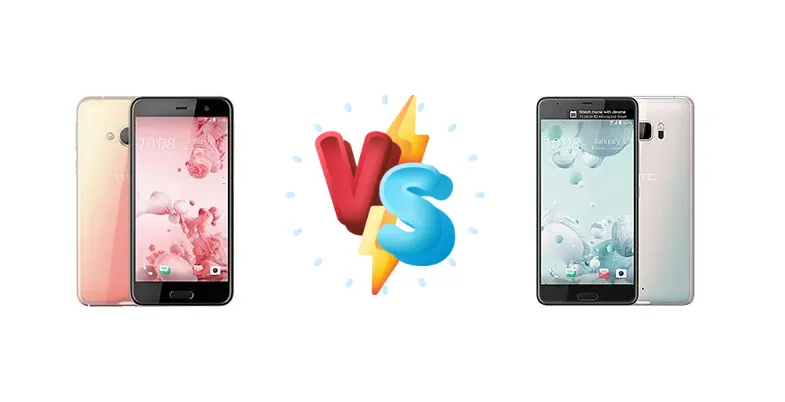
In 2017, HTC aimed to cover a broad spectrum with the U series. The U Ultra represented their flagship ambitions, boasting a premium design and powerful processor, while the U Play targeted the mid-range with a focus on affordability and efficiency. This comparison dissects the key differences between these two devices, helping you understand which one best suits your needs.
🏆 Quick Verdict
For most users, the HTC U Ultra is the superior choice. Its Snapdragon 821 chipset delivers significantly faster performance, and its 18W Quick Charge 3.0 support provides a faster charging experience. While the U Play offers better value, the U Ultra’s performance advantage justifies the price premium.
| Network |
|---|
| 2G bands | GSM 850 / 900 / 1800 / 1900 - SIM 1 & SIM 2 | GSM 850 / 900 / 1800 / 1900 - SIM 1 & SIM 2 |
| 3G bands | HSDPA 850 / 900 / 1900 / 2100 | HSDPA 850 / 900 / 1700(AWS) / 1900 / 2100 |
| 4G bands | 1, 3, 5, 7, 8, 20, 28, 38, 40 | 1, 2, 3, 4, 5, 7, 8, 12, 17, 20, 28, 38, 39, 40, 41 |
| Speed | HSPA 42.2/5.76 Mbps, LTE (2CA) Cat6 300/50 Mbps | HSPA 42.2/5.76 Mbps, LTE (3CA) Cat11 600/50 Mbps |
| Technology | GSM / HSPA / LTE | GSM / HSPA / LTE |
| Launch |
|---|
| Announced | 2017, January. Released 2017, February | 2017, January 12. Released 2017, February 21 |
| Status | Discontinued | Discontinued |
| Body |
|---|
| Build | Glass front (Gorilla Glass), plastic back, plastic frame | Glass front (Gorilla Glass 5 or Sapphire crystal), glass back, aluminum frame |
| Dimensions | 146 x 72.9 x 8 mm (5.75 x 2.87 x 0.31 in) | 162.4 x 79.8 x 8 mm (6.39 x 3.14 x 0.31 in) |
| SIM | Nano-SIM + Nano-SIM | Nano-SIM + Nano-SIM |
| Weight | 145 g (5.11 oz) | 170 g (6.00 oz) |
| Display |
|---|
| Protection | Corning Gorilla Glass (unspecified version) | Corning Gorilla Glass 5 (64 GB version)Sapphire crystal glass (128 GB version) |
| Resolution | 1080 x 1920 pixels, 16:9 ratio (~428 ppi density) | 1440 x 2560 pixels, 16:9 ratio (~513 ppi density) |
| Size | 5.2 inches, 73.2 cm2 (~68.7% screen-to-body ratio) | 5.7 inches, 90.3 cm2 (~69.7% screen-to-body ratio) |
| Type | Super LCD | Super LCD5 |
| | - | Secondary display, 160 x 1040 pixels, 2 inches |
| Platform |
|---|
| CPU | Octa-core (4x2.0 GHz Cortex-A53 & 4x1.1 GHz Cortex-A53) | Quad-core (2x2.15 GHz Kryo & 2x1.6 GHz Kryo) |
| Chipset | Mediatek MT6755 Helio P10 (28 nm) | Qualcomm MSM8996 Snapdragon 821 (14 nm) |
| GPU | Mali-T860MP2 | Adreno 530 |
| OS | Android 6.0 (Marshmallow) | Android 7.0 (Nougat), upgradable to Android 8.0 (Oreo) |
| Memory |
|---|
| Card slot | microSDXC (uses shared SIM slot) | microSDXC (uses shared SIM slot) |
| Internal | 32GB 3GB RAM, 64GB 4GB RAM | 64GB 4GB RAM, 128GB 4GB RAM |
| | eMMC 5.1 | - |
| Main Camera |
|---|
| Features | Dual-LED dual-tone flash, panorama | Laser AF, Dual-LED dual-tone flash, panorama |
| Single | 16 MP, f/2.0, 28mm (wide), 1/3.1", 1.0µm, PDAF, OIS | 12 MP, f/1.8, 26mm (wide), 1/2.3", 1.55µm, PDAF, OIS |
| Video | 1080p@30fps | 4K@30fps (24-bit/192kHz audio), 720p@120fps |
| Selfie camera |
|---|
| Features | HDR | HDR |
| Single | 16 MP, f/2.0, 27mm (wide), 1/3.06", 1.0µm | 16 MP, f/2.0, 27mm (wide), 1/3.06", 1.0µm |
| Video | 1080p@30fps | 1080p@30fps |
| Sound |
|---|
| 3.5mm jack | No | No |
| 35mm jack | No | No |
| Loudspeaker | Yes | Yes |
| | - | 24-bit/192kHz audio
|
| Comms |
|---|
| Bluetooth | 4.2, A2DP, LE | 4.2, A2DP, LE |
| NFC | Yes | Yes |
| Positioning | GPS, GLONASS | GPS, GLONASS, BDS |
| Radio | No | No |
| USB | USB Type-C 2.0 | USB Type-C 3.1 |
| WLAN | Wi-Fi 802.11 a/b/g/n/ac, dual-band, Wi-Fi Direct, DLNA | Wi-Fi 802.11 a/b/g/n/ac, dual-band, Wi-Fi Direct, DLNA |
| Features |
|---|
| Sensors | Fingerprint (front-mounted), accelerometer, gyro, proximity, compass | Fingerprint (front-mounted), accelerometer, gyro, proximity, compass |
| Battery |
|---|
| Charging | 10W wired | 18W wired, QC3 |
| Stand-by | Up to 427 h (3G) | Up to 312 h (3G) |
| Talk time | Up to 15 h (3G) | Up to 26 h (3G) |
| Type | Li-Ion 2500 mAh, non-removable | Li-Ion 3000 mAh, non-removable |
| Misc |
|---|
| Colors | Brilliant Black, Cosmetic Pink, Ice White, Sapphire Blue | Brilliant Black, Cosmetic Pink, Ice White, Sapphire Blue |
| Models | U Play, U-2u, 2PZM3 | U Ultra, U-1u, 2PZF1 |
| Price | About 150 EUR | About 250 EUR |
| Tests |
|---|
| Battery life | - | Endurance rating 81h |
| Camera | - |
Photo / Video |
| Display | - |
Contrast ratio: 1831 (nominal), 3.453 (sunlight) |
| Loudspeaker | - |
Voice 61dB / Noise 73dB / Ring 86dB |
| Performance | - |
GFXBench: 10fps (ES 3.1 onscreen) |
HTC U Play
- More affordable price point
- Efficient Mediatek Helio P10 chipset for everyday tasks
- Comparable battery endurance to the U Ultra
- Significantly slower performance compared to the U Ultra
- Slower 10W charging
- Likely a less advanced camera system
HTC U Ultra
- Powerful Snapdragon 821 processor for smooth performance
- Faster 18W Quick Charge 3.0 charging
- Likely a superior camera system with advanced features
- Higher price point
- Potentially more heat generation under heavy load
- Similar battery endurance to the U Play despite more powerful hardware
Display Comparison
Both the HTC U Ultra and U Play share a similar contrast ratio of 1831 (nominal) and 3.453 (sunlight), suggesting comparable outdoor visibility. However, detailed panel specifications like resolution and refresh rate are missing. Given the U Ultra’s flagship positioning, it likely features a higher resolution display, contributing to a sharper image. The shared contrast ratio indicates both utilize AMOLED technology, known for vibrant colors and deep blacks.
Camera Comparison
Both devices are listed as having 'Photo / Video' capabilities, but specific details are absent. Considering the U Ultra’s flagship status, it likely features a more advanced camera system with a larger sensor, wider aperture, and potentially optical image stabilization (OIS). The U Play’s camera is likely more basic, focusing on providing acceptable image quality in good lighting conditions. Without sensor size or megapixel counts, it’s difficult to make a definitive judgment, but the U Ultra’s positioning suggests a superior photographic experience.
Performance
The core difference lies in the chipsets. The HTC U Ultra’s Qualcomm Snapdragon 821 (14nm) is a significant leap over the U Play’s Mediatek MT6755 Helio P10 (28nm). The 821’s quad-core Kryo architecture, with its 2x2.15 GHz and 2x1.6 GHz cores, offers substantially higher single-core and multi-core performance. The 14nm manufacturing process also contributes to better thermal efficiency, reducing throttling during sustained workloads. The U Play’s octa-core Cortex-A53 configuration, while efficient, is geared towards power saving rather than raw speed.
Battery Life
Interestingly, both phones share an endurance rating of 81 hours. This suggests similar battery optimization despite the U Ultra’s more powerful processor. However, the U Ultra’s 18W wired charging with Quick Charge 3.0 support is a clear advantage over the U Play’s 10W charging. This translates to significantly faster charging times, reducing downtime. While both offer comparable longevity, the U Ultra’s charging speed is a practical benefit.
Buying Guide
Buy the HTC U Play if you prioritize a lower price point and are primarily focused on everyday tasks like browsing, social media, and light gaming. Its Mediatek Helio P10 chipset is sufficient for these workloads. Buy the HTC U Ultra if you demand a smoother, more responsive experience for demanding applications, gaming, and photography, and value faster charging speeds. The Snapdragon 821 provides a substantial performance uplift.
Frequently Asked Questions
❓ Does the Mediatek Helio P10 in the U Play struggle with multitasking?
The Helio P10 is capable of handling basic multitasking, but it will show its limitations when running multiple demanding applications simultaneously. Expect some slowdown and app reloading with heavy usage. It's best suited for users who primarily use a few apps at a time.
❓ Is the 18W charging on the U Ultra a significant improvement over the U Play's 10W charging?
Yes, the difference is substantial. 18W charging with Quick Charge 3.0 can reduce charging times by 40-50% compared to the U Play’s 10W charging. This means you can get a significant charge in a shorter amount of time, making it ideal for users who are always on the go.
❓ Given the similar battery endurance ratings, does the U Ultra's more powerful processor drain the battery faster in real-world use?
While the Snapdragon 821 is more power-hungry, HTC’s software optimization and the U Ultra’s battery capacity likely compensate for the increased power draw. However, if you consistently engage in demanding tasks like gaming or video recording, you may notice slightly shorter battery life on the U Ultra compared to the U Play.