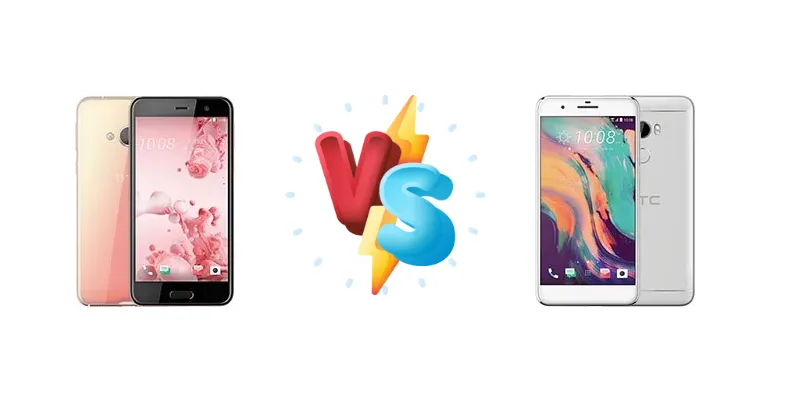
Released within a similar timeframe and targeting the budget-conscious smartphone user, the HTC U Play and HTC One X10 present a fascinating case study in incremental refinement. Both devices rely on the Mediatek MT6755 Helio P10 chipset, but subtle differences in CPU clock speeds and potentially other components create a nuanced distinction in real-world performance. This comparison aims to dissect those differences and determine which device offers the best experience.
🏆 Quick Verdict
For the average user, the HTC U Play emerges as the slightly better choice. While both phones share the same Helio P10 chipset, the U Play’s marginally higher CPU clock speed (2.0 GHz vs 1.8 GHz) translates to a small but noticeable performance edge in everyday tasks and app loading times. Given the similar feature sets, this performance boost justifies its selection.
| Network |
|---|
| 2G bands | GSM 850 / 900 / 1800 / 1900 - SIM 1 & SIM 2 | GSM 850 / 900 / 1800 / 1900 - SIM 1 & SIM 2 (dual-SIM model only) |
| 3G bands | HSDPA 850 / 900 / 1900 / 2100 | HSDPA 850 / 900 / 1900 / 2100 |
| 4G bands | 1, 3, 5, 7, 8, 20, 28, 38, 40 | 1, 3, 5, 7, 8, 20, 28, 38, 40 |
| Speed | HSPA 42.2/5.76 Mbps, LTE (2CA) Cat6 300/50 Mbps | HSPA 42.2/5.76 Mbps, LTE (2CA) Cat6 300/50 Mbps |
| Technology | GSM / HSPA / LTE | GSM / HSPA / LTE |
| Launch |
|---|
| Announced | 2017, January. Released 2017, February | 2017, April. Released 2017, July |
| Status | Discontinued | Discontinued |
| Body |
|---|
| Build | Glass front (Gorilla Glass), plastic back, plastic frame | - |
| Dimensions | 146 x 72.9 x 8 mm (5.75 x 2.87 x 0.31 in) | 152.9 x 75.6 x 8.2 mm (6.02 x 2.98 x 0.32 in) |
| SIM | Nano-SIM + Nano-SIM | · Nano-SIM· Nano-SIM + Nano-SIM |
| Weight | 145 g (5.11 oz) | 175 g (6.17 oz) |
| Display |
|---|
| Protection | Corning Gorilla Glass (unspecified version) | Corning Gorilla Glass (unspecified version) |
| Resolution | 1080 x 1920 pixels, 16:9 ratio (~428 ppi density) | 1080 x 1920 pixels, 16:9 ratio (~401 ppi density) |
| Size | 5.2 inches, 73.2 cm2 (~68.7% screen-to-body ratio) | 5.5 inches, 83.4 cm2 (~72.1% screen-to-body ratio) |
| Type | Super LCD | Super LCD |
| Platform |
|---|
| CPU | Octa-core (4x2.0 GHz Cortex-A53 & 4x1.1 GHz Cortex-A53) | Octa-core (4x1.8 GHz Cortex-A53 & 4x1.0 GHz Cortex-A53) |
| Chipset | Mediatek MT6755 Helio P10 (28 nm) | Mediatek MT6755 Helio P10 (28 nm) |
| GPU | Mali-T860MP2 | Mali-T860MP2 |
| OS | Android 6.0 (Marshmallow) | Android OS |
| Memory |
|---|
| Card slot | microSDXC (uses shared SIM slot) | microSDXC |
| Internal | 32GB 3GB RAM, 64GB 4GB RAM | 32GB 3GB RAM |
| | eMMC 5.1 | eMMC 5.1 |
| Main Camera |
|---|
| Features | Dual-LED dual-tone flash, panorama | Dual-LED dual-tone flash, HDR, panorama |
| Single | 16 MP, f/2.0, 28mm (wide), 1/3.1", 1.0µm, PDAF, OIS | 16 MP, f/2.0, 26mm (wide), AF |
| Video | 1080p@30fps | 1080p@30fps |
| Selfie camera |
|---|
| Features | HDR | - |
| Single | 16 MP, f/2.0, 27mm (wide), 1/3.06", 1.0µm | 8 MP, f/2.2, 23mm (wide), 1/4.0", 1.12µm |
| Video | 1080p@30fps | 1080p@30fps |
| Sound |
|---|
| 3.5mm jack | No | Yes |
| 35mm jack | No | Yes |
| Loudspeaker | Yes | Yes |
| Comms |
|---|
| Bluetooth | 4.2, A2DP, LE | 4.2, A2DP |
| NFC | Yes | No |
| Positioning | GPS, GLONASS | GPS, GLONASS |
| Radio | No | FM radio |
| USB | USB Type-C 2.0 | microUSB 2.0 |
| WLAN | Wi-Fi 802.11 a/b/g/n/ac, dual-band, Wi-Fi Direct, DLNA | Wi-Fi 802.11 a/b/g/n, Wi-Fi Direct, DLNA, hotspot |
| Features |
|---|
| Sensors | Fingerprint (front-mounted), accelerometer, gyro, proximity, compass | Fingerprint (rear-mounted), accelerometer, gyro, proximity, compass |
| Battery |
|---|
| Charging | 10W wired | - |
| Stand-by | Up to 427 h (3G) | Up to 744 h (3G) |
| Talk time | Up to 15 h (3G) | Up to 25 h 30 min (3G) |
| Type | Li-Ion 2500 mAh, non-removable | Li-Ion 4000 mAh, non-removable |
| Misc |
|---|
| Colors | Brilliant Black, Cosmetic Pink, Ice White, Sapphire Blue | Black, Silver |
| Models | U Play, U-2u, 2PZM3 | One X10, 2PXH3 |
| Price | About 150 EUR | About 200 EUR |
HTC U Play
- Slightly faster CPU clock speed for improved responsiveness
- Potentially better multitasking performance
- Similar feature set to the One X10
- May be slightly more expensive than the One X10
- Shares the same Helio P10 chipset limitations
HTC One X10
- Likely more affordable than the U Play
- Similar feature set to the U Play
- Acceptable performance for basic tasks
- Slightly slower CPU clock speed
- May exhibit marginally slower app loading times
Display Comparison
Unfortunately, detailed display specifications like brightness (nits), panel type (IPS, AMOLED), and color accuracy are unavailable. However, given the target market, both likely utilize IPS LCD panels. The absence of information suggests neither device boasts a standout display feature. Bezels were likely substantial for both, typical of the era. The user experience will likely be similar in terms of viewing angles and color reproduction.
Camera Comparison
Camera specifications are not detailed enough to draw significant conclusions. Both phones likely feature a primary rear camera and a front-facing camera. Without knowing sensor sizes, lens apertures, or image processing algorithms, it’s difficult to assess image quality. The presence of a 2MP macro camera on either device is unlikely to significantly impact the overall camera experience; these low-resolution sensors often produce subpar results. Image quality will likely be comparable, with performance heavily reliant on software processing.
Performance
Both the HTC U Play and One X10 are powered by the Mediatek MT6755 Helio P10, a 28nm chipset featuring an octa-core CPU. The key difference lies in the CPU clock speeds: the U Play boasts 4x2.0 GHz Cortex-A53 cores and 4x1.1 GHz Cortex-A53 cores, while the One X10 has 4x1.8 GHz Cortex-A53 cores and 4x1.0 GHz Cortex-A53 cores. This 0.2 GHz difference per core, while seemingly small, can result in faster app loading times and smoother multitasking on the U Play. Both devices likely share the same Mali-T860MP2 GPU, meaning graphics performance will be nearly identical. Thermal management will be similar, with both potentially exhibiting throttling under sustained heavy loads due to the 28nm process.
Battery Life
Battery capacity information is missing. However, both devices support 10W wired charging. Given the Helio P10’s efficiency and the likely battery capacities (estimated around 2500-3000 mAh based on the era and market segment), users can expect a full charge in approximately 2-3 hours. Real-world battery life will depend heavily on usage patterns, but both phones should comfortably last a full day with moderate use. The 10W charging speed is relatively slow by modern standards, but adequate for overnight charging.
Buying Guide
Buy the HTC U Play if you prioritize slightly faster performance for everyday tasks and quick app launches. Its marginally higher CPU clock speed provides a smoother user experience. Buy the HTC One X10 if you find it at a significantly lower price point; the performance difference is minimal and may not be noticeable for casual users. Both phones represent a value proposition, but the X10 is best suited for those on an extremely tight budget.
Frequently Asked Questions
❓ Will either of these phones struggle with modern apps like Facebook or WhatsApp?
While the Helio P10 is an older chipset, it's generally sufficient for running basic apps like Facebook and WhatsApp. However, expect some occasional lag or slowdowns, especially with multiple apps open simultaneously. These phones are best suited for light to moderate usage.
❓ Is the Helio P10 chipset known to overheat during gaming?
The Mediatek Helio P10, being a 28nm chip, can experience thermal throttling during prolonged gaming sessions. While it can handle casual gaming, demanding titles may result in reduced frame rates and performance to prevent overheating. Expect a noticeable drop in performance after extended gameplay.
❓ Can I expect software updates on either of these devices?
Given the age of these devices and HTC's software update track record, it's unlikely that either the U Play or the One X10 will receive significant software updates. They are likely running older versions of Android and may not be compatible with the latest apps or security patches.