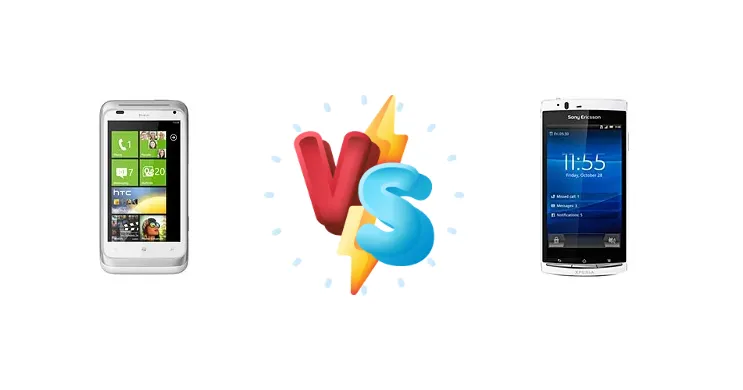
Released around the same time, the HTC Radar and Sony Ericsson Xperia Arc S represent a fascinating snapshot of the Android landscape in 2011. Both devices leverage Qualcomm's Snapdragon S2 platform, but diverge in their approach to performance and user experience. This comparison dissects their key differences to determine which phone offers the best value today.
🏆 Quick Verdict
For the average user seeking a functional and reliable Android experience, the Sony Ericsson Xperia Arc S emerges as the slightly better choice. Its 1.4 GHz CPU provides a noticeable performance edge over the HTC Radar’s 1.0 GHz processor, making it more responsive for everyday tasks and light multitasking.
| Network |
|---|
| 2G bands | GSM 850 / 900 / 1800 / 1900 | GSM 850 / 900 / 1800 / 1900 |
| 3G bands | HSDPA 900 / 2100 | HSDPA 900 / 2100 - LT18i |
| EDGE | - | Yes |
| GPRS | - | Yes |
| Speed | HSPA 14.4/5.76 Mbps | HSPA 14.4/5.76 Mbps |
| Technology | GSM / HSPA | GSM / HSPA |
| | HSDPA 1700 / 2100 - for T-Mobile | HSDPA 850 / 1900 / 2100 / 800 - LT18a |
| Launch |
|---|
| Announced | 2011, September. Released 2011, October | 2011, August. Released 2011, September |
| Status | Discontinued | Discontinued |
| Body |
|---|
| Dimensions | 120.5 x 61.5 x 10.9 mm (4.74 x 2.42 x 0.43 in) | 125 x 63 x 8.7 mm (4.92 x 2.48 x 0.34 in) |
| SIM | Mini-SIM | Mini-SIM |
| Weight | 137 g (4.83 oz) | 117 g (4.13 oz) |
| Display |
|---|
| Protection | Corning Gorilla Glass | Scratch-resistant glass |
| Resolution | 480 x 800 pixels, 5:3 ratio (~246 ppi density) | 480 x 854 pixels, 16:9 ratio (~233 ppi density) |
| Size | 3.8 inches, 41.1 cm2 (~55.5% screen-to-body ratio) | 4.2 inches, 48.6 cm2 (~61.7% screen-to-body ratio) |
| Type | S-LCD | LED-backlit LCD, |
| Platform |
|---|
| CPU | 1.0 GHz Scorpion | 1.4 GHz Scorpion |
| Chipset | Qualcomm MSM8255 Snapdragon S2 | Qualcomm MSM8255T Snapdragon S2 |
| GPU | Adreno 205 | Adreno 205 |
| OS | Microsoft Windows Phone 7.5 Mango | Android 2.3.4 (Gingerbread), 4.0.4 (Ice Cream Sandwich), not upgradable to 4.1 (Jelly Bean) |
| Memory |
|---|
| Card slot | No | microSDHC (dedicated slot), 8 GB included |
| Internal | 8GB 512MB RAM | 1GB (320MB user available), 512MB RAM |
| Main Camera |
|---|
| Features | LED flash | LED flash, panorama |
| Single | 5 MP, AF | 8 MP, AF |
| Video | 720p@30fps | 720p@30fps |
| Selfie camera |
|---|
| Single | VGA | - |
| | - | No |
| Sound |
|---|
| 3.5mm jack | Yes | Yes |
| 35mm jack | Yes | Yes |
| Loudspeaker | Yes, with stereo speakers | Yes |
| | SRS audio | - |
| Comms |
|---|
| Bluetooth | 2.1, A2DP, EDR | 2.1, A2DP, EDR |
| NFC | - | No |
| Positioning | GPS, A-GPS; Bing Maps | GPS, A-GPS; GLONASS |
| Radio | Stereo FM radio, RDS | Stereo FM radio, RDS |
| USB | microUSB 2.0 | microUSB 2.0, OTG |
| WLAN | Wi-Fi 802.11 b/g/n, DLNA | Wi-Fi 802.11 b/g/n, DLNA, hotspot |
| Features |
|---|
| Sensors | Accelerometer, proximity | Accelerometer, proximity, compass |
| | HTC Locations
MP3/eAAC+/WAV/WMA player
MP4/H.264/WMV player
Document viewer/editor
Facebook integration | ANT+
HDMI port
MP4/H.264/WMV player
MP3/eAAC+/WMA/WAV player
TrackID music recognition
NeoReader barcode scanner
Document viewer
Voice memo/dial/commands
Predictive text input |
| Battery |
|---|
| Music play | - | Up to 37 h |
| Stand-by | Up to 480 h (2G) / Up to 535 h (3G) | Up to 460 h (2G) / Up to 460 h (3G) |
| Talk time | Up to 10 h (2G) / Up to 8 h 5 min (3G) | Up to 7 h 25 min (2G) / Up to 7 h 35 min (3G) |
| Type | Non-removable Li-Ion 1520 mAh battery | Removable Li-Po 1500 mAh battery |
| Misc |
|---|
| Colors | Active White, Metal Silver | Pure White, Midnight Blue, Misty Silver, Gloss Black, Sakura Pink |
| Price | About 140 EUR | About 210 EUR |
| SAR | 0.45 W/kg (head) 1.17 W/kg (body) | - |
| SAR EU | - | 0.66 W/kg (head) |
| Tests |
|---|
| Audio quality |
Noise -88.3dB / Crosstalk -74.7dB |
Noise -89.3dB / Crosstalk -90.2dB |
| Battery life |
Endurance rating 34h
| - |
| Camera |
Photo / Video |
Photo / Video |
| Display |
Contrast ratio: 797:1 (nominal) | - |
| Loudspeaker |
Voice 66dB / Noise 66dB / Ring 78dB
|
Voice 67dB / Noise 65dB / Ring 76dB
|
HTC Radar
- Potentially better battery life due to lower CPU clock speed
- Reported durable build quality (HTC reputation)
- Good contrast ratio (797:1)
- Slower CPU (1.0 GHz) compared to the Arc S
- Limited performance for multitasking
- Lack of detailed camera specifications
Sony Ericsson Xperia Arc S
- Faster CPU (1.4 GHz) for improved responsiveness
- Potentially better camera image processing (Sony Ericsson history)
- Slightly larger physical size may offer a better viewing experience
- Potentially shorter battery life due to faster CPU
- No contrast ratio data available
- Limited detailed specifications
Display Comparison
Display specifications are limited, but the HTC Radar boasts a contrast ratio of 797:1, suggesting a reasonably vibrant image. The Xperia Arc S lacks this specific metric in the provided data. Given both phones targeted a similar price point, it's likely they employed similar LCD panel technology. The Arc S’s larger physical size *may* translate to a slightly more immersive viewing experience, but without knowing screen size or resolution, it’s difficult to definitively say. Neither device is expected to compete with modern OLED displays in terms of color accuracy or viewing angles.
Camera Comparison
Both the HTC Radar and Sony Ericsson Xperia Arc S offer photo and video capabilities, but detailed specifications are absent. Given the era, both likely featured 5-8 megapixel sensors. Sony Ericsson historically focused on camera technology, suggesting the Arc S *may* have benefited from superior image processing algorithms. Without sensor size or aperture information, it’s impossible to declare a clear winner. The absence of details regarding features like autofocus or flash further complicates the comparison.
Performance
The core difference lies in the CPU clock speed: the Xperia Arc S features a 1.4 GHz Scorpion processor, while the HTC Radar is clocked at 1.0 GHz. Both utilize the Qualcomm MSM8255T and MSM8255 Snapdragon S2 chipsets respectively. This 40% increase in clock speed directly impacts application launch times and overall system responsiveness. While both share the same architecture, the Arc S will demonstrably outperform the Radar in CPU-bound tasks. The lack of information regarding RAM capacity prevents a complete performance assessment, but the faster CPU is the clear advantage for the Arc S.
Battery Life
The HTC Radar is listed with a 34-hour endurance rating. The Xperia Arc S lacks this metric. However, a faster processor generally consumes more power. Therefore, the Radar’s lower CPU clock speed *could* translate to slightly better battery life under similar usage conditions. Without knowing battery capacity (mAh) for either device, it’s difficult to provide a definitive assessment. The 34-hour rating for the Radar is a broad estimate and doesn’t account for varying usage patterns.
Buying Guide
Buy the HTC Radar if you prioritize a potentially more durable build quality (based on HTC's reputation at the time) and are comfortable with a slightly slower processor. Buy the Sony Ericsson Xperia Arc S if you prefer a smoother, more responsive user experience thanks to its faster CPU, and value the potential for slightly better application performance. Both represent a budget-friendly entry point into the Android ecosystem.
Frequently Asked Questions
❓ Will either of these phones struggle with modern Android apps?
Yes, both the HTC Radar and Sony Ericsson Xperia Arc S are severely underpowered by today's standards. Their Snapdragon S2 processors and limited RAM will result in significant lag and performance issues with most modern Android applications. They are best suited for basic tasks like calls, texts, and simple web browsing.
❓ Is the difference in CPU speed between the Radar and Arc S noticeable in everyday use?
Absolutely. The 40% increase in CPU clock speed on the Xperia Arc S translates to a demonstrably smoother user experience. You'll notice faster app launch times, quicker web page loading, and less lag when switching between applications. While both phones run Android Gingerbread, the Arc S will feel significantly more responsive.
❓ Are replacement batteries readily available for either of these phones?
Finding replacement batteries for these older models can be challenging. Availability is limited and often relies on third-party sellers. Battery health will likely be degraded after years of use, making a replacement a worthwhile consideration if you plan to use either phone regularly.