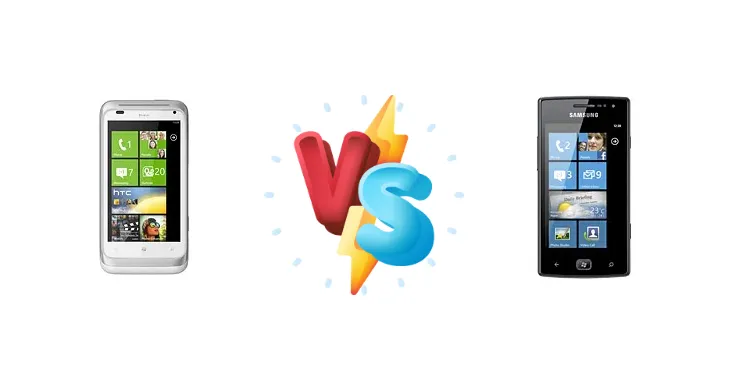
Released around the same time, the HTC Radar and Samsung Omnia W represent two distinct approaches to the Windows Phone ecosystem. Both leverage the Qualcomm Snapdragon S2 platform, but diverge in display technology and subtle performance tuning. This comparison dissects these differences to determine which device offers the best experience for today's user.
🏆 Quick Verdict
For the average user prioritizing display quality, the Samsung Omnia W emerges as the better choice. Its 'Infinite' contrast ratio (and more realistically, 3.301:1 in sunlight) provides a significantly more vibrant viewing experience than the HTC Radar's 797:1 contrast ratio. While both share the same chipset, the Omnia W's slightly faster CPU offers a marginal performance edge.
| Network |
|---|
| 2G bands | GSM 850 / 900 / 1800 / 1900 | GSM 850 / 900 / 1800 / 1900 |
| 3G bands | HSDPA 900 / 2100 | HSDPA 900 / 2100 |
| Speed | HSPA 14.4/5.76 Mbps | HSPA 14.4/5.76 Mbps |
| Technology | GSM / HSPA | GSM / HSPA |
| | HSDPA 1700 / 2100 - for T-Mobile | HSDPA 850 / 1900 - Samsung Omnia W I8350T |
| Launch |
|---|
| Announced | 2011, September. Released 2011, October | 2011, September. Released 2011, October |
| Status | Discontinued | Discontinued |
| Body |
|---|
| Dimensions | 120.5 x 61.5 x 10.9 mm (4.74 x 2.42 x 0.43 in) | 115.6 x 58.8 x 10.9 mm (4.55 x 2.31 x 0.43 in) |
| SIM | Mini-SIM | Mini-SIM |
| Weight | 137 g (4.83 oz) | 115.3 g (4.06 oz) |
| Display |
|---|
| Protection | Corning Gorilla Glass | Corning Gorilla Glass |
| Resolution | 480 x 800 pixels, 5:3 ratio (~246 ppi density) | 480 x 800 pixels, 5:3 ratio (~252 ppi density) |
| Size | 3.8 inches, 41.1 cm2 (~55.5% screen-to-body ratio) | 3.7 inches, 39.0 cm2 (~57.3% screen-to-body ratio) |
| Type | S-LCD | Super AMOLED |
| Platform |
|---|
| CPU | 1.0 GHz Scorpion | 1.4 GHz Scorpion |
| Chipset | Qualcomm MSM8255 Snapdragon S2 | Qualcomm MSM8255 Snapdragon S2 |
| GPU | Adreno 205 | Adreno 205 |
| OS | Microsoft Windows Phone 7.5 Mango | Microsoft Windows Phone 7.5 Mango |
| Memory |
|---|
| Card slot | No | No |
| Internal | 8GB 512MB RAM | 8GB 512MB RAM |
| Main Camera |
|---|
| Features | LED flash | LED flash |
| Single | 5 MP, AF | 5 MP, AF |
| Video | 720p@30fps | 720p@30fps |
| Selfie camera |
|---|
| Single | VGA | VGA |
| Sound |
|---|
| 3.5mm jack | Yes | Yes |
| 35mm jack | Yes | Yes |
| Loudspeaker | Yes, with stereo speakers | Yes |
| | SRS audio | - |
| Comms |
|---|
| Bluetooth | 2.1, A2DP, EDR | 2.1, A2DP |
| Positioning | GPS, A-GPS; Bing Maps | GPS, A-GPS, Bing map |
| Radio | Stereo FM radio, RDS | Stereo FM radio, RDS |
| USB | microUSB 2.0 | microUSB 2.0 |
| WLAN | Wi-Fi 802.11 b/g/n, DLNA | Wi-Fi 802.11 b/g/n, hotspot |
| Features |
|---|
| Sensors | Accelerometer, proximity | Accelerometer, gyro, proximity, compass |
| | HTC Locations
MP3/eAAC+/WAV/WMA player
MP4/H.264/WMV player
Document viewer/editor
Facebook integration | Document viewer/editor
MP4/WMV/H.264 player
MP3/WAV/WMA/eAAC+ player |
| Battery |
|---|
| Stand-by | Up to 480 h (2G) / Up to 535 h (3G) | Up to 370 h |
| Talk time | Up to 10 h (2G) / Up to 8 h 5 min (3G) | Up to 7 h |
| Type | Non-removable Li-Ion 1520 mAh battery | Removable Li-Ion 1500 mAh battery |
| Misc |
|---|
| Colors | Active White, Metal Silver | Black |
| Price | About 140 EUR | About 150 EUR |
| SAR | 0.45 W/kg (head) 1.17 W/kg (body) | - |
| SAR EU | - | 0.36 W/kg (head) |
| Tests |
|---|
| Audio quality |
Noise -88.3dB / Crosstalk -74.7dB |
Noise -84.8dB / Crosstalk -84.2dB |
| Battery life |
Endurance rating 34h
| - |
| Camera |
Photo / Video |
Photo / Video |
| Display |
Contrast ratio: 797:1 (nominal) |
Contrast ratio: Infinite (nominal) / 3.301:1 (sunlight) |
| Loudspeaker |
Voice 66dB / Noise 66dB / Ring 78dB
|
Voice 67dB / Noise 66dB / Ring 67dB |
HTC Radar
- Proven HTC build quality
- Reliable Windows Phone experience
- Decent battery endurance (34h)
- Inferior display contrast ratio
- Slower CPU clock speed
Samsung Omnia W I8350
- Superior display contrast ratio
- Faster CPU clock speed
- Potentially smoother multitasking
- Samsung's TouchWiz UI can be resource intensive
- Build quality may not match HTC's reputation
Display Comparison
The most significant difference between these two devices lies in their displays. The Samsung Omnia W boasts a contrast ratio advertised as 'Infinite' (nominal) and a more practical 3.301:1 in direct sunlight. This suggests a superior AMOLED or similar technology capable of true blacks, resulting in a more dynamic and vibrant image. Conversely, the HTC Radar’s 797:1 contrast ratio indicates a standard LCD panel, which will appear less vivid and have less impressive black levels. While both likely share similar resolutions given the era, the Omnia W’s contrast advantage is a clear win for media viewers.
Camera Comparison
Both devices feature photo and video capabilities, but the provided context data lacks specifics regarding sensor size, aperture, or image processing. Given the era, it's reasonable to assume both utilize similar 5-8MP sensors. The image processing style will likely be the differentiating factor – HTC historically favored more natural colors, while Samsung often boosted saturation. Without detailed specifications, it’s difficult to declare a clear winner; however, the Omnia W’s slightly more powerful processor *could* translate to faster image processing times.
Performance
Both the HTC Radar and Samsung Omnia W are powered by the Qualcomm MSM8255 Snapdragon S2 chipset, featuring a 1.0 GHz Scorpion CPU. However, the Omnia W edges out the Radar with a 1.4 GHz Scorpion CPU. This 40% clock speed increase, while not transformative, will result in slightly snappier application loading and smoother multitasking. Both devices likely share 512MB of RAM, typical for Windows Phone 7 devices, meaning performance differences will be most noticeable in demanding scenarios. Thermal management is unlikely to be a concern with this chipset, as it's relatively power-efficient.
Battery Life
The HTC Radar is rated for 34 hours of endurance, suggesting a moderate battery capacity. The Samsung Omnia W’s battery capacity is not specified, but its slightly faster processor could potentially offset any capacity differences. Real-world battery life will depend heavily on usage patterns, but the Radar’s endurance rating provides a baseline expectation. Charging speeds are also unknown, but given the age of these devices, neither is likely to support fast charging technologies.
Buying Guide
Buy the HTC Radar if you prioritize a proven track record of build quality from HTC and are less concerned with absolute display fidelity. It's a solid, reliable device for basic smartphone tasks. Buy the Samsung Omnia W I8350 if you value a superior display experience, particularly for media consumption, and appreciate the slightly faster processor for smoother multitasking. It's the better option for users who want a more visually engaging smartphone.
Frequently Asked Questions
❓ Is the 1.4 GHz CPU on the Samsung Omnia W a noticeable improvement over the 1.0 GHz CPU on the HTC Radar in everyday use?
While the 40% clock speed increase is measurable, the difference in everyday use will be subtle. You'll likely notice it more when multitasking or launching demanding applications, but for basic tasks like calling, texting, and browsing, the difference will be minimal. Both devices are limited by the 512MB of RAM.
❓ Does the 'Infinite' contrast ratio on the Samsung Omnia W mean it has an OLED display?
It strongly suggests the Omnia W utilizes an AMOLED or similar display technology capable of displaying true blacks. This results in a much more vibrant and visually appealing image compared to the LCD panel found in the HTC Radar, which has a lower contrast ratio of 797:1. The 'Infinite' rating is a marketing term, but the 3.301:1 sunlight contrast confirms a superior display.
❓ Are these phones still receiving software updates?
No. Both the HTC Radar and Samsung Omnia W ran Windows Phone 7, which reached its end of life years ago. Microsoft no longer provides updates or support for this operating system, meaning these devices are vulnerable to security risks and lack access to modern apps.