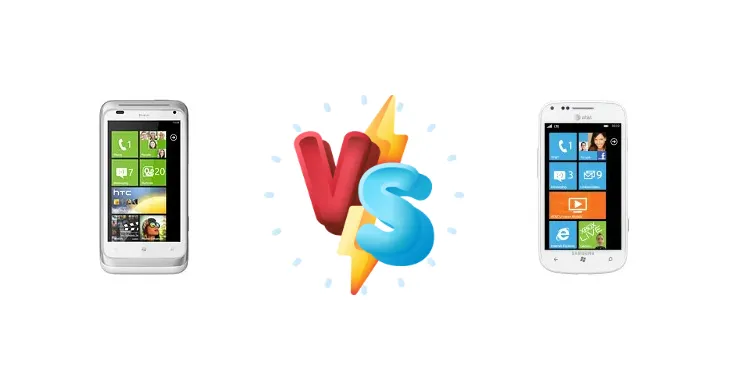
The HTC Radar and Samsung Focus 2 represent a fascinating snapshot of the Windows Phone era. Both devices leveraged Qualcomm's Snapdragon S2 platform, but with subtle differences in clock speed and implementation. This comparison dissects those nuances to determine which phone delivers a superior user experience, particularly for those seeking a functional and affordable Windows Phone today.
🏆 Quick Verdict
For the average user seeking a functional Windows Phone, the Samsung Focus 2 I667 edges out the HTC Radar. The 1.4 GHz CPU provides a noticeable performance boost over the Radar’s 1.0 GHz, translating to snappier app loading and multitasking, despite both sharing the same Snapdragon S2 chipset.
| Network |
|---|
| 2G bands | GSM 850 / 900 / 1800 / 1900 | GSM 850 / 900 / 1800 / 1900 |
| 3G bands | HSDPA 900 / 2100 | HSDPA 850 / 900 / 2100 |
| 4G bands | - | 4, 17 |
| Speed | HSPA 14.4/5.76 Mbps | HSPA 21.1/5.76 Mbps, LTE Cat3 100/50 Mbps |
| Technology | GSM / HSPA | GSM / HSPA / LTE |
| | HSDPA 1700 / 2100 - for T-Mobile | - |
| Launch |
|---|
| Announced | 2011, September. Released 2011, October | 2012, May. Released 2012, May |
| Status | Discontinued | Discontinued |
| Body |
|---|
| Dimensions | 120.5 x 61.5 x 10.9 mm (4.74 x 2.42 x 0.43 in) | 121.7 x 62.7 x 11 mm (4.79 x 2.47 x 0.43 in) |
| SIM | Mini-SIM | Mini-SIM |
| Weight | 137 g (4.83 oz) | 122 g (4.30 oz) |
| Display |
|---|
| Protection | Corning Gorilla Glass | - |
| Resolution | 480 x 800 pixels, 5:3 ratio (~246 ppi density) | 480 x 800 pixels, 5:3 ratio (~233 ppi density) |
| Size | 3.8 inches, 41.1 cm2 (~55.5% screen-to-body ratio) | 4.0 inches, 45.5 cm2 (~59.7% screen-to-body ratio) |
| Type | S-LCD | Super AMOLED |
| Platform |
|---|
| CPU | 1.0 GHz Scorpion | 1.4 GHz Scorpion |
| Chipset | Qualcomm MSM8255 Snapdragon S2 | Qualcomm MSM8255T Snapdragon S2 |
| GPU | Adreno 205 | Adreno 205 |
| OS | Microsoft Windows Phone 7.5 Mango | Microsoft Windows Phone 7.5 Mango |
| Memory |
|---|
| Card slot | No | No |
| Internal | 8GB 512MB RAM | 8GB |
| Main Camera |
|---|
| Features | LED flash | LED flash |
| Single | 5 MP, AF | 5 MP, AF |
| Video | 720p@30fps | 720p@30fps |
| Selfie camera |
|---|
| Single | VGA | VGA |
| Sound |
|---|
| 3.5mm jack | Yes | Yes |
| 35mm jack | Yes | Yes |
| Loudspeaker | Yes, with stereo speakers | Yes |
| | SRS audio | - |
| Comms |
|---|
| Bluetooth | 2.1, A2DP, EDR | 2.1, A2DP |
| Positioning | GPS, A-GPS; Bing Maps | GPS, A-GPS |
| Radio | Stereo FM radio, RDS | FM radio |
| USB | microUSB 2.0 | microUSB 2.0 |
| WLAN | Wi-Fi 802.11 b/g/n, DLNA | Wi-Fi 802.11 b/g/n |
| Features |
|---|
| Sensors | Accelerometer, proximity | Accelerometer, proximity, compass |
| | HTC Locations
MP3/eAAC+/WAV/WMA player
MP4/H.264/WMV player
Document viewer/editor
Facebook integration | Document viewer/editor
MP4/WMV player
MP3/WAV/WMA/eAAC+ player
Facebook integration |
| Battery |
|---|
| Stand-by | Up to 480 h (2G) / Up to 535 h (3G) | Up to 250 h |
| Talk time | Up to 10 h (2G) / Up to 8 h 5 min (3G) | Up to 6 h |
| Type | Non-removable Li-Ion 1520 mAh battery | Removable Li-Ion 1750 mAh battery |
| Misc |
|---|
| Colors | Active White, Metal Silver | White |
| Price | About 140 EUR | About 110 EUR |
| SAR | 0.45 W/kg (head) 1.17 W/kg (body) | 0.68 W/kg (head) 0.99 W/kg (body) |
| Tests |
|---|
| Audio quality |
Noise -88.3dB / Crosstalk -74.7dB | - |
| Battery life |
Endurance rating 34h
| - |
| Camera |
Photo / Video | - |
| Display |
Contrast ratio: 797:1 (nominal) | - |
| Loudspeaker |
Voice 66dB / Noise 66dB / Ring 78dB
| - |
HTC Radar
- Higher display contrast ratio (797:1)
- Proven build quality (HTC reputation)
- Slightly better potential battery life (based on endurance rating)
- Slower 1.0 GHz CPU
- Potentially less responsive user experience
- Limited performance headroom for future updates
Samsung Focus 2 I667
- Faster 1.4 GHz CPU
- More responsive user interface
- Potentially improved multitasking performance
- Contrast ratio not specified (potentially lower)
- Potentially shorter battery life due to faster CPU
- Build quality may not match HTC's reputation
Display Comparison
Both the HTC Radar and Samsung Focus 2 feature displays of similar size and resolution, typical for the Windows Phone 7 era. However, the HTC Radar boasts a contrast ratio of 797:1, suggesting deeper blacks and more vibrant colors compared to the Focus 2 (whose contrast ratio is not specified). This difference, while not massive, could be noticeable in side-by-side viewing, particularly for media consumption. Neither device is expected to offer particularly high brightness levels, making outdoor visibility a potential challenge for both.
Camera Comparison
Both devices are listed as having 'Photo / Video' capabilities, but specific details regarding sensor size, aperture, or image processing are absent. Given the era, it’s reasonable to assume both cameras are capable of capturing acceptable photos in good lighting conditions. However, low-light performance is likely to be limited. Without further specifications, it’s difficult to definitively declare a winner in the camera department. The absence of details suggests neither device was positioned as a camera-centric phone.
Performance
The core difference between these two devices lies in their CPU clock speeds. The Samsung Focus 2 I667 utilizes a 1.4 GHz Qualcomm MSM8255T Snapdragon S2, while the HTC Radar is clocked at 1.0 GHz. While both are based on the same Snapdragon S2 architecture, the higher clock speed of the Focus 2 translates directly to faster processing speeds. This means quicker app launches, smoother multitasking, and a more responsive overall user experience. The 'T' designation in the Focus 2's chipset suggests a minor revision, potentially offering slight efficiency improvements, though concrete details are scarce. Both devices likely share the same amount of RAM, making the CPU the primary performance differentiator.
Battery Life
The HTC Radar has an endurance rating of 34 hours, indicating a reasonable battery life for its time. The Samsung Focus 2’s battery life is not specified, making a direct comparison difficult. However, the Focus 2’s faster processor could potentially consume more power, potentially offsetting any gains from minor chipset optimizations. Users prioritizing battery life might lean towards the Radar, but real-world usage will heavily influence actual results. Both devices would likely benefit from conservative usage patterns to maximize uptime.
Buying Guide
Buy the HTC Radar if you prioritize a proven track record of build quality and a slightly better contrast ratio for display visibility in bright conditions. Buy the Samsung Focus 2 I667 if you prefer a faster processor for improved responsiveness and a more fluid user experience, even if it means potentially sacrificing a small amount of display contrast.
Frequently Asked Questions
❓ Will the Samsung Focus 2's faster processor significantly improve app loading times?
Yes, the 1.4 GHz CPU in the Focus 2 should noticeably reduce app loading times compared to the Radar's 1.0 GHz processor. While both devices run the same operating system, the faster CPU provides more processing power for handling app initialization and data processing.
❓ Is the difference in display contrast between the HTC Radar and Samsung Focus 2 noticeable in everyday use?
The 797:1 contrast ratio of the HTC Radar suggests slightly deeper blacks and more vibrant colors. While the difference may not be dramatic, it could be perceptible when viewing photos or videos, especially in side-by-side comparisons. The impact will be more noticeable in darker environments.
❓ Given the age of these devices, are there any known software compatibility issues?
Both the HTC Radar and Samsung Focus 2 run Windows Phone 7, which is no longer officially supported by Microsoft. This means users may encounter compatibility issues with newer apps and services. Finding functional apps may require exploring alternative app stores or relying on older versions.