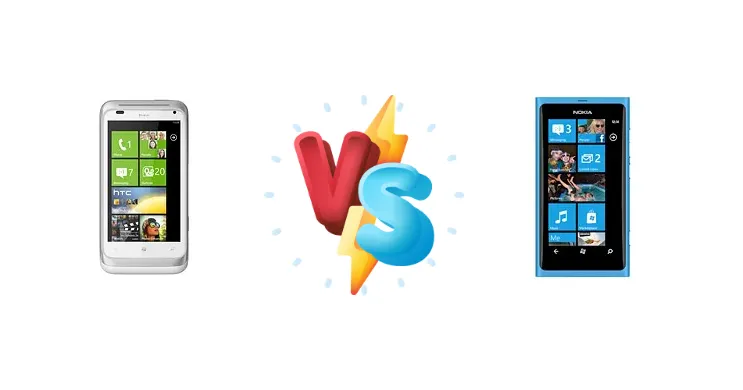
Released in late 2011 and early 2012, the HTC Radar and Nokia Lumia 800 represented the peak of Windows Phone 7 hardware. Both devices leveraged Qualcomm's Snapdragon S2 platform, but diverged in key areas like display technology and CPU clock speed. This comparison dissects these differences to determine which phone offered the better experience for the user.
🏆 Quick Verdict
For the average user seeking a balance of features and battery life, the Nokia Lumia 800 emerges as the slightly better choice. Its 'Infinite' contrast ratio display provides a superior visual experience, and the marginally longer battery endurance, though minimal, adds to its appeal. However, the Radar remains a viable option for those prioritizing a more compact form factor.
| Network |
|---|
| 2G bands | GSM 850 / 900 / 1800 / 1900 | GSM 850 / 900 / 1800 / 1900 |
| 3G bands | HSDPA 900 / 2100 | HSDPA 850 / 900 / 1900 / 2100 - RM-819 |
| Speed | HSPA 14.4/5.76 Mbps | HSPA 14.4/5.76 Mbps |
| Technology | GSM / HSPA | GSM / HSPA |
| | HSDPA 1700 / 2100 - for T-Mobile | HSDPA 850 / 1900 / 2100 - for Canada |
| Launch |
|---|
| Announced | 2011, September. Released 2011, October | 2011, October. Released 2011, November |
| Status | Discontinued | Discontinued |
| Body |
|---|
| Dimensions | 120.5 x 61.5 x 10.9 mm (4.74 x 2.42 x 0.43 in) | 116.5 x 61.2 x 12.1 mm, 76.1 cc (4.59 x 2.41 x 0.48 in) |
| SIM | Mini-SIM | Micro-SIM |
| Weight | 137 g (4.83 oz) | 142 g (5.01 oz) |
| Display |
|---|
| Protection | Corning Gorilla Glass | Corning Gorilla Glass |
| Resolution | 480 x 800 pixels, 5:3 ratio (~246 ppi density) | 480 x 800 pixels, 5:3 ratio (~252 ppi density) |
| Size | 3.8 inches, 41.1 cm2 (~55.5% screen-to-body ratio) | 3.7 inches, 39.0 cm2 (~54.7% screen-to-body ratio) |
| Type | S-LCD | AMOLED |
| | - | Nokia ClearBlack display
|
| Platform |
|---|
| CPU | 1.0 GHz Scorpion | 1.4 GHz Scorpion |
| Chipset | Qualcomm MSM8255 Snapdragon S2 | Qualcomm MSM8255 Snapdragon S2 |
| GPU | Adreno 205 | Adreno 205 |
| OS | Microsoft Windows Phone 7.5 Mango | Microsoft Windows Phone 7.5 Mango, upgradable to 7.8 |
| Memory |
|---|
| Card slot | No | No |
| Internal | 8GB 512MB RAM | 16GB 512MB RAM |
| Main Camera |
|---|
| Features | LED flash | Carl Zeiss optics, dual-LED flash |
| Single | 5 MP, AF | 8 MP, AF |
| Video | 720p@30fps | 720p@30fps |
| Selfie camera |
|---|
| Single | VGA | - |
| | - | No |
| Sound |
|---|
| 3.5mm jack | Yes | Yes |
| 35mm jack | Yes | Yes |
| Loudspeaker | Yes, with stereo speakers | Yes |
| | SRS audio | - |
| Comms |
|---|
| Bluetooth | 2.1, A2DP, EDR | 2.1, A2DP, EDR |
| Positioning | GPS, A-GPS; Bing Maps | GPS, A-GPS |
| Radio | Stereo FM radio, RDS | Stereo FM radio, RDS |
| USB | microUSB 2.0 | microUSB 2.0 |
| WLAN | Wi-Fi 802.11 b/g/n, DLNA | Wi-Fi 802.11 b/g/n |
| Features |
|---|
| Sensors | Accelerometer, proximity | Accelerometer, proximity, compass |
| | HTC Locations
MP3/eAAC+/WAV/WMA player
MP4/H.264/WMV player
Document viewer/editor
Facebook integration | MP3/WAV/eAAC+/WMA player
MP4/H.264/WMV player
Document viewer/editor
Video/photo editor |
| Battery |
|---|
| Music play | - | Up to 55 h |
| Stand-by | Up to 480 h (2G) / Up to 535 h (3G) | Up to 265 h (2G) / Up to 335 h (3G) |
| Talk time | Up to 10 h (2G) / Up to 8 h 5 min (3G) | Up to 13 h (2G) / Up to 9 h 30 min (3G) |
| Type | Non-removable Li-Ion 1520 mAh battery | Non-removable Li-Ion 1450 mAh battery (BV-5JW) |
| Misc |
|---|
| Colors | Active White, Metal Silver | Black, Cyan, Magenta, White |
| Price | About 140 EUR | About 140 EUR |
| SAR | 0.45 W/kg (head) 1.17 W/kg (body) | 1.27 W/kg (head) 1.08 W/kg (body) |
| SAR EU | - | 0.94 W/kg (head) |
| Tests |
|---|
| Audio quality |
Noise -88.3dB / Crosstalk -74.7dB |
Noise -87.3dB / Crosstalk -87.8dB |
| Battery life |
Endurance rating 34h
|
Endurance rating 35h
|
| Camera |
Photo / Video |
Photo / Video |
| Display |
Contrast ratio: 797:1 (nominal) |
Contrast ratio: Infinite (nominal) |
| Loudspeaker |
Voice 66dB / Noise 66dB / Ring 78dB
|
Voice 60dB / Noise 59dB / Ring 61dB
|
HTC Radar
- More compact and pocketable design.
- Slightly lower price point (likely at launch).
- Familiar HTC Sense UI (for those accustomed to it).
- Inferior display contrast ratio.
- Slower CPU clock speed.
- Marginally shorter battery life.
Nokia Lumia 800
- Superior display contrast ratio.
- Faster CPU clock speed.
- Slightly longer battery life.
- Nokia’s imaging expertise.
- Larger form factor.
- Potentially higher price point (at launch).
- Less customizable UI compared to HTC Sense.
Display Comparison
The Nokia Lumia 800 boasts a significant advantage in display technology, advertising an 'Infinite' contrast ratio compared to the HTC Radar’s 797:1 nominal ratio. While 'Infinite' is a marketing term, it suggests a superior AMOLED panel capable of true blacks and vibrant colors. The Radar’s LCD, while perfectly serviceable, would likely appear less dynamic in comparison. Both devices share similar resolutions typical of the era, so the difference in contrast is the primary distinguishing factor. Bezels were relatively standard for the time on both devices, and color accuracy data is unavailable, but the panel technology itself dictates a clear win for the Lumia 800.
Camera Comparison
Both devices feature photo and video capabilities, but detailed camera specifications beyond this are unavailable. Given Nokia’s historical strength in mobile imaging, it’s reasonable to assume the Lumia 800 benefited from more sophisticated image processing algorithms. The larger sensor size, if present, would also contribute to better low-light performance. Without specific sensor details or sample images, it’s difficult to definitively declare a winner, but Nokia’s brand reputation suggests a slight edge in camera quality for the Lumia 800.
Performance
Both the HTC Radar and Nokia Lumia 800 are powered by the Qualcomm MSM8255 Snapdragon S2 chipset, featuring a 1.0 GHz Scorpion CPU in the Radar and a 1.4 GHz Scorpion CPU in the Lumia 800. This 40% clock speed increase in the Lumia 800 translates to a noticeable, though not dramatic, performance boost in everyday tasks and application loading times. However, both devices share the same architecture, meaning the performance gap isn’t as large as the clock speed difference suggests. The Snapdragon S2 was a capable processor for its time, but struggles with modern demands. Thermal management wasn’t a major concern with this chipset, so throttling isn’t a significant factor in comparing these two.
Battery Life
The Nokia Lumia 800 offers a slightly better endurance rating of 35 hours compared to the HTC Radar’s 34 hours. This difference, while minimal, suggests the Lumia 800’s more efficient power management or slightly larger battery capacity (specific mAh figures are unavailable) contributes to longer usage times. Both phones would offer a full day of moderate use, but the Lumia 800 provides a small margin of safety for heavier users. Charging speeds were relatively slow by today’s standards on both devices, with full charges taking several hours.
Buying Guide
Buy the HTC Radar if you prioritize a more compact and pocketable design, and are less concerned with having the absolute best display quality. Buy the Nokia Lumia 800 if you value a visually striking display with superior contrast, and a slightly longer-lasting battery, even if it means a larger device. Both phones are excellent examples of Windows Phone 7 hardware, but cater to slightly different user preferences.
Frequently Asked Questions
❓ Is the performance difference between the 1.0 GHz and 1.4 GHz CPUs noticeable in real-world use?
While the 40% clock speed increase on the Lumia 800 is significant on paper, the Snapdragon S2’s architecture limits the practical performance gain. You’ll likely notice faster app loading times and smoother multitasking on the Lumia 800, but the difference won’t be dramatic.
❓ Given the age of these devices, are replacement batteries readily available?
Finding original batteries for the HTC Radar and Nokia Lumia 800 can be challenging. Third-party replacement batteries are available, but their quality and longevity can vary significantly. Battery health is a major consideration when purchasing either of these phones today.
❓ How does the Windows Phone 7 operating system hold up in 2024?
Windows Phone 7 is no longer supported by Microsoft, meaning no security updates or app compatibility. Modern web browsing is possible, but many apps will not function. These phones are best suited for collectors or those interested in experiencing a historical mobile operating system.