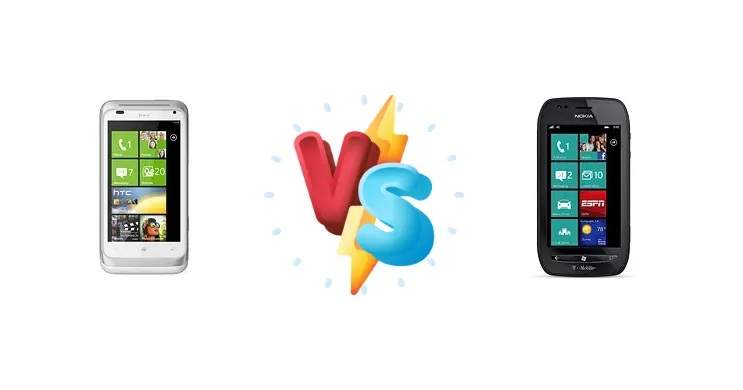
Released in late 2011 and early 2012, the HTC Radar and Nokia Lumia 710 represented compelling entry points into the Windows Phone 7 ecosystem. Both devices leveraged Qualcomm's Snapdragon S2 platform, but subtle differences in CPU clock speed and display characteristics created distinct user experiences. This comparison dissects those nuances to determine which phone offered the better overall package.
🏆 Quick Verdict
For the average user prioritizing a slightly more refined display experience, the HTC Radar emerges as the better choice. Its superior contrast ratio, while not groundbreaking, provides a more visually appealing experience. However, the Nokia Lumia 710's faster CPU offers a marginal performance boost that may appeal to those seeking the snappiest responsiveness.
| Network |
|---|
| 2G bands | GSM 850 / 900 / 1800 / 1900 | GSM 850 / 900 / 1800 / 1900 |
| 3G bands | HSDPA 900 / 2100 | HSDPA 850 / 1700 / 1900 / 2100 |
| Speed | HSPA 14.4/5.76 Mbps | HSPA 14.4/5.76 Mbps |
| Technology | GSM / HSPA | GSM / HSPA |
| | HSDPA 1700 / 2100 - for T-Mobile | - |
| Launch |
|---|
| Announced | 2011, September. Released 2011, October | 2011, December. Released 2012, January |
| Status | Discontinued | Discontinued |
| Body |
|---|
| Dimensions | 120.5 x 61.5 x 10.9 mm (4.74 x 2.42 x 0.43 in) | 119 x 62.4 x 12.5 mm, 81.1 cc (4.69 x 2.46 x 0.49 in) |
| SIM | Mini-SIM | Micro-SIM |
| Weight | 137 g (4.83 oz) | 125.5 g (4.41 oz) |
| Display |
|---|
| Protection | Corning Gorilla Glass | Corning Gorilla Glass |
| Resolution | 480 x 800 pixels, 5:3 ratio (~246 ppi density) | 480 x 800 pixels, 5:3 ratio (~252 ppi density) |
| Size | 3.8 inches, 41.1 cm2 (~55.5% screen-to-body ratio) | 3.7 inches, 39.0 cm2 (~52.5% screen-to-body ratio) |
| Type | S-LCD | TFT |
| | - | Nokia ClearBlack display |
| Platform |
|---|
| CPU | 1.0 GHz Scorpion | 1.4 GHz Scorpion |
| Chipset | Qualcomm MSM8255 Snapdragon S2 | Qualcomm MSM8255 Snapdragon S2 |
| GPU | Adreno 205 | Adreno 205 |
| OS | Microsoft Windows Phone 7.5 Mango | Microsoft Windows Phone 7.5 Mango |
| Memory |
|---|
| Card slot | No | No |
| Internal | 8GB 512MB RAM | 8GB 512MB RAM |
| Main Camera |
|---|
| Features | LED flash | LED flash |
| Single | 5 MP, AF | 5 MP, AF |
| Video | 720p@30fps | 720p@30fps |
| Selfie camera |
|---|
| Single | VGA | - |
| | - | No |
| Sound |
|---|
| 3.5mm jack | Yes | Yes |
| 35mm jack | Yes | Yes |
| Loudspeaker | Yes, with stereo speakers | Yes |
| | SRS audio | - |
| Comms |
|---|
| Bluetooth | 2.1, A2DP, EDR | 2.1, A2DP, EDR |
| Positioning | GPS, A-GPS; Bing Maps | GPS, A-GPS |
| Radio | Stereo FM radio, RDS | Stereo FM radio, RDS |
| USB | microUSB 2.0 | microUSB 2.0 |
| WLAN | Wi-Fi 802.11 b/g/n, DLNA | Wi-Fi 802.11 b/g/n |
| Features |
|---|
| Sensors | Accelerometer, proximity | Accelerometer, proximity, compass |
| | HTC Locations
MP3/eAAC+/WAV/WMA player
MP4/H.264/WMV player
Document viewer/editor
Facebook integration | MP3/WAV/eAAC+/WMA player
MP4/H.264/WMV player
Document viewer/editor
Video/photo editor |
| Battery |
|---|
| Stand-by | Up to 480 h (2G) / Up to 535 h (3G) | Up to 396 h |
| Talk time | Up to 10 h (2G) / Up to 8 h 5 min (3G) | Up to 7 h |
| Type | Non-removable Li-Ion 1520 mAh battery | Removable Li-Ion 1300 mAh battery (BP-3L) |
| Misc |
|---|
| Colors | Active White, Metal Silver | Black, white/black |
| Price | About 140 EUR | About 130 EUR |
| SAR | 0.45 W/kg (head) 1.17 W/kg (body) | 1.06 W/kg (head) 0.94 W/kg (body) |
| SAR EU | - | 1.30 W/kg (head) |
| Tests |
|---|
| Audio quality |
Noise -88.3dB / Crosstalk -74.7dB | - |
| Battery life |
Endurance rating 34h
| - |
| Camera |
Photo / Video | - |
| Display |
Contrast ratio: 797:1 (nominal) | - |
| Loudspeaker |
Voice 66dB / Noise 66dB / Ring 78dB
| - |
HTC Radar
- Superior display contrast ratio for a more vibrant image.
- Potentially more refined build quality (HTC's reputation).
- Slightly more premium aesthetic.
- Slower CPU clock speed compared to the Lumia 710.
- Limited information available on camera specifications.
Nokia Lumia 710 T-Mobile
- Faster CPU clock speed for potentially snappier performance.
- Benefit from Nokia’s software optimization.
- T-Mobile branding may offer network advantages for some users.
- Likely lower display contrast ratio.
- Limited information available on camera specifications.
Display Comparison
Both the HTC Radar and Nokia Lumia 710 feature displays of similar size and resolution, typical for the era. However, the HTC Radar distinguishes itself with a contrast ratio of 797:1, a notable figure for a phone of this vintage. While neither device boasts the vibrant colors or high resolutions of modern displays, the Radar’s higher contrast contributes to deeper blacks and a more dynamic image. The Lumia 710’s display specifications are not provided, implying a standard contrast ratio for the time, likely lower than the Radar’s.
Camera Comparison
Both the HTC Radar and Nokia Lumia 710 are equipped with cameras capable of both photo and video capture. However, detailed specifications regarding sensor size, aperture, or image processing are unavailable. Given the market positioning of both devices, it’s reasonable to assume they feature similar camera hardware. The Lumia 710, benefiting from Nokia’s imaging expertise, may offer slightly better image processing algorithms, but without concrete data, this remains speculative. The absence of information suggests neither phone was a standout performer in the camera department.
Performance
At the heart of both devices lies the Qualcomm MSM8255 Snapdragon S2 chipset. The key difference lies in the CPU clock speed: the HTC Radar features a 1.0 GHz Scorpion processor, while the Nokia Lumia 710 boasts a 1.4 GHz Scorpion. This 40% increase in clock speed theoretically translates to faster application loading and smoother multitasking. However, the Snapdragon S2 was not known for being a performance powerhouse, and the real-world difference in speed is likely to be subtle, especially given the limitations of Windows Phone 7’s operating system. Both devices likely share the same Adreno 205 GPU, meaning graphics performance will be comparable.
Battery Life
The HTC Radar is rated for 34 hours of endurance, a figure that reflects typical usage patterns of the time. This endurance rating is the only battery-related specification provided. The Nokia Lumia 710’s battery capacity and charging specifications are unknown. Given the similar chipsets and display technologies, battery life is likely to be comparable between the two devices, with real-world performance heavily dependent on usage patterns and network conditions.
Buying Guide
Buy the HTC Radar if you value a more visually pleasing display and appreciate a slightly more polished aesthetic. It's ideal for users who consume media and prioritize a comfortable viewing experience. Buy the Nokia Lumia 710 T-Mobile if you prioritize a marginally faster processor for app loading and multitasking, and are less concerned with display quality. This phone is best suited for users who heavily rely on quick app switching and responsiveness.
Frequently Asked Questions
❓ Is the CPU difference between the HTC Radar and Nokia Lumia 710 noticeable in everyday use?
While the Nokia Lumia 710’s 1.4 GHz CPU is faster on paper, the Snapdragon S2 chipset was a bottleneck in both devices. The difference in CPU speed is likely to be subtle, manifesting in slightly faster app loading times and smoother multitasking, but not a dramatically different user experience.
❓ Does the HTC Radar’s display contrast ratio make a significant difference when watching videos?
Yes, the HTC Radar’s 797:1 contrast ratio will result in deeper blacks and a more dynamic image when viewing videos or photos. This is particularly noticeable compared to displays with lower contrast ratios, offering a more immersive viewing experience.
❓ Which phone is better for playing games on Windows Phone 7?
Both phones share the same Adreno 205 GPU, so graphics performance will be nearly identical. The Nokia Lumia 710’s faster CPU might provide a slight edge in games that are CPU-intensive, but the Snapdragon S2’s limitations will prevent either phone from delivering a high-end gaming experience.