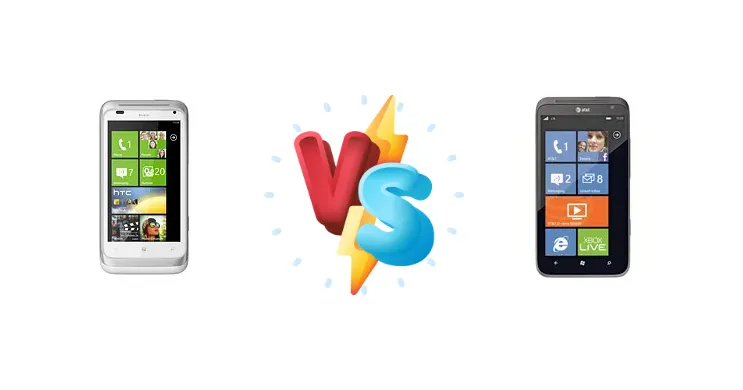
Released around the same timeframe, the HTC Radar and Titan II represent different approaches to the Windows Phone experience. The Radar prioritized battery endurance and display quality, while the Titan II focused on raw processing power. This comparison dissects their specifications to determine which device delivers the best overall value, especially considering their age and current availability.
🏆 Quick Verdict
For the average user seeking a functional, long-lasting Windows Phone, the HTC Radar emerges as the better choice. Its significantly superior battery endurance (34h vs 23h) and higher display contrast ratio (797:1) outweigh the Titan II’s faster processor, especially given both share the same Snapdragon S2 chipset architecture.
| Network |
|---|
| 2G bands | GSM 850 / 900 / 1800 / 1900 | GSM 850 / 900 / 1800 / 1900 |
| 3G bands | HSDPA 900 / 2100 | HSDPA 850 / 1900 / 2100 |
| 4G bands | - | 4, 17 - AT&T |
| Speed | HSPA 14.4/5.76 Mbps | HSPA |
| Technology | GSM / HSPA | GSM / HSPA / LTE |
| | HSDPA 1700 / 2100 - for T-Mobile | 9 - Australia |
| Launch |
|---|
| Announced | 2011, September. Released 2011, October | 2012, January. Released 2012, April |
| Status | Discontinued | Discontinued |
| Body |
|---|
| Dimensions | 120.5 x 61.5 x 10.9 mm (4.74 x 2.42 x 0.43 in) | 132 x 69 x 13 mm (5.20 x 2.72 x 0.51 in) |
| SIM | Mini-SIM | Mini-SIM |
| Weight | 137 g (4.83 oz) | 147 g (5.19 oz) |
| Display |
|---|
| Protection | Corning Gorilla Glass | - |
| Resolution | 480 x 800 pixels, 5:3 ratio (~246 ppi density) | 480 x 800 pixels, 5:3 ratio (~199 ppi density) |
| Size | 3.8 inches, 41.1 cm2 (~55.5% screen-to-body ratio) | 4.7 inches, 62.9 cm2 (~69.0% screen-to-body ratio) |
| Type | S-LCD | S-LCD |
| Platform |
|---|
| CPU | 1.0 GHz Scorpion | 1.5 GHz Scorpion |
| Chipset | Qualcomm MSM8255 Snapdragon S2 | Qualcomm Snapdragon S2 |
| GPU | Adreno 205 | - |
| OS | Microsoft Windows Phone 7.5 Mango | Microsoft Windows Phone 7.5 Mango |
| Memory |
|---|
| Card slot | No | No |
| Internal | 8GB 512MB RAM | 16GB |
| Main Camera |
|---|
| Features | LED flash | Dual-LED flash |
| Single | 5 MP, AF | 16 MP, AF |
| Video | 720p@30fps | 720p@30fps |
| Selfie camera |
|---|
| Single | VGA | 1.3 MP |
| Sound |
|---|
| 3.5mm jack | Yes | Yes |
| 35mm jack | Yes | Yes |
| Loudspeaker | Yes, with stereo speakers | Yes |
| | SRS audio | - |
| Comms |
|---|
| Bluetooth | 2.1, A2DP, EDR | 2.1, A2DP, EDR |
| Positioning | GPS, A-GPS; Bing Maps | GPS, A-GPS; Bing Maps |
| Radio | Stereo FM radio, RDS | Stereo FM radio, RDS |
| USB | microUSB 2.0 | microUSB 2.0 |
| WLAN | Wi-Fi 802.11 b/g/n, DLNA | Wi-Fi 802.11 b/g/n, DLNA |
| Features |
|---|
| Sensors | Accelerometer, proximity | Accelerometer, gyro, proximity, compass |
| | HTC Locations
MP3/eAAC+/WAV/WMA player
MP4/H.264/WMV player
Document viewer/editor
Facebook integration | MP3/WAV/WMA/eAAC+ player
MP4/WMV/H.264 player
Document viewer/editor
Voice memo/dial/commands
Predictive text input |
| Battery |
|---|
| Stand-by | Up to 480 h (2G) / Up to 535 h (3G) | Up to 290 h |
| Talk time | Up to 10 h (2G) / Up to 8 h 5 min (3G) | Up to 4 h 20 min |
| Type | Non-removable Li-Ion 1520 mAh battery | Non-removable Li-Ion 1730 mAh battery |
| Misc |
|---|
| Colors | Active White, Metal Silver | Black |
| Price | About 140 EUR | About 200 EUR |
| SAR | 0.45 W/kg (head) 1.17 W/kg (body) | 0.60 W/kg (head) 1.36 W/kg (body) |
| Tests |
|---|
| Audio quality |
Noise -88.3dB / Crosstalk -74.7dB | - |
| Battery life |
Endurance rating 34h
|
Endurance rating 23h
|
| Camera |
Photo / Video | - |
| Display |
Contrast ratio: 797:1 (nominal) | - |
| Loudspeaker |
Voice 66dB / Noise 66dB / Ring 78dB
| - |
HTC Radar
- Superior battery endurance (34h)
- Higher display contrast ratio (797:1)
- Potentially better thermal management
- Slower CPU clock speed (1.0 GHz)
- Limited camera specifications
HTC Titan II
- Faster CPU clock speed (1.5 GHz)
- Potentially snappier performance
- Same Snapdragon S2 chipset
- Significantly lower battery endurance (23h)
- Missing display contrast ratio specification
Display Comparison
The HTC Radar boasts a notable advantage in display quality, evidenced by its 797:1 contrast ratio. While neither device’s display specifications detail resolution or brightness, the higher contrast ratio suggests deeper blacks and a more vibrant image. The Titan II lacks this specification, implying a potentially washed-out visual experience. Given both phones are older, panel technology is likely similar (TFT LCD), but the Radar’s contrast ratio is a clear win for media consumption.
Camera Comparison
Both devices are listed with simply 'Photo / Video' capabilities, lacking detail on sensor size, aperture, or resolution. Given the era, it’s reasonable to assume both feature similar camera hardware, likely around 5-8 megapixels. Without further specifications, it’s impossible to definitively declare a camera winner. The image processing algorithms employed by HTC would be the differentiating factor, but this is unavailable in the provided data. The lack of detail suggests neither phone was a standout performer in the camera department.
Performance
Both the Radar and Titan II utilize the Qualcomm Snapdragon S2 chipset with a Scorpion CPU. However, the Titan II features a faster clock speed of 1.5 GHz compared to the Radar’s 1.0 GHz. This 50% increase in CPU frequency translates to quicker application loading times and smoother multitasking, though the underlying architecture remains the same. The performance difference will be most noticeable in demanding tasks, but the Snapdragon S2 is a relatively dated platform, limiting the overall performance gains. The Radar’s lower clock speed will likely result in slightly better thermal management, though neither phone is prone to significant overheating.
Battery Life
The most significant difference between these two devices lies in their battery endurance. The HTC Radar achieves a remarkable 34 hours of endurance, while the Titan II manages only 23 hours. This 11-hour difference is substantial and directly impacts real-world usability. While battery capacity (mAh) isn’t specified, the Radar’s superior endurance suggests a more efficient combination of hardware and software optimization. The Titan II’s faster processor likely contributes to its reduced battery life, demonstrating a clear trade-off between performance and longevity.
Buying Guide
Buy the HTC Radar if you prioritize all-day battery life and a more visually appealing display experience. It’s ideal for users who primarily use their phone for communication, light browsing, and occasional photography. Buy the HTC Titan II if you absolutely need the fastest possible performance within the limitations of the Snapdragon S2 platform, and are willing to sacrifice battery life for a slightly snappier user interface. This makes it a better, though marginal, choice for those who attempted to push the limits of Windows Phone multitasking.
Frequently Asked Questions
❓ Will the HTC Titan II’s faster processor make a noticeable difference in everyday tasks?
While the 1.5 GHz CPU in the Titan II is faster than the Radar’s 1.0 GHz, both phones are limited by the Snapdragon S2 chipset’s overall capabilities. The difference will be most apparent in demanding applications or when multitasking, but for basic tasks like calling, texting, and browsing, the performance gap will be minimal.
❓ Is the battery life difference between the Radar and Titan II significant enough to matter?
Absolutely. The 11-hour difference in endurance rating is substantial. The HTC Radar’s 34-hour endurance means you’re far less likely to need a mid-day charge, making it a more convenient option for users who are frequently on the go. The Titan II’s 23-hour endurance may require more frequent charging, especially with moderate to heavy usage.
❓ Given their age, are these phones still secure and usable with modern services?
Security is a major concern with these older Windows Phone devices. Microsoft ended support for Windows Phone 8.1 in 2019, meaning no further security updates are being released. While some basic functionality may still work, using these phones with sensitive information is strongly discouraged. Modern app compatibility is also limited.