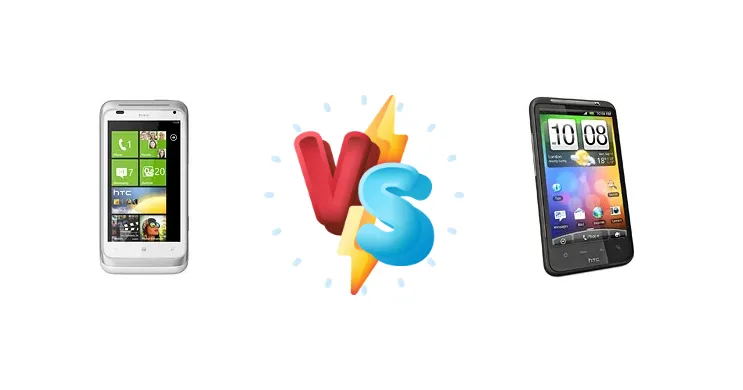
The HTC Radar and Desire HD represent a pivotal moment in Android history, both powered by the Qualcomm Snapdragon S2. Released within a similar timeframe, they catered to different user priorities. This comparison dissects their specifications to determine which device holds up better for users seeking a nostalgic Android experience or a budget-friendly backup phone.
🏆 Quick Verdict
For the average user revisiting these older devices, the HTC Radar emerges as the slightly better choice. Its superior display contrast ratio, while not groundbreaking, offers a more visually pleasing experience, and the inclusion of video recording capability adds a degree of versatility absent in the Desire HD.
| Network |
|---|
| 2G bands | GSM 850 / 900 / 1800 / 1900 | GSM 850 / 900 / 1800 / 1900 |
| 3G bands | HSDPA 900 / 2100 | HSDPA 900 / 2100 |
| Speed | HSPA 14.4/5.76 Mbps | HSPA 14.4/5.76 Mbps or HSPA 7.2/2 Mbps (carrier dependent) |
| Technology | GSM / HSPA | GSM / HSPA |
| | HSDPA 1700 / 2100 - for T-Mobile | HSDPA 850 / 1900 - North America |
| Launch |
|---|
| Announced | 2011, September. Released 2011, October | 2010, September. Released 2010, October |
| Status | Discontinued | Discontinued |
| Body |
|---|
| Dimensions | 120.5 x 61.5 x 10.9 mm (4.74 x 2.42 x 0.43 in) | 123 x 68 x 11.8 mm (4.84 x 2.68 x 0.46 in) |
| SIM | Mini-SIM | Mini-SIM |
| Weight | 137 g (4.83 oz) | 164 g (5.78 oz) |
| Display |
|---|
| Protection | Corning Gorilla Glass | Corning Gorilla Glass |
| Resolution | 480 x 800 pixels, 5:3 ratio (~246 ppi density) | 480 x 800 pixels, 5:3 ratio (~217 ppi density) |
| Size | 3.8 inches, 41.1 cm2 (~55.5% screen-to-body ratio) | 4.3 inches, 52.6 cm2 (~62.9% screen-to-body ratio) |
| Type | S-LCD | LCD |
| Platform |
|---|
| CPU | 1.0 GHz Scorpion | 1.0 GHz Scorpion |
| Chipset | Qualcomm MSM8255 Snapdragon S2 | Qualcomm MSM8255 Snapdragon S2 |
| GPU | Adreno 205 | Adreno 205 |
| OS | Microsoft Windows Phone 7.5 Mango | Android 2.2 (Froyo), 2.3 (Gingerbread), not upgradable to 4.0 (Ice Cream Sandwich), Sense UI |
| Memory |
|---|
| Card slot | No | microSDHC (dedicated slot), 8 GB included |
| Internal | 8GB 512MB RAM | 1.5GB; 768MB RAM |
| Main Camera |
|---|
| Features | LED flash | Dual-LED flash |
| Single | 5 MP, AF | 8 MP, AF |
| Video | 720p@30fps | 720p |
| Selfie camera |
|---|
| Single | VGA | - |
| | - | No |
| Sound |
|---|
| 3.5mm jack | Yes | Yes |
| 35mm jack | Yes | Yes |
| Loudspeaker | Yes, with stereo speakers | Yes |
| | SRS audio | - |
| Comms |
|---|
| Bluetooth | 2.1, A2DP, EDR | 2.1, A2DP |
| Positioning | GPS, A-GPS; Bing Maps | GPS, A-GPS |
| Radio | Stereo FM radio, RDS | Stereo FM radio, RDS |
| USB | microUSB 2.0 | microUSB 2.0 |
| WLAN | Wi-Fi 802.11 b/g/n, DLNA | Wi-Fi 802.11 b/g/n, DLNA, hotspot |
| Features |
|---|
| Browser | - | HTML, Adobe Flash |
| Sensors | Accelerometer, proximity | Accelerometer, proximity, compass |
| | HTC Locations
MP3/eAAC+/WAV/WMA player
MP4/H.264/WMV player
Document viewer/editor
Facebook integration | Dedicated search key
MP3/AAC+/WAV/WMA9 player
DivX/Xvid/MP4/H.264/WMV9/player
Voice memo
Predictive text input |
| Battery |
|---|
| Stand-by | Up to 480 h (2G) / Up to 535 h (3G) | Up to 490 h (2G) / Up to 420 h (3G) |
| Talk time | Up to 10 h (2G) / Up to 8 h 5 min (3G) | Up to 9 h 15 min (2G) / Up to 5 h 30 min (3G) |
| Type | Non-removable Li-Ion 1520 mAh battery | Removable Li-Ion 1230 mAh battery |
| Misc |
|---|
| Colors | Active White, Metal Silver | Black, Brown |
| Price | About 140 EUR | About 150 EUR |
| SAR | 0.45 W/kg (head) 1.17 W/kg (body) | 0.47 W/kg (head) 0.84 W/kg (body) |
| Tests |
|---|
| Audio quality |
Noise -88.3dB / Crosstalk -74.7dB |
Noise -90.6dB / Crosstalk -92.6dB |
| Battery life |
Endurance rating 34h
| - |
| Camera |
Photo / Video |
Photo |
| Display |
Contrast ratio: 797:1 (nominal) | - |
| Loudspeaker |
Voice 66dB / Noise 66dB / Ring 78dB
|
Voice 69dB / Noise 66dB / Ring 78dB |
HTC Radar
- Better display contrast ratio for a more vibrant image.
- Video recording capability adds versatility.
- Specified battery endurance rating provides a benchmark.
- Still an aging device with limited software support.
- Performance will be slow by modern standards.
HTC Desire HD
- Potentially lower price point due to simpler feature set.
- Focus on still photography may appeal to some users.
- Identical processor to the Radar for basic tasks.
- Lacks video recording capability.
- No specified display contrast ratio suggests a lower quality screen.
- Battery life is unknown.
Display Comparison
The HTC Radar boasts a contrast ratio of 797:1, a notable advantage over the Desire HD, which lacks any specified contrast ratio data. While neither display will rival modern panels, the Radar’s higher contrast suggests deeper blacks and a more vibrant image. Both devices likely utilize TFT LCD technology, common for the era, and resolution is assumed to be similar, around 480x800, given the market segment. The lack of information on the Desire HD’s display suggests it was a cost-saving measure, prioritizing other features.
Camera Comparison
The HTC Desire HD is specified as having a camera capable of only photo capture, while the Radar supports both photo and video recording. This is a significant differentiator for users who wish to document moments beyond still images. While neither device is expected to deliver exceptional image quality by today’s standards, the Radar’s video capability provides added functionality. Sensor size and aperture information are unavailable, making a detailed comparison of image quality impossible, but both likely featured 5-8MP sensors common in 2011.
Performance
Both the HTC Radar and Desire HD are equipped with the Qualcomm MSM8255 Snapdragon S2 chipset, featuring a 1.0 GHz Scorpion CPU. This means performance will be virtually identical for most tasks. The Snapdragon S2 was a mid-range processor in its time, capable of handling basic Android Gingerbread applications and light multitasking. Neither device will excel at demanding modern applications or games. The absence of RAM specifications in the provided data makes it difficult to assess multitasking capabilities, but both likely featured around 512MB to 1GB, typical for the period.
Battery Life
The HTC Radar is rated for 34 hours of endurance, a metric that encompasses talk time, data usage, and other activities. The Desire HD’s battery life is not specified. Given the identical chipset and similar screen sizes, the Desire HD’s battery life is likely comparable, but the Radar’s specified endurance rating provides a quantifiable advantage. Charging times were significantly slower in this era, and neither device supports fast charging technologies.
Buying Guide
Buy the HTC Radar if you prioritize a marginally better viewing experience and the ability to record video. It’s the better all-rounder for basic smartphone tasks. Buy the HTC Desire HD if you are solely focused on still photography and are looking for the potentially lowest possible price point for a functional Snapdragon S2 device. The Desire HD represents a simpler, photography-focused experience.
Frequently Asked Questions
❓ Will either of these phones work with modern apps?
No. Both the HTC Radar and Desire HD run older versions of Android (likely Gingerbread) and lack the processing power and software support to run most modern applications. They are best suited for basic tasks like calls, texts, and potentially older, lightweight apps.
❓ Can I upgrade the Android version on either of these phones?
Officially, no. HTC stopped providing software updates for these devices years ago. However, it may be possible to install custom ROMs, but this is a complex process and carries risks, including bricking the device. It's not recommended for novice users.
❓ What kind of SIM card do these phones use?
Both the HTC Radar and Desire HD use Mini-SIM cards. This is an older SIM card format, and you may need an adapter if you currently use a Nano-SIM.
❓ Is the Snapdragon S2 chipset still adequate for basic use?
For extremely basic tasks like making calls, sending texts, and checking email, the Snapdragon S2 is still functional. However, expect significant lag and slow loading times, even with simple apps. It's not suitable for web browsing or any demanding applications.