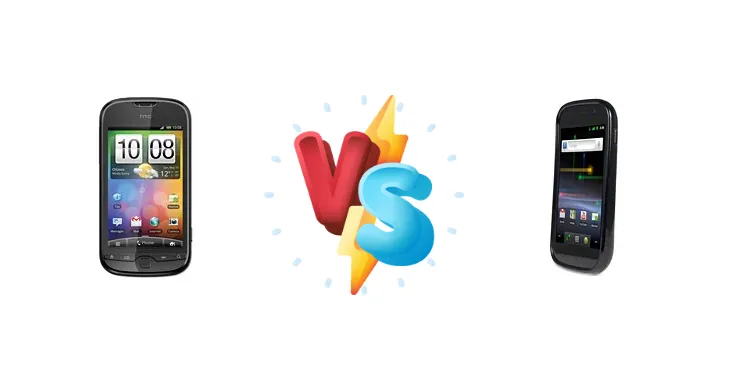
The HTC Panache and Samsung Google Nexus S 4G represent a snapshot of the early Android era, offering distinct features and experiences. Both devices aimed to deliver a compelling smartphone experience, but with different approaches. Let's dive into a detailed comparison to see which phone holds up best today.
🏆 Quick Verdict
The Samsung Google Nexus S 4G edges out the HTC Panache thanks to its superior Cortex-A8 processor and generally better software experience. While the Panache has its merits, the Nexus S 4G's performance and access to timely updates give it the advantage for most users.
| Network |
|---|
| 2G bands | GSM 850 / 900 / 1800 / 1900 | CDMA 800 / 1900 |
| 3G bands | HSDPA 1700 / 2100 | CDMA2000 1xEV-DO |
| Speed | HSPA 14.4/2 Mbps | EV-DO Rev.A 3.1 Mbps |
| Technology | GSM / HSPA | CDMA / EVDO |
| Launch |
|---|
| Announced | 2011, June. Released 2011, July | 2011, March. Released 2011, May 08 |
| Status | Discontinued | Discontinued |
| Body |
|---|
| Dimensions | 122.2 x 62.5 x 11.1 mm (4.81 x 2.46 x 0.44 in) | 123.9 x 63 x 10.9 mm (4.88 x 2.48 x 0.43 in) |
| SIM | Mini-SIM | Mini-SIM |
| Weight | 150 g (5.29 oz) | 131 g (4.62 oz) |
| | Optical trackpad | - |
| Display |
|---|
| Protection | - | Oleophobic coating |
| Resolution | 480 x 800 pixels, 5:3 ratio (~246 ppi density) | 480 x 800 pixels, 5:3 ratio (~233 ppi density) |
| Size | 3.8 inches, 41.1 cm2 (~53.8% screen-to-body ratio) | 4.0 inches, 45.5 cm2 (~58.3% screen-to-body ratio) |
| Type | TFT | Super AMOLED |
| Platform |
|---|
| CPU | 1.0 GHz Scorpion | 1.0 GHz Cortex-A8 |
| Chipset | Qualcomm MSM8255 Snapdragon S2 | Hummingbird |
| GPU | Adreno 205 | PowerVR SGX540 |
| OS | Android 2.3 (Gingerbread), Sense UI 2 | Android 2.3 (Gingerbread) |
| Memory |
|---|
| Card slot | microSDHC (dedicated slot), 8 GB included | No |
| Internal | 8GB (1.2GB user available), 768MB RAM | 16GB 512MB RAM |
| Main Camera |
|---|
| Features | LED flash | LED flash |
| Single | 5 MP, AF | 5 MP, AF |
| Video | 720p@30fps | w480p@30fps |
| Selfie camera |
|---|
| Single | VGA videocall camera | VGA |
| Sound |
|---|
| 3.5mm jack | Yes | Yes |
| 35mm jack | Yes | Yes |
| Loudspeaker | Yes | Yes, with stereo speakers |
| Comms |
|---|
| Bluetooth | 2.1, A2DP, EDR | 2.1, A2DP, EDR |
| NFC | - | Yes |
| Positioning | GPS, A-GPS | GPS, A-GPS |
| Radio | FM radio | No |
| USB | microUSB 2.0 | microUSB 2.0 |
| WLAN | Wi-Fi 802.11 b/g/n, DLNA, hotspot | Wi-Fi 802.11 b/g/n, WiMAX, hotspot |
| Features |
|---|
| Browser | - | HTML, Adobe Flash |
| Sensors | Accelerometer, proximity | Accelerometer, gyro, proximity, compass, barometer |
| | MP4/H.264 player
MP3/WAV/eAAC+ player
Organizer
Document viewer
Voice memo/dial/commands
Predictive text input (Swype) | MP4/H.264 player
MP3/WAV/eAAC+ player
Organizer
Photo/video editor
Voice memo/dial/commands
Predictive text input
Near Field Communications |
| Battery |
|---|
| Stand-by | Up to 243 h | Up to 428 h |
| Talk time | Up to 6 h 40 min | Up to 6 h |
| Type | Removable Li-Ion 1400 mAh battery | Removable Li-Ion 1500 mAh battery |
| Misc |
|---|
| Colors | Black | Black |
| Price | About 200 EUR | About 150 EUR |
| SAR | 0.68 W/kg (head) | 0.64 W/kg (head) 0.95 W/kg (body) |
HTC Panache
- Compact size
- Affordable (when new)
- Decent build quality
- Underpowered processor
- Outdated software
- Lower resolution display
- Limited camera quality
Samsung Google Nexus S 4G
- Faster processor (Cortex-A8)
- Better display (Super AMOLED)
- Smoother Android experience
- Generally better camera
- Older design
- Limited storage
- No longer receiving updates
Display Comparison
Both phones feature Super AMOLED (Nexus S) and LCD (Panache) displays, respectively, around the 3.7-4 inch range. The Nexus S 4G's Super AMOLED technology generally offers more vibrant colors and better contrast, though both are limited by their resolution. The Panache's display is adequate but lacks the punch of the Nexus S.
Camera Comparison
The Nexus S 4G boasts a 5MP camera, while the HTC Panache has a 3.2MP camera. While megapixels aren't everything, the Nexus S 4G generally produces better image quality, especially in low light. Both cameras are dated by today's standards.
Performance
This is where the Nexus S 4G shines. Its 1.0 GHz Cortex-A8 processor is significantly more powerful than the HTC Panache's 1.0 GHz Scorpion. Expect smoother multitasking, faster app loading times, and a more responsive overall experience on the Nexus S 4G. The Panache can feel sluggish at times.
Battery Life
The Nexus S 4G has a slightly larger battery (1500 mAh) compared to the HTC Panache (1400 mAh). However, the Nexus S 4G's more efficient processor and optimized software contribute to better battery life overall. Expect a full day of moderate use from both devices.
Buying Guide
The HTC Panache might appeal to budget-conscious users seeking a basic Android experience. The Samsung Google Nexus S 4G is a better choice for those prioritizing performance, a smoother user interface, and access to the latest Android updates (though support has long ended).
Frequently Asked Questions
❓ Which phone was released first?
The HTC Panache was released slightly earlier than the Samsung Google Nexus S 4G.
❓ Are software updates still available for either phone?
No, neither phone receives official software updates. Both are considered legacy devices.
❓ Which phone is better for gaming?
The Samsung Google Nexus S 4G is significantly better for gaming due to its more powerful processor.