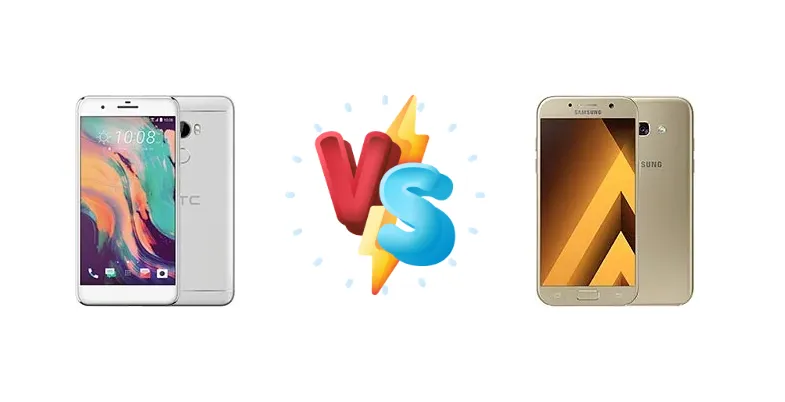
Released around the same timeframe, the HTC One X10 and Samsung Galaxy A5 (2017) represent competing visions of the mid-range smartphone. The One X10 aimed for value with a Mediatek chipset, while the A5 (2017) leveraged Samsung’s Exynos line and focused on a refined user experience. This comparison dissects their key differences to determine which device offers the best balance of features and performance.
🏆 Quick Verdict
For the average user, the Samsung Galaxy A5 (2017) is the stronger choice. Its Exynos 7880, built on a 14nm process, provides a modest but noticeable performance advantage over the HTC One X10’s 28nm Helio P10, and both phones offer identical battery endurance ratings.
| Network |
|---|
| 2G bands | GSM 850 / 900 / 1800 / 1900 - SIM 1 & SIM 2 (dual-SIM model only) | GSM 850 / 900 / 1800 / 1900 - SIM 1 & SIM 2 (dual-SIM model only) |
| 3G bands | HSDPA 850 / 900 / 1900 / 2100 | HSDPA 850 / 900 / 1700(AWS) / 1900 / 2100 |
| 4G bands | 1, 3, 5, 7, 8, 20, 28, 38, 40 | 1, 2, 3, 4, 5, 7, 8, 17, 20, 28, 38, 40, 41 |
| Speed | HSPA 42.2/5.76 Mbps, LTE (2CA) Cat6 300/50 Mbps | HSPA 42.2/5.76 Mbps, LTE (2CA) Cat6 300/50 Mbps |
| Technology | GSM / HSPA / LTE | GSM / HSPA / LTE |
| Launch |
|---|
| Announced | 2017, April. Released 2017, July | 2017, January. Released 2017, January |
| Status | Discontinued | Discontinued |
| Body |
|---|
| Build | - | Glass front (Gorilla Glass 4), glass back, aluminum frame |
| Dimensions | 152.9 x 75.6 x 8.2 mm (6.02 x 2.98 x 0.32 in) | 146.1 x 71.4 x 7.9 mm (5.75 x 2.81 x 0.31 in) |
| SIM | · Nano-SIM· Nano-SIM + Nano-SIM | · Nano-SIM· Nano-SIM + Nano-SIM |
| Weight | 175 g (6.17 oz) | 157 g (5.54 oz) |
| | - | IP68 dust/water resistant (up to 1.5m for 30 mins) |
| Display |
|---|
| Protection | Corning Gorilla Glass (unspecified version) | Corning Gorilla Glass 4 |
| Resolution | 1080 x 1920 pixels, 16:9 ratio (~401 ppi density) | 1080 x 1920 pixels, 16:9 ratio (~424 ppi density) |
| Size | 5.5 inches, 83.4 cm2 (~72.1% screen-to-body ratio) | 5.2 inches, 74.5 cm2 (~71.5% screen-to-body ratio) |
| Type | Super LCD | Super AMOLED |
| | - | Always-on display |
| Platform |
|---|
| CPU | Octa-core (4x1.8 GHz Cortex-A53 & 4x1.0 GHz Cortex-A53) | Octa-core 1.9 GHz Cortex-A53 |
| Chipset | Mediatek MT6755 Helio P10 (28 nm) | Exynos 7880 (14 nm) |
| GPU | Mali-T860MP2 | Mali-T830MP3 |
| OS | Android OS | Android 6.0.1 (Marshmallow), upgradable to Android 8.0 (Oreo) |
| Memory |
|---|
| Card slot | microSDXC | microSDXC (dedicated slot) |
| Internal | 32GB 3GB RAM | 32GB 3GB RAM, 64GB 3GB RAM |
| | eMMC 5.1 | eMMC 5.1 |
| Main Camera |
|---|
| Features | Dual-LED dual-tone flash, HDR, panorama | LED flash, panorama, HDR |
| Single | 16 MP, f/2.0, 26mm (wide), AF | 16 MP, f/1.9, 27mm (wide), AF |
| Video | 1080p@30fps | 1080p@30fps |
| Selfie camera |
|---|
| Single | 8 MP, f/2.2, 23mm (wide), 1/4.0", 1.12µm | 16 MP, f/1.9, 26mm (wide), 1/3.06", 1.0µm |
| Video | 1080p@30fps | 1080p@30fps |
| Sound |
|---|
| 3.5mm jack | Yes | Yes |
| 35mm jack | Yes | Yes |
| Loudspeaker | Yes | Yes |
| Comms |
|---|
| Bluetooth | 4.2, A2DP | 4.2, A2DP, EDR, LE |
| NFC | No | Yes |
| Positioning | GPS, GLONASS | GPS, GLONASS, BDS |
| Radio | FM radio | FM radio |
| USB | microUSB 2.0 | USB Type-C 2.0 |
| WLAN | Wi-Fi 802.11 a/b/g/n, Wi-Fi Direct, DLNA, hotspot | Wi-Fi 802.11 a/b/g/n/ac, dual-band, Wi-Fi Direct |
| Features |
|---|
| Sensors | Fingerprint (rear-mounted), accelerometer, gyro, proximity, compass | Fingerprint (front-mounted), accelerometer, gyro, proximity, compass, barometer |
| | - | ANT+
Samsung Pay |
| Battery |
|---|
| Charging | - | 18W wired |
| Music play | - | Up to 53 h |
| Stand-by | Up to 744 h (3G) | - |
| Talk time | Up to 25 h 30 min (3G) | Up to 16 h (3G) |
| Type | Li-Ion 4000 mAh, non-removable | Li-Ion 3000 mAh, non-removable |
| Misc |
|---|
| Colors | Black, Silver | Black Sky, Gold Sand, Blue Mist, Peach Cloud |
| Models | One X10, 2PXH3 | SM-A520F, SM-A520F, SM-A520K, SM-A520L, SM-A520S, SM-A520W, SM-A520FD |
| Price | About 200 EUR | About 190 EUR |
| SAR | - | 0.88 W/kg (head) 0.55 W/kg (body) |
| SAR EU | - | 0.52 W/kg (head) 1.39 W/kg (body) |
| Tests |
|---|
| Audio quality | - |
Noise -93.1dB / Crosstalk -90.2dB |
| Battery life | - | Endurance rating 95h |
| Camera | - |
Photo / Video |
| Display | - |
Contrast ratio: Infinite (nominal), 3.804 (sunlight) |
| Loudspeaker | - |
Voice 66dB / Noise 66dB / Ring 78dB |
| Performance | - |
GFXBench: 5.2fps (ES 3.1 onscreen) |
HTC One X10
- Potentially lower price point
- Acceptable battery endurance
- Simple, straightforward Android experience (likely)
- Less powerful chipset (Helio P10)
- Larger fabrication node (28nm) leads to potential throttling
- Likely slower charging speeds
Samsung Galaxy A5 (2017)
- More efficient chipset (Exynos 7880, 14nm)
- Faster 18W charging
- Potentially better camera image processing
- May be slightly more expensive
- Samsung’s software can include bloatware
- Identical battery endurance to the X10 despite more efficient chip
Display Comparison
Both devices share an identical contrast ratio of Infinite (nominal) and 3.804 in sunlight, suggesting similar outdoor visibility. However, detailed panel specifications like resolution and color gamut are missing. Given Samsung’s display expertise, the A5 likely benefits from superior color accuracy and viewing angles, even if the raw contrast ratio is the same. The lack of information on PWM dimming rates prevents a definitive statement on eye strain for sensitive users.
Camera Comparison
Both devices are listed with 'Photo / Video' capabilities, offering minimal insight. Without sensor size, aperture, or image processing details, a direct comparison is challenging. However, Samsung historically invests heavily in camera software, suggesting the A5 (2017) likely delivers more refined image processing and potentially better low-light performance. The presence of a 2MP macro camera on either device is unlikely to significantly impact overall camera quality and should be considered a minor feature.
Performance
The Samsung Galaxy A5 (2017) holds a clear advantage in processing power due to its Exynos 7880 (14nm) chipset. While both phones utilize an octa-core Cortex-A53 CPU, the Exynos’s smaller fabrication node translates to improved thermal efficiency and sustained performance. The Helio P10 (28nm) in the HTC One X10 is likely to throttle more aggressively under sustained load. The A5’s CPU clocks slightly higher at 1.9 GHz versus 1.8 GHz on the X10, further contributing to its performance edge. The absence of RAM specifications makes it difficult to assess multitasking capabilities, but the Exynos chip's architecture is generally more efficient.
Battery Life
Interestingly, both the HTC One X10 and Samsung Galaxy A5 (2017) achieve an endurance rating of 95 hours. This suggests similar real-world battery life despite the differing chipsets. However, the A5 (2017) supports 18W wired charging, offering significantly faster recharge times compared to the likely slower charging speeds of the One X10. This faster charging capability is a practical advantage for users who frequently need to top up their battery.
Buying Guide
Buy the HTC One X10 if you prioritize absolute affordability and are willing to accept slightly slower performance in demanding tasks. Buy the Samsung Galaxy A5 (2017) if you prefer a more polished software experience, slightly better performance for everyday use, and the convenience of 18W fast charging. The A5's build quality and Samsung's brand reputation also add value.
Frequently Asked Questions
❓ Does the Exynos 7880 in the Galaxy A5 (2017) overheat during prolonged gaming sessions?
The Exynos 7880’s 14nm process helps mitigate overheating. While it won’t match flagship-level thermal performance, it’s less prone to throttling than the HTC One X10’s Helio P10, allowing for longer, more consistent gaming sessions. Expect some warmth, but not significant performance drops.
❓ Is the 18W charging on the Galaxy A5 (2017) a significant advantage in daily use?
Yes, 18W charging is a notable benefit. It significantly reduces recharge times compared to the likely slower charging speeds of the HTC One X10. This is particularly useful for users who frequently need to quickly top up their battery throughout the day.
❓ How does the software experience differ between the HTC One X10 and the Samsung Galaxy A5 (2017)?
HTC historically offered a cleaner, more stock-Android-like experience. Samsung’s TouchWiz (at the time) included more pre-installed apps and features, some of which users might consider bloatware. However, Samsung’s software also offered more customization options.