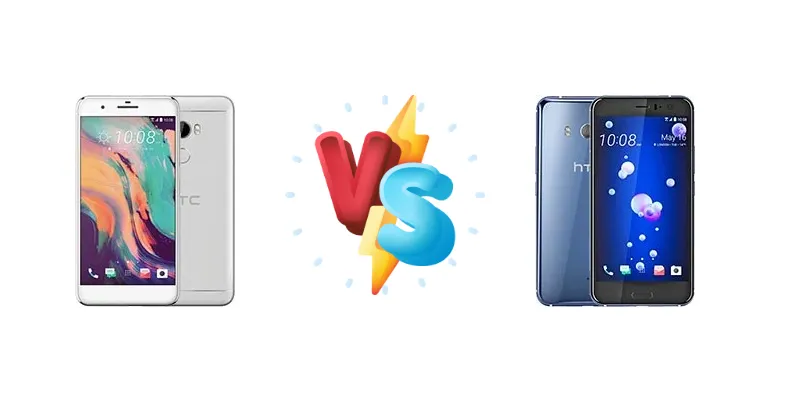
The HTC U11 and One X10 represent distinct approaches to the smartphone market. The U11, released as a flagship, aimed to compete with the top-tier devices of its time. The One X10, positioned as a more affordable option, sought to deliver a usable experience without the premium price tag. This comparison dissects the core differences between these two HTC devices, focusing on the impact of their contrasting chipsets and feature sets.
🏆 Quick Verdict
For the average user prioritizing performance and a smoother overall experience, the HTC U11 is the clear winner. Its Snapdragon 835 chipset offers significantly faster processing speeds and improved efficiency compared to the One X10’s Helio P10. While both phones boast a 73-hour endurance rating, the U11’s faster charging and superior processing power make it the more compelling choice.
| Network |
|---|
| 2G bands | GSM 850 / 900 / 1800 / 1900 - SIM 1 & SIM 2 (dual-SIM model only) | GSM 850 / 900 / 1800 / 1900 - SIM 1 & SIM 2 (dual-SIM model only) |
| 3G bands | HSDPA 850 / 900 / 1900 / 2100 | HSDPA 850 / 900 / 1900 / 2100 |
| 4G bands | 1, 3, 5, 7, 8, 20, 28, 38, 40 | 1, 3, 4, 5, 7, 8, 12, 17, 20, 28, 32, 38, 39, 40, 41 |
| Speed | HSPA 42.2/5.76 Mbps, LTE (2CA) Cat6 300/50 Mbps | HSPA 42.2/5.76 Mbps, LTE (4CA) Cat16 1024/75 Mbps |
| Technology | GSM / HSPA / LTE | GSM / HSPA / LTE |
| Launch |
|---|
| Announced | 2017, April. Released 2017, July | 2017, May 16. Released 2017, June 10 |
| Status | Discontinued | Discontinued |
| Body |
|---|
| Build | - | Glass front (Gorilla Glass 5), glass back, aluminum frame |
| Dimensions | 152.9 x 75.6 x 8.2 mm (6.02 x 2.98 x 0.32 in) | 153.9 x 75.9 x 7.9 mm (6.06 x 2.99 x 0.31 in) |
| SIM | · Nano-SIM· Nano-SIM + Nano-SIM | · Nano-SIM· Nano-SIM + Nano-SIM |
| Weight | 175 g (6.17 oz) | 169 g (5.96 oz) |
| | - | IP67 dust/water resistant (up to 1m for 30 mins) |
| Display |
|---|
| Protection | Corning Gorilla Glass (unspecified version) | Corning Gorilla Glass 5 |
| Resolution | 1080 x 1920 pixels, 16:9 ratio (~401 ppi density) | 1440 x 2560 pixels, 16:9 ratio (~534 ppi density) |
| Size | 5.5 inches, 83.4 cm2 (~72.1% screen-to-body ratio) | 5.5 inches, 83.4 cm2 (~71.4% screen-to-body ratio) |
| Type | Super LCD | Super LCD5 |
| Platform |
|---|
| CPU | Octa-core (4x1.8 GHz Cortex-A53 & 4x1.0 GHz Cortex-A53) | Octa-core (4x2.45 GHz Kryo & 4x1.9 GHz Kryo) |
| Chipset | Mediatek MT6755 Helio P10 (28 nm) | Qualcomm MSM8998 Snapdragon 835 (10 nm) |
| GPU | Mali-T860MP2 | Adreno 540 |
| OS | Android OS | Android 7.1 (Nougat), upgradable to Android 9.0 (Pie), Sense UI |
| Memory |
|---|
| Card slot | microSDXC | microSDXC (uses shared SIM slot) - dual SIM model only |
| Internal | 32GB 3GB RAM | 64GB 4GB RAM, 128GB 6GB RAM |
| | eMMC 5.1 | - |
| Main Camera |
|---|
| Features | Dual-LED dual-tone flash, HDR, panorama | Dual-LED dual-tone flash, HDR, panorama |
| Single | 16 MP, f/2.0, 26mm (wide), AF | 12 MP, f/1.7, 1/2.55", 1.4µm, dual pixel PDAF, 5-axis OIS |
| Video | 1080p@30fps | 4K@30fps, 1080p@30/60/120fps, HDR, 24-bit/192kHz stereo sound rec. |
| Selfie camera |
|---|
| Single | 8 MP, f/2.2, 23mm (wide), 1/4.0", 1.12µm | 16 MP, f/2.0, 27mm (wide), 1/3.06", 1.0µm |
| Video | 1080p@30fps | 1080p@30fps |
| Sound |
|---|
| 3.5mm jack | Yes | No |
| 35mm jack | Yes | No |
| Loudspeaker | Yes | Yes, with stereo speakers |
| | - | 24-bit/192kHz audio
|
| Comms |
|---|
| Bluetooth | 4.2, A2DP | 4.2, A2DP, LE (5.0 after SW update) |
| NFC | No | Yes |
| Positioning | GPS, GLONASS | GPS, GLONASS, BDS |
| Radio | FM radio | No |
| USB | microUSB 2.0 | USB Type-C 3.1 |
| WLAN | Wi-Fi 802.11 a/b/g/n, Wi-Fi Direct, DLNA, hotspot | Wi-Fi 802.11 a/b/g/n/ac, dual-band, Wi-Fi Direct, DLNA |
| Features |
|---|
| Sensors | Fingerprint (rear-mounted), accelerometer, gyro, proximity, compass | Fingerprint (front-mounted), accelerometer, gyro, proximity, compass |
| Battery |
|---|
| Charging | - | 18W wired, QC3 |
| Stand-by | Up to 744 h (3G) | Up to 336 h (3G) |
| Talk time | Up to 25 h 30 min (3G) | Up to 24 h 30 min (3G) |
| Type | Li-Ion 4000 mAh, non-removable | Li-Ion 3000 mAh, non-removable |
| Misc |
|---|
| Colors | Black, Silver | Amazing Silver, Sapphire Blue, Brilliant Black, Ice White, Solar Red |
| Models | One X10, 2PXH3 | U11, HTV33, 2PZC100, 2PZC5, 601HT |
| Price | About 200 EUR | About 300 EUR |
| Tests |
|---|
| Audio quality | - |
Noise -94.1 / Crosstalk -94.5 |
| Battery life | - |
Endurance rating 73h
|
| Camera | - |
Photo / Video |
| Loudspeaker | - |
Voice 68dB / Noise 73dB / Ring 79dB
|
| Performance | - |
GeekBench: 6393 (v4.4)
GFXBench: 13fps (ES 3.1 onscreen) |
HTC One X10
- More affordable price point
- Decent battery endurance (73h)
- Functional for basic smartphone tasks
- Significantly slower processor
- Less efficient chipset (28nm)
- Inferior camera performance
HTC U11
- Powerful Snapdragon 835 processor
- Faster charging with QC3 (18W)
- Superior camera capabilities
- More efficient 10nm process
- Higher price point
- May be harder to find new
Display Comparison
Context data lacks display specifics for both devices. However, given the U11’s flagship status, it likely features a higher-resolution and more color-accurate display than the One X10. The U11 likely employed a Super LCD panel, known for its vibrant colors, while the One X10 likely used a standard IPS LCD. Bezels were also likely smaller on the U11, contributing to a more modern aesthetic.
Camera Comparison
Both devices are listed as having Photo/Video capabilities, but specifics are missing. The U11, as a flagship, likely features a larger sensor and more advanced image processing algorithms. The Snapdragon 835’s ISP (Image Signal Processor) is also superior to the Helio P10’s, resulting in better image quality, especially in low-light conditions. While the One X10 may be adequate for casual snapshots, the U11 is expected to deliver significantly more detailed and vibrant photos and videos.
Performance
The core difference lies in the chipsets. The HTC U11’s Qualcomm MSM8998 Snapdragon 835, built on a 10nm process, is a substantial upgrade over the HTC One X10’s Mediatek MT6755 Helio P10 (28nm). The Snapdragon 835’s octa-core Kryo CPU (4x2.45 GHz & 4x1.9 GHz) delivers significantly faster processing speeds than the Helio P10’s (4x1.8 GHz Cortex-A53 & 4x1.0 GHz Cortex-A53). The 10nm process also translates to better thermal efficiency, meaning the U11 is less prone to throttling during sustained workloads like gaming. The U11 will handle demanding applications and multitasking with ease, while the One X10 will struggle with more intensive tasks.
Battery Life
Interestingly, both phones share a 73-hour endurance rating. However, this doesn’t tell the whole story. The U11 benefits from 18W wired charging with Quick Charge 3.0 (QC3), allowing for significantly faster charging times compared to the One X10, which likely has slower charging capabilities. While the mAh capacity isn’t specified, the Snapdragon 835’s superior power efficiency means the U11 can likely maintain its charge for longer under similar usage scenarios.
Buying Guide
Buy the HTC One X10 if you need a functional smartphone for basic tasks like calling, texting, and light social media use, and your budget is extremely limited. It’s a viable option for those who prioritize affordability over performance. Buy the HTC U11 if you prefer a responsive and capable device for multitasking, gaming, and photography. The U11’s superior chipset and features justify the higher price point for users who demand a premium experience.
Frequently Asked Questions
❓ Is the HTC One X10 suitable for playing demanding games like PUBG or Call of Duty?
The Helio P10 chipset in the HTC One X10 will struggle with graphically intensive games like PUBG or Call of Duty. You’ll likely experience significant frame rate drops and lag, even on lower settings. The phone may also heat up considerably during extended gaming sessions.
❓ Does the HTC U11 still receive software updates and security patches?
As of late 2023, official software support for the HTC U11 has ended. While it may still be possible to install custom ROMs, you should be aware that you won’t receive official security updates, which could pose a security risk.
❓ How does the camera performance of the HTC One X10 compare to more modern budget smartphones?
The HTC One X10’s camera is likely to be noticeably inferior to modern budget smartphones. While it may be adequate for casual snapshots in good lighting conditions, it will struggle in low-light environments and lack the advanced features found in newer devices, such as night mode or HDR.