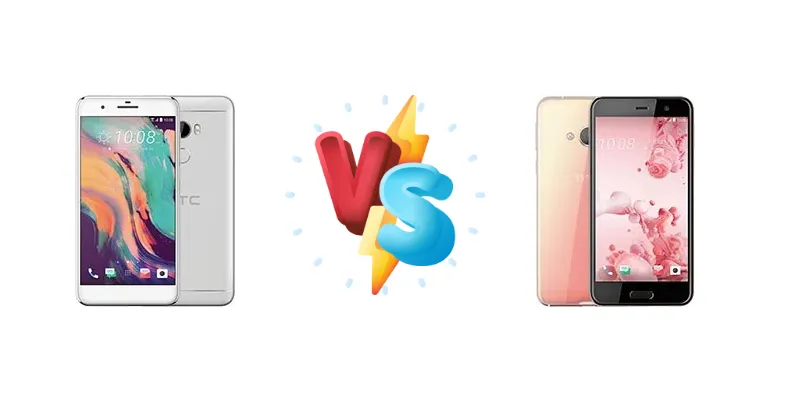
Both the HTC One X10 and U Play represent HTC's attempts to deliver affordable smartphones powered by MediaTek's Helio P10 chipset. Released in different periods, they cater to a similar budget-conscious audience. However, subtle differences in CPU clock speeds and the inclusion of fast charging on the U Play create a nuanced comparison, demanding a closer look at which device delivers the better overall experience.
🏆 Quick Verdict
For most users, the HTC U Play offers a slight edge. While both phones share the same Helio P10 chipset, the U Play’s marginally faster CPU clock speeds and 10W charging capability provide a more responsive experience and quicker top-ups, making it the better all-rounder.
| Network |
|---|
| 2G bands | GSM 850 / 900 / 1800 / 1900 - SIM 1 & SIM 2 (dual-SIM model only) | GSM 850 / 900 / 1800 / 1900 - SIM 1 & SIM 2 |
| 3G bands | HSDPA 850 / 900 / 1900 / 2100 | HSDPA 850 / 900 / 1900 / 2100 |
| 4G bands | 1, 3, 5, 7, 8, 20, 28, 38, 40 | 1, 3, 5, 7, 8, 20, 28, 38, 40 |
| Speed | HSPA 42.2/5.76 Mbps, LTE (2CA) Cat6 300/50 Mbps | HSPA 42.2/5.76 Mbps, LTE (2CA) Cat6 300/50 Mbps |
| Technology | GSM / HSPA / LTE | GSM / HSPA / LTE |
| Launch |
|---|
| Announced | 2017, April. Released 2017, July | 2017, January. Released 2017, February |
| Status | Discontinued | Discontinued |
| Body |
|---|
| Build | - | Glass front (Gorilla Glass), plastic back, plastic frame |
| Dimensions | 152.9 x 75.6 x 8.2 mm (6.02 x 2.98 x 0.32 in) | 146 x 72.9 x 8 mm (5.75 x 2.87 x 0.31 in) |
| SIM | · Nano-SIM· Nano-SIM + Nano-SIM | Nano-SIM + Nano-SIM |
| Weight | 175 g (6.17 oz) | 145 g (5.11 oz) |
| Display |
|---|
| Protection | Corning Gorilla Glass (unspecified version) | Corning Gorilla Glass (unspecified version) |
| Resolution | 1080 x 1920 pixels, 16:9 ratio (~401 ppi density) | 1080 x 1920 pixels, 16:9 ratio (~428 ppi density) |
| Size | 5.5 inches, 83.4 cm2 (~72.1% screen-to-body ratio) | 5.2 inches, 73.2 cm2 (~68.7% screen-to-body ratio) |
| Type | Super LCD | Super LCD |
| Platform |
|---|
| CPU | Octa-core (4x1.8 GHz Cortex-A53 & 4x1.0 GHz Cortex-A53) | Octa-core (4x2.0 GHz Cortex-A53 & 4x1.1 GHz Cortex-A53) |
| Chipset | Mediatek MT6755 Helio P10 (28 nm) | Mediatek MT6755 Helio P10 (28 nm) |
| GPU | Mali-T860MP2 | Mali-T860MP2 |
| OS | Android OS | Android 6.0 (Marshmallow) |
| Memory |
|---|
| Card slot | microSDXC | microSDXC (uses shared SIM slot) |
| Internal | 32GB 3GB RAM | 32GB 3GB RAM, 64GB 4GB RAM |
| | eMMC 5.1 | eMMC 5.1 |
| Main Camera |
|---|
| Features | Dual-LED dual-tone flash, HDR, panorama | Dual-LED dual-tone flash, panorama |
| Single | 16 MP, f/2.0, 26mm (wide), AF | 16 MP, f/2.0, 28mm (wide), 1/3.1", 1.0µm, PDAF, OIS |
| Video | 1080p@30fps | 1080p@30fps |
| Selfie camera |
|---|
| Features | - | HDR |
| Single | 8 MP, f/2.2, 23mm (wide), 1/4.0", 1.12µm | 16 MP, f/2.0, 27mm (wide), 1/3.06", 1.0µm |
| Video | 1080p@30fps | 1080p@30fps |
| Sound |
|---|
| 3.5mm jack | Yes | No |
| 35mm jack | Yes | No |
| Loudspeaker | Yes | Yes |
| Comms |
|---|
| Bluetooth | 4.2, A2DP | 4.2, A2DP, LE |
| NFC | No | Yes |
| Positioning | GPS, GLONASS | GPS, GLONASS |
| Radio | FM radio | No |
| USB | microUSB 2.0 | USB Type-C 2.0 |
| WLAN | Wi-Fi 802.11 a/b/g/n, Wi-Fi Direct, DLNA, hotspot | Wi-Fi 802.11 a/b/g/n/ac, dual-band, Wi-Fi Direct, DLNA |
| Features |
|---|
| Sensors | Fingerprint (rear-mounted), accelerometer, gyro, proximity, compass | Fingerprint (front-mounted), accelerometer, gyro, proximity, compass |
| Battery |
|---|
| Charging | - | 10W wired |
| Stand-by | Up to 744 h (3G) | Up to 427 h (3G) |
| Talk time | Up to 25 h 30 min (3G) | Up to 15 h (3G) |
| Type | Li-Ion 4000 mAh, non-removable | Li-Ion 2500 mAh, non-removable |
| Misc |
|---|
| Colors | Black, Silver | Brilliant Black, Cosmetic Pink, Ice White, Sapphire Blue |
| Models | One X10, 2PXH3 | U Play, U-2u, 2PZM3 |
| Price | About 200 EUR | About 150 EUR |
HTC One X10
- Potentially lower price point
- Reliable MediaTek Helio P10 chipset
- Likely durable build quality (HTC's reputation)
- Slower CPU clock speeds
- No fast charging support
- Potentially slower app loading times
HTC U Play
- Slightly faster CPU clock speeds
- 10W wired charging for quicker top-ups
- Potentially smoother multitasking
- May be slightly more expensive
- Still uses the power-inefficient Helio P10
- Likely similar camera performance to the One X10
Display Comparison
Neither HTC provides display specifications in the provided data. Given their market positioning, both likely feature 1080p IPS LCD panels. The absence of information regarding refresh rates suggests standard 60Hz panels. The user experience will likely be similar, with color accuracy and brightness dependent on panel quality control, which was not a strong suit for HTC during this period. Bezels are expected to be noticeable, typical of phones from this era.
Camera Comparison
Camera details are absent beyond the chipset. Given the era and price point, both phones likely feature a primary camera around 13-16MP. Image quality will heavily rely on software processing and lens quality. The absence of Optical Image Stabilization (OIS) is almost certain. Any secondary cameras (depth, macro) are likely low-resolution and of limited utility. Expect decent performance in good lighting conditions, but struggles in low-light scenarios. The U Play may have a slight edge if HTC implemented any software optimizations for its camera.
Performance
Both the One X10 and U Play are powered by the MediaTek MT6755 Helio P10, a 28nm chipset. However, the U Play boasts a slightly faster CPU configuration: 4x2.0 GHz Cortex-A53 cores versus the One X10’s 4x1.8 GHz Cortex-A53 cores. While the difference may seem small, this 0.2 GHz increase per core can translate to marginally faster app loading times and smoother multitasking. The remaining 4x1.0 GHz (One X10) and 4x1.1 GHz (U Play) Cortex-A53 cores handle background tasks. Thermal throttling will be a concern under sustained load, as the Helio P10 isn't known for its efficiency. The U Play’s slight CPU advantage may allow it to maintain peak performance for a marginally longer duration.
Battery Life
Battery capacity is not specified. However, the U Play includes 10W wired charging, a significant advantage over the One X10, which likely lacks fast charging support. This means the U Play will recharge considerably faster, reducing downtime. Without knowing the battery capacities, it’s difficult to definitively say which phone offers better battery life. However, the faster charging on the U Play mitigates the impact of a potentially smaller battery, providing a more convenient user experience.
Buying Guide
Buy the HTC One X10 if you prioritize a potentially lower price point and are comfortable with slower charging speeds. It's a solid choice for basic smartphone tasks. Buy the HTC U Play if you value a slightly snappier user experience and the convenience of 10W wired charging, even if it means potentially paying a small premium.
Frequently Asked Questions
❓ Will the Helio P10 struggle with modern apps on either the One X10 or U Play?
Yes, the MediaTek Helio P10 is an older chipset and will likely exhibit slowdowns with demanding modern applications and multitasking. Expect acceptable performance with basic tasks like calling, texting, and social media, but avoid resource-intensive games or apps.
❓ Does the 10W charging on the U Play make a significant difference in real-world use?
Absolutely. While 10W isn't fast by today's standards, it's a substantial improvement over the likely lack of fast charging on the One X10. This translates to a noticeably quicker recharge time, reducing downtime and making the U Play more convenient for daily use.
❓ Are software updates still available for either the HTC One X10 or U Play?
It's highly unlikely that either device receives regular software updates. HTC has largely withdrawn support for these older models. Security updates are almost certainly discontinued, posing a potential security risk.
❓ Which phone is better for light gaming?
Both phones will struggle with graphically intensive games. However, the U Play’s slightly faster CPU might provide a marginally smoother experience in less demanding titles. Expect to lower graphics settings and resolution for playable frame rates.