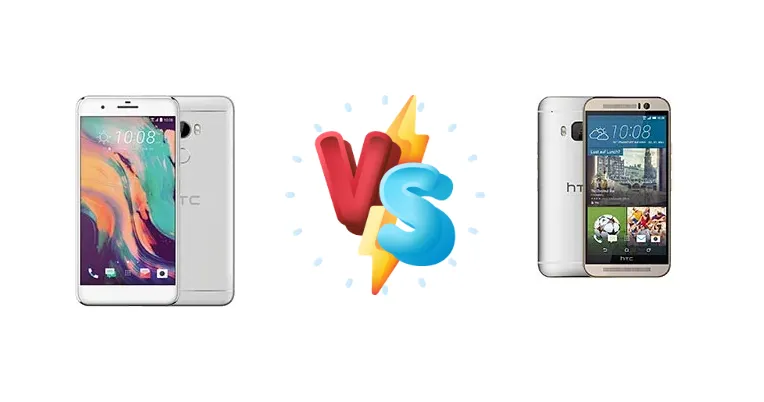
The HTC One M9 represented a peak in HTC's flagship ambitions, but its price has fallen significantly since launch. The HTC One X10 arrived later as a more affordable option. This comparison dissects the trade-offs between the M9’s aging but potent Snapdragon 810 and the X10’s more modern, yet less powerful, Mediatek Helio P10, helping you determine which offers the best value in 2024.
🏆 Quick Verdict
For the average user prioritizing battery life and a slightly more modern software experience, the HTC One X10 is the better choice. However, users who demand peak performance for demanding applications or gaming will find the HTC One M9’s Snapdragon 810 a more compelling option, despite its age.
| Network |
|---|
| 2G bands | GSM 850 / 900 / 1800 / 1900 - SIM 1 & SIM 2 (dual-SIM model only) | GSM 850 / 900 / 1800 / 1900 |
| 3G bands | HSDPA 850 / 900 / 1900 / 2100 | HSDPA 850 / 900 / 1900 / 2100 |
| 4G bands | 1, 3, 5, 7, 8, 20, 28, 38, 40 | 1, 3, 5, 7, 8, 20, 28, 38, 40, 41 |
| Speed | HSPA 42.2/5.76 Mbps, LTE (2CA) Cat6 300/50 Mbps | HSPA 42.2/21.1 Mbps, LTE Cat6 300/50 Mbps |
| Technology | GSM / HSPA / LTE | GSM / HSPA / LTE |
| Launch |
|---|
| Announced | 2017, April. Released 2017, July | 2015, March 01. Released 2015, March 09 |
| Status | Discontinued | Discontinued |
| Body |
|---|
| Build | - | Glass front (Gorilla Glass 3), aluminum back, aluminum frame |
| Dimensions | 152.9 x 75.6 x 8.2 mm (6.02 x 2.98 x 0.32 in) | 144.6 x 69.7 x 9.6 mm (5.69 x 2.74 x 0.38 in) |
| SIM | · Nano-SIM· Nano-SIM + Nano-SIM | Nano-SIM |
| Weight | 175 g (6.17 oz) | 157 g (5.54 oz) |
| Display |
|---|
| Protection | Corning Gorilla Glass (unspecified version) | Corning Gorilla Glass 3 |
| Resolution | 1080 x 1920 pixels, 16:9 ratio (~401 ppi density) | 1080 x 1920 pixels, 16:9 ratio (~441 ppi density) |
| Size | 5.5 inches, 83.4 cm2 (~72.1% screen-to-body ratio) | 5.0 inches, 68.9 cm2 (~68.4% screen-to-body ratio) |
| Type | Super LCD | Super LCD3 |
| Platform |
|---|
| CPU | Octa-core (4x1.8 GHz Cortex-A53 & 4x1.0 GHz Cortex-A53) | Octa-core (4x1.5 GHz Cortex-A53 & 4x2.0 GHz Cortex-A57) |
| Chipset | Mediatek MT6755 Helio P10 (28 nm) | Qualcomm MSM8994 Snapdragon 810 (20 nm) |
| GPU | Mali-T860MP2 | Adreno 430 |
| OS | Android OS | Android 5.0 (Lollipop), upgradable to 7.0 (Nougat), Sense UI 7 |
| Memory |
|---|
| Card slot | microSDXC | microSDXC (dedicated slot) |
| Internal | 32GB 3GB RAM | 32GB 3GB RAM |
| | eMMC 5.1 | eMMC 5.0 |
| Main Camera |
|---|
| Features | Dual-LED dual-tone flash, HDR, panorama | Dual-LED dual-tone flash, HDR, panorama |
| Single | 16 MP, f/2.0, 26mm (wide), AF | 20 MP, f/2.2, 28mm (wide), 1/2.4", 1.2µm, AF |
| Video | 1080p@30fps | 4K@30fps, 1080p@60fps, 720p@120fps, HDR, stereo sound rec. |
| Selfie camera |
|---|
| Features | - | HDR |
| Single | 8 MP, f/2.2, 23mm (wide), 1/4.0", 1.12µm | 4 MP, f/2.0, 27mm (wide), 1/3", 2µm |
| Video | 1080p@30fps | 1080p@30fps |
| Sound |
|---|
| 3.5mm jack | Yes | Yes |
| 35mm jack | Yes | Yes |
| Loudspeaker | Yes | Yes, with stereo speakers |
| | - | 24-bit/192kHz audio
|
| Comms |
|---|
| Bluetooth | 4.2, A2DP | 4.1, A2DP, aptX |
| Infrared port | - | Yes |
| NFC | No | Yes |
| Positioning | GPS, GLONASS | GPS, GLONASS |
| Radio | FM radio | Stereo FM radio, RDS |
| USB | microUSB 2.0 | microUSB 2.0 (MHL 3.0 TV-out), OTG |
| WLAN | Wi-Fi 802.11 a/b/g/n, Wi-Fi Direct, DLNA, hotspot | Wi-Fi 802.11 a/b/g/n/ac, dual-band, Wi-Fi Direct, DLNA, hotspot |
| Features |
|---|
| Sensors | Fingerprint (rear-mounted), accelerometer, gyro, proximity, compass | Accelerometer, gyro, proximity, compass |
| Battery |
|---|
| Charging | - | 18W wired, QC2 |
| Stand-by | Up to 744 h (3G) | Up to 391 h (2G) / Up to 402 h (3G) |
| Talk time | Up to 25 h 30 min (3G) | Up to 25 h 20 min (2G) / Up to 21 h 50 min (3G) |
| Type | Li-Ion 4000 mAh, non-removable | Li-Po 2840 mAh, non-removable |
| Misc |
|---|
| Colors | Black, Silver | Gunmetal Gray, Amber Gold, Silver/Rose gold, Gold/Pink, Pink |
| Models | One X10, 2PXH3 | One M9, M9u, 0PJA2, HTC6535LVW, M9pw, M9, 0PJA10 |
| Price | About 200 EUR | About 360 EUR |
| Tests |
|---|
| Audio quality | - |
Noise -94.8dB / Crosstalk -93.7dB |
| Battery life | - |
Endurance rating 62h
|
| Camera | - |
Photo / Video |
| Display | - |
Contrast ratio: 1221:1 (nominal), 2.334 (sunlight) |
| Loudspeaker | - |
Voice 65dB / Noise 64dB / Ring 76dB
|
| Performance | - |
Basemark OS II 2.0: 1365Basemark X: 19848 |
HTC One X10
- Potentially better thermal management due to the Helio P10's efficiency.
- Likely more affordable price point.
- May have a more up-to-date software experience (though likely still limited).
- Significantly less powerful CPU compared to the Snapdragon 810.
- Missing detailed display specifications raise concerns about panel quality.
- Camera performance likely inferior to the M9.
HTC One M9
- More powerful Snapdragon 810 processor for demanding tasks.
- Faster charging with Quick Charge 2.0 (18W).
- Likely superior display quality due to its flagship origins.
- Prone to thermal throttling under sustained load.
- Older device with limited software support.
- Potentially shorter battery life compared to the X10.
Display Comparison
Both the HTC One X10 and One M9 share a similar contrast ratio of 1221:1 (nominal) and 2.334 (sunlight), suggesting comparable outdoor visibility. However, detailed display specs like resolution and panel type are missing for the X10. Given the M9’s flagship status, it likely features a higher quality panel with more accurate color reproduction. The X10, being a budget device, may utilize a less expensive panel, potentially impacting color accuracy and viewing angles.
Camera Comparison
Both phones are listed as having 'Photo / Video' capabilities, but specific details are absent. Given the M9’s flagship positioning, it likely boasts a more sophisticated camera system with better image processing. The X10, as a budget device, likely features a simpler camera setup. Without sensor size or aperture information, it’s difficult to make a definitive judgment, but the M9 likely offers superior image quality, especially in low-light conditions. The absence of details suggests neither phone is a standout performer in the camera department by today’s standards.
Performance
The core difference lies in the chipsets. The HTC One M9’s Qualcomm MSM8994 Snapdragon 810, built on a 20nm process, features a more powerful CPU configuration – 4x2.0 GHz Cortex-A57 and 4x1.5 GHz Cortex-A53 cores – compared to the X10’s Mediatek MT6755 Helio P10 (28nm) with its 4x1.8 GHz Cortex-A53 and 4x1.0 GHz Cortex-A53 cores. While both are octa-core, the A57 cores in the Snapdragon 810 provide a significant performance advantage in CPU-intensive tasks. However, the Snapdragon 810 is known for thermal throttling under sustained load, a problem the more efficient, albeit slower, Helio P10 is less prone to. The 20nm process of the Snapdragon 810 is less efficient than the 28nm process of the Helio P10.
Battery Life
Interestingly, both the HTC One X10 and One M9 share an endurance rating of 62 hours. This suggests similar real-world battery performance despite the differing chipsets. The X10’s more efficient Helio P10 likely offsets the Snapdragon 810’s higher power consumption. The M9 supports 18W wired charging with Quick Charge 2.0, offering faster charging speeds than what is likely available on the X10, which lacks charging specifications in the provided data. This faster charging capability is a significant advantage for the M9.
Buying Guide
Buy the HTC One X10 if you need a reliable daily driver with decent battery life and aren't heavily reliant on demanding apps or games. It’s ideal for users who prioritize efficiency and longevity. Buy the HTC One M9 if you prefer a phone capable of handling more intensive tasks, such as gaming or video editing, and are willing to accept potentially shorter battery life and a device that is no longer receiving software updates.
Frequently Asked Questions
❓ Is the Snapdragon 810 in the HTC One M9 likely to overheat during extended gaming sessions?
Yes, the Snapdragon 810 is known for thermal throttling. While it offers peak performance, prolonged gaming or demanding tasks can cause the processor to overheat, leading to reduced performance to prevent damage. The HTC One X10’s Helio P10 is less prone to this issue, but at the cost of overall processing power.
❓ Does the HTC One X10 receive regular software updates?
Given its age and positioning as a budget device, the HTC One X10 likely has limited or no ongoing software support. The HTC One M9, while also older, may have received more updates during its lifespan, but is now also likely unsupported. Security updates are a major concern for both devices.
❓ Which phone is better for basic everyday tasks like browsing and social media?
Both phones are perfectly capable of handling basic tasks like browsing and social media. However, the HTC One X10’s more efficient processor and potentially longer battery life make it a slightly better choice for users who primarily use their phone for these activities.