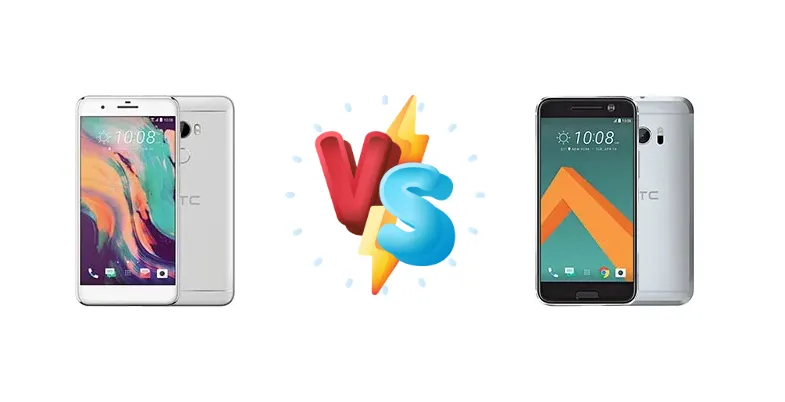
The HTC 10 represented a high point for HTC's flagship ambitions, while the One X10 arrived later as a more budget-conscious offering. This comparison dissects the core differences between these two devices, focusing on the impact of their contrasting chipsets and how those differences translate to real-world performance and user experience.
🏆 Quick Verdict
For the average user prioritizing smooth performance and a more refined experience, the HTC 10 is the clear winner. Its Snapdragon 820 chipset, despite its age, offers significantly more processing power and efficiency than the One X10’s Helio P10. However, the One X10 remains a viable option for those on a very tight budget.
| Network |
|---|
| 2G bands | GSM 850 / 900 / 1800 / 1900 - SIM 1 & SIM 2 (dual-SIM model only) | GSM 850 / 900 / 1800 / 1900 |
| 3G bands | HSDPA 850 / 900 / 1900 / 2100 | HSDPA 850 / 900 / 1900 / 2100 |
| 4G bands | 1, 3, 5, 7, 8, 20, 28, 38, 40 | 1, 3, 5, 7, 8, 20, 28, 38, 40, 41 |
| Speed | HSPA 42.2/5.76 Mbps, LTE (2CA) Cat6 300/50 Mbps | HSPA, LTE (3CA) Cat9 450/50 Mbps |
| Technology | GSM / HSPA / LTE | GSM / HSPA / LTE |
| Launch |
|---|
| Announced | 2017, April. Released 2017, July | 2016, April 12. Released 2016, April 12 |
| Status | Discontinued | Discontinued |
| Body |
|---|
| Build | - | Glass front (Gorilla Glass 3), aluminum back, aluminum frame |
| Dimensions | 152.9 x 75.6 x 8.2 mm (6.02 x 2.98 x 0.32 in) | 145.9 x 71.9 x 9 mm (5.74 x 2.83 x 0.35 in) |
| SIM | · Nano-SIM· Nano-SIM + Nano-SIM | Nano-SIM |
| Weight | 175 g (6.17 oz) | 161 g (5.68 oz) |
| Display |
|---|
| Protection | Corning Gorilla Glass (unspecified version) | Corning Gorilla Glass 3 |
| Resolution | 1080 x 1920 pixels, 16:9 ratio (~401 ppi density) | 1440 x 2560 pixels, 16:9 ratio (~565 ppi density) |
| Size | 5.5 inches, 83.4 cm2 (~72.1% screen-to-body ratio) | 5.2 inches, 74.5 cm2 (~71.1% screen-to-body ratio) |
| Type | Super LCD | Super LCD5 |
| Platform |
|---|
| CPU | Octa-core (4x1.8 GHz Cortex-A53 & 4x1.0 GHz Cortex-A53) | Quad-core (2x2.15 GHz Kryo & 2x1.6 GHz Kryo) |
| Chipset | Mediatek MT6755 Helio P10 (28 nm) | Qualcomm MSM8996 Snapdragon 820 (14 nm) |
| GPU | Mali-T860MP2 | Adreno 530 |
| OS | Android OS | Android 6.0.1 (Marshmallow), upgradable to Android 8.0 (Oreo), Sense UI |
| Memory |
|---|
| Card slot | microSDXC | microSDXC (dedicated slot) |
| Internal | 32GB 3GB RAM | 32GB 4GB RAM, 64GB 4GB RAM |
| | eMMC 5.1 | - |
| Main Camera |
|---|
| Features | Dual-LED dual-tone flash, HDR, panorama | Laser AF, Dual-LED dual-tone flash, HDR, panorama |
| Single | 16 MP, f/2.0, 26mm (wide), AF | 12 MP, f/1.8, 26mm (wide), 1/2.3", 1.55µm, OIS |
| Video | 1080p@30fps | 4K@30fps, 720p@120fps, HDR, stereo sound rec. |
| Selfie camera |
|---|
| Features | - | HDR |
| Single | 8 MP, f/2.2, 23mm (wide), 1/4.0", 1.12µm | 5 MP, f/1.8, 23mm (wide), 1/4.1", 1.34µm, OIS, AF |
| Video | 1080p@30fps | 1080p@30fps |
| Sound |
|---|
| 3.5mm jack | Yes | Yes |
| 35mm jack | Yes | Yes |
| Loudspeaker | Yes | Yes, with stereo speakers |
| | - | 24-bit/192kHz audio
|
| Comms |
|---|
| Bluetooth | 4.2, A2DP | 4.2, A2DP, aptX |
| NFC | No | Yes |
| Positioning | GPS, GLONASS | GPS, GLONASS/ BDS (region dependent) |
| Radio | FM radio | No |
| USB | microUSB 2.0 | USB Type-C 3.1 |
| WLAN | Wi-Fi 802.11 a/b/g/n, Wi-Fi Direct, DLNA, hotspot | Wi-Fi 802.11 a/b/g/n/ac, dual-band, Wi-Fi Direct, DLNA |
| Features |
|---|
| Sensors | Fingerprint (rear-mounted), accelerometer, gyro, proximity, compass | Fingerprint (front-mounted), accelerometer, gyro, proximity, compass |
| Battery |
|---|
| Charging | - | 18W wired, QC3, 50% in 30 min |
| Stand-by | Up to 744 h (3G) | Up to 456 h (3G) |
| Talk time | Up to 25 h 30 min (3G) | Up to 27 h (3G) |
| Type | Li-Ion 4000 mAh, non-removable | Li-Ion 3000 mAh, non-removable |
| Misc |
|---|
| Colors | Black, Silver | Carbon Gray, Topaz Gold, Glacier Silver, Camellia Red |
| Models | One X10, 2PXH3 | 10, M10h, HTC6545LVW, HTV32, 2PS64, 2PS6200 |
| Price | About 200 EUR | About 300 EUR |
| SAR | - | 0.47 W/kg (head) 0.64 W/kg (body) |
| Tests |
|---|
| Audio quality | - |
Noise -90.4dB / Crosstalk -87.3dB |
| Battery life | - |
Endurance rating 66h
|
| Camera | - |
Photo / Video |
| Loudspeaker | - |
Voice 65dB / Noise 62dB / Ring 63dB
|
| Performance | - |
Basemark OS II 2.0: 1839Basemark X: 28882 |
HTC One X10
- More powerful Snapdragon 820 processor
- Faster charging with Quick Charge 3.0
- Likely superior camera performance
- Potentially higher price point
- Older device, may have limited software support
HTC 10
- Lower price point
- Decent battery endurance (66h rating)
- Functional for basic smartphone tasks
- Significantly weaker Helio P10 processor
- Slower charging speeds
- Likely inferior camera quality
Display Comparison
Neither device's display specifications are provided, so a direct comparison is limited. However, given the HTC 10's flagship status, it likely featured a higher-quality panel with better color accuracy and brightness. The One X10, positioned as a budget device, likely utilized a more cost-effective display solution. Bezels are also likely smaller on the HTC 10, reflecting its premium design.
Camera Comparison
Both devices feature photo and video capabilities, but the HTC 10 likely boasts a superior camera system due to its flagship positioning. While specific sensor details are missing, the HTC 10 likely incorporates a larger sensor and more advanced image processing algorithms. The Snapdragon 820’s image signal processor (ISP) is also more capable than the Helio P10’s, resulting in better image quality, especially in low-light conditions. The One X10’s camera will likely be adequate for casual snapshots, but will struggle in challenging lighting scenarios.
Performance
The core difference lies in the chipsets. The HTC 10’s Qualcomm MSM8996 Snapdragon 820 (14nm) is a significantly more powerful processor than the HTC One X10’s Mediatek MT6755 Helio P10 (28nm). The Snapdragon 820 utilizes quad-core Kryo cores, offering superior single-core and multi-core performance compared to the Helio P10’s octa-core Cortex-A53 arrangement. The 14nm manufacturing process of the Snapdragon 820 also provides better thermal efficiency, reducing the likelihood of throttling during sustained workloads. This translates to smoother multitasking, faster app loading times, and a more responsive overall experience on the HTC 10.
Battery Life
Interestingly, both phones share an endurance rating of 66 hours. However, this doesn't tell the whole story. The Snapdragon 820’s superior efficiency means the HTC 10 can likely achieve similar battery life with less capacity. The HTC 10 also supports 18W wired charging with Quick Charge 3.0, allowing for a 50% charge in just 30 minutes. The One X10’s charging speed is likely slower, and its overall battery management less optimized.
Buying Guide
Buy the HTC One X10 if you need a functional smartphone for basic tasks like calling, texting, and light social media use, and your budget is extremely limited. Buy the HTC 10 if you prioritize a smoother, more responsive user experience, better camera performance, and faster charging, and are willing to spend a bit more for a flagship-level device.
Frequently Asked Questions
❓ Will the HTC 10 still receive software updates?
Given the age of the HTC 10, official software updates are unlikely. However, the Android open-source community may offer custom ROMs to extend its lifespan and provide newer Android versions. The One X10 is also likely to have limited software support.
❓ Is the Helio P10 in the HTC One X10 powerful enough for modern mobile games?
The Helio P10 will struggle with demanding modern mobile games. While it can handle less graphically intensive titles, expect low frame rates and potential lag in popular games like PUBG or Genshin Impact. The Snapdragon 820 in the HTC 10 offers a much smoother gaming experience.
❓ How does the thermal performance differ between the two phones during prolonged use?
The Snapdragon 820’s 14nm process is more thermally efficient than the Helio P10’s 28nm process. This means the HTC 10 is less likely to overheat and experience performance throttling during extended gaming sessions or video recording.