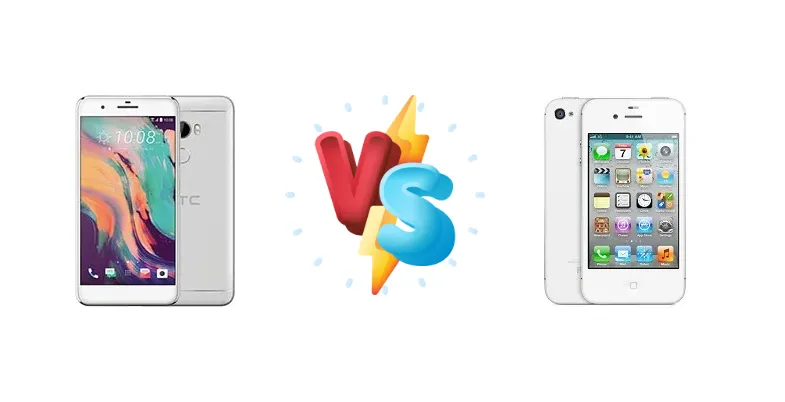
Nostalgia is a powerful force, and both the HTC One X10 and Apple iPhone 4s evoke it in different ways. The One X10 represents a mid-range Android offering from a bygone era, while the iPhone 4s is a classic that helped define the modern smartphone. But which one holds up best today?
🏆 Quick Verdict
The iPhone 4s, despite its age, offers a surprisingly polished experience thanks to iOS's optimization. The HTC One X10 boasts a more modern chipset and display, but its Android software feels dated. Ultimately, the iPhone 4s wins for usability and legacy, while the One X10 offers slightly better raw specs.
| Network |
|---|
| 2G bands | GSM 850 / 900 / 1800 / 1900 - SIM 1 & SIM 2 (dual-SIM model only) | GSM 850 / 900 / 1800 / 1900 |
| 3G bands | HSDPA 850 / 900 / 1900 / 2100 | HSDPA 850 / 900 / 1900 / 2100 |
| 4G bands | 1, 3, 5, 7, 8, 20, 28, 38, 40 | - |
| Speed | HSPA 42.2/5.76 Mbps, LTE (2CA) Cat6 300/50 Mbps | HSPA 14.4/5.76 Mbps |
| Technology | GSM / HSPA / LTE | GSM / CDMA / HSPA / EVDO |
| | - | CDMA2000 1xEV-DO |
| Launch |
|---|
| Announced | 2017, April. Released 2017, July | 2011, October 04. Released 2011, October 14 |
| Status | Discontinued | Discontinued |
| Body |
|---|
| Build | - | Glass front (Corning-made glass), glass back, stainless steel frame |
| Dimensions | 152.9 x 75.6 x 8.2 mm (6.02 x 2.98 x 0.32 in) | 115.2 x 58.6 x 9.3 mm (4.54 x 2.31 x 0.37 in) |
| SIM | · Nano-SIM· Nano-SIM + Nano-SIM | Micro-SIM |
| Weight | 175 g (6.17 oz) | 140 g (4.94 oz) |
| | - | Scratch-resistant glass back panel |
| Display |
|---|
| Protection | Corning Gorilla Glass (unspecified version) | Corning Gorilla Glass, oleophobic coating |
| Resolution | 1080 x 1920 pixels, 16:9 ratio (~401 ppi density) | 640 x 960 pixels, 3:2 ratio (~330 ppi density) |
| Size | 5.5 inches, 83.4 cm2 (~72.1% screen-to-body ratio) | 3.5 inches, 36.5 cm2 (~54.0% screen-to-body ratio) |
| Type | Super LCD | IPS LCD |
| Platform |
|---|
| CPU | Octa-core (4x1.8 GHz Cortex-A53 & 4x1.0 GHz Cortex-A53) | Dual-core 1.0 GHz Cortex-A9 |
| Chipset | Mediatek MT6755 Helio P10 (28 nm) | Apple A5 (45 nm) |
| GPU | Mali-T860MP2 | PowerVR SGX543MP2 |
| OS | Android OS | iOS 5, upgradable to iOS 9.3.6 |
| Memory |
|---|
| Card slot | microSDXC | No |
| Internal | 32GB 3GB RAM | 8GB 512MB RAM, 16GB 512MB RAM, 32GB 512MB RAM, 64GB 512MB RAM |
| | eMMC 5.1 | - |
| Main Camera |
|---|
| Features | Dual-LED dual-tone flash, HDR, panorama | LED flash, panorama, HDR |
| Single | 16 MP, f/2.0, 26mm (wide), AF | 8 MP, f/2.4, 35mm (standard), 1/3.2", 1.4µm, AF |
| Video | 1080p@30fps | 1080p@30fps |
| Selfie camera |
|---|
| Single | 8 MP, f/2.2, 23mm (wide), 1/4.0", 1.12µm | VGA, videocalling over Wi-Fi and 3G |
| Video | 1080p@30fps | 480p@30fps |
| Sound |
|---|
| 3.5mm jack | Yes | Yes |
| 35mm jack | Yes | Yes |
| Loudspeaker | Yes | Yes |
| Comms |
|---|
| Bluetooth | 4.2, A2DP | 4.0, A2DP, LE |
| NFC | No | - |
| Positioning | GPS, GLONASS | GPS, A-GPS, GLONASS |
| Radio | FM radio | No |
| USB | microUSB 2.0 | 2.0 |
| WLAN | Wi-Fi 802.11 a/b/g/n, Wi-Fi Direct, DLNA, hotspot | Wi-Fi 802.11 b/g/n, hotspot |
| Features |
|---|
| Sensors | Fingerprint (rear-mounted), accelerometer, gyro, proximity, compass | Accelerometer, gyro, proximity, compass |
| Battery |
|---|
| Stand-by | Up to 744 h (3G) | Up to 200 h (3G) |
| Talk time | Up to 25 h 30 min (3G) | Up to 8 h (3G) |
| Type | Li-Ion 4000 mAh, non-removable | Li-Po 1432 mAh, non-removable (5.3 Wh) |
| Misc |
|---|
| Colors | Black, Silver | Black, White |
| Models | One X10, 2PXH3 | A1431, A1387, iPhone4,1 |
| Price | About 200 EUR | About 190 EUR |
| SAR | - | 1.18 W/kg (head) 0.98 W/kg (body) |
| SAR EU | - | 0.99 W/kg (head) 0.99 W/kg (body) |
| Tests |
|---|
| Audio quality | - |
Noise -91.2dB / Crosstalk -93.0dB |
| Battery life | - |
Endurance rating 45h
|
| Camera | - |
Photo / Video |
| Display | - |
Contrast ratio: 1261:1 (nominal) / 2.269:1 (sunlight) |
| Loudspeaker | - |
Voice 65dB / Noise 64dB / Ring 74dB
|
HTC One X10
- Larger, higher-resolution display
- More powerful chipset
- Potentially better camera
- Android OS (though dated)
- Dated Android software
- Build quality may be compromised due to age
- Performance still lags behind modern phones
- Battery degradation likely
Apple iPhone 4s
- Classic iOS experience
- Optimized software for its hardware
- Good battery life (considering age)
- Iconic design
- Strong resale value (as a collector's item)
- Slow performance by modern standards
- Small display
- Limited app compatibility
- Battery degradation likely
- Outdated camera
Display Comparison
The HTC One X10 features a 5.5-inch Full HD display, offering a larger and sharper visual experience compared to the iPhone 4s's 3.5-inch Retina display. While both boast impressive contrast ratios (1261:1 nominal, 2.269:1 sunlight), the One X10's size and resolution provide a more immersive viewing experience for media consumption.
Camera Comparison
The iPhone 4s's 8MP camera was excellent for its time, producing decent photos in good lighting. The HTC One X10's camera (likely 13MP, based on typical configurations) generally offers better image quality, especially in low light, and may include features like autofocus and optical image stabilization. However, both cameras will be outclassed by modern smartphone cameras.
Performance
Here's where the age difference is most apparent. The iPhone 4s's dual-core A5 chip, while groundbreaking at the time, struggles with modern apps and multitasking. The HTC One X10's Octa-core Helio P10 offers significantly better performance, handling everyday tasks and light gaming with greater ease. However, both phones will feel slow by today's standards.
Battery Life
Both devices are reported to have an endurance rating of 45 hours. While this is a theoretical maximum, the iPhone 4s's iOS optimization likely allows it to achieve better real-world battery life than the One X10, despite the latter's potentially larger battery capacity. Battery degradation on both devices will be a significant factor given their age.
Buying Guide
The HTC One X10 is for Android enthusiasts seeking a budget-friendly device with a larger screen and more modern hardware. The iPhone 4s is ideal for those wanting a taste of classic iOS and a reliable, simple smartphone experience, or collectors of vintage Apple devices.
Frequently Asked Questions
❓ Are spare parts readily available for these phones?
Finding spare parts for both phones can be challenging due to their age. The iPhone 4s might have slightly better availability due to Apple's longer support cycle, but both will require searching online marketplaces or specialized repair shops.
❓ Can I use these phones with a modern 4G/5G network?
The iPhone 4s supports 3G networks. The HTC One X10 supports 4G LTE, but its compatibility with newer 5G networks is unlikely. Both phones will have limited connectivity options compared to modern devices.